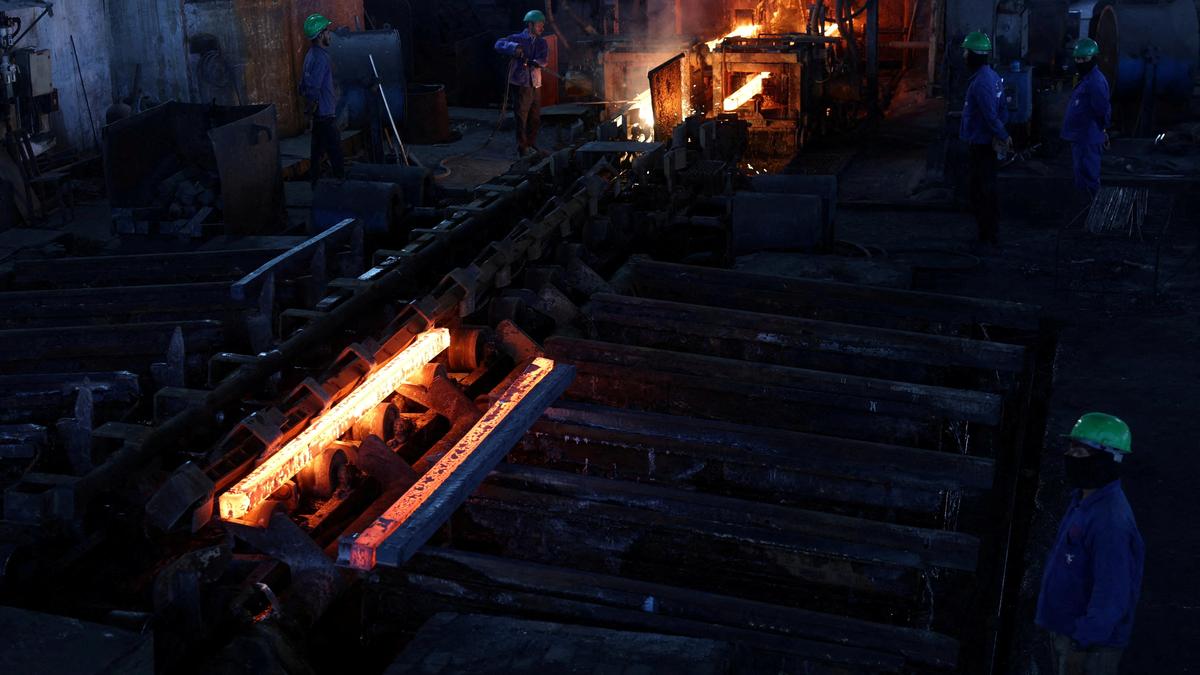
IIP growth quickens to 26-month high of 7.8% in December 2025
The Hindu
IIP growth reaches 26-month high of 7.8% in December 2025, driven by manufacturing, electricity, and consumer goods sectors.
Growth in industrial activity accelerated to a 26-month high of 7.8% in December 2025, driven by strong performances across sectors including manufacturing, electricity, and the consumer goods sectors, official data released on Wednesday (January 28, 2026) showed.
Data released by the Ministry of Statistics and Programme Implementation on the Index of Industrial Production showed that the index last grew faster than December’s growth rate in October 2023, when it grew 11.9%.
The manufacturing sector grew 8.1% in December 2025, marginally slower than the 25-month high of 8.5% seen in November. This was, however, significantly faster than the 3.7% growth seen in December 2024.
“Industry registered high growth of 7.8% in December aided by revival in manufacturing as well as the advantage of low base effect,” Madan Sabnavis, chief economist at the Bank of Baroda said. “High growth in November and December is reflective of the buoyancy expected post GST rationalisation as well as the investment activity in the country.”
A reflection of this investment activity could be seen in the capital goods sector, which grew at 8.1% in December 2025. This follows a 10-month high growth rate of 10.1% in November. Notably, the growth in capital goods came on a high base of a 10.5% growth rate in December 2024.
“On the investment front, infrastructure and construction goods continued to register healthy growth, supported by sustained capex at both the Central and state government levels,” Rajani Sinha, chief economist at CareEdge Ratings said.


Stock markets recover as Sensex and Nifty bounce back following a three-day slump, driven by value-buying in blue-chip stocks.

U.S. President Donald Trump’s administration is set to receive a roughly $10 billion fee from investors in the recently completed deal to take control of TikTok’s U.S. business, the Wall Street Journal reported

Meta is planning sweeping layoffs that could affect 20% or more of the company, three sources familiar with the matter told Reuters

Learn how to choose the best personal loan lender by evaluating eligibility, interest rates, and borrowing experience.

Discover why pension planning is essential in modern India to ensure financial security and peace during retirement.

The U.S. has launched two investigations under Section 301 of the Trade Act of 1974 against India and other economies to examine practices that may be ‘unreasonable or discriminatory and burden or restrict U.S. commerce’. One probe examines whether countries, including India, are using excess manufacturing capacity to export to the U.S. in a manner that hurts American businesses, while another looks at whether countries have taken ‘sufficient steps’ to prohibit imports of goods produced with forced labour.

NHAI raises annual pass fee to ₹3,075 from April 1, 2026, streamlining toll payments for FASTag users.

The U.S. probes forced labour in global supply chains, scrutinizing China and India's exports, warns the Global Trade Research Initiative.

The Hindu collection of images of the LPG crisis: War lights a kitchen fire

The company, which launched its IPO in 2020, is now listed on the National Stock Exchange as well as the Bombay Stock Exchange.

Explore the Essential Commodities Act's role in addressing India's gas crisis and its impact on various sectors.

Star Health Insurance plans to boost AI-driven claim settlements from 20% to 50% within two years, investing heavily in technology.

The iron ore production has increased by nearly two-thirds since 2015