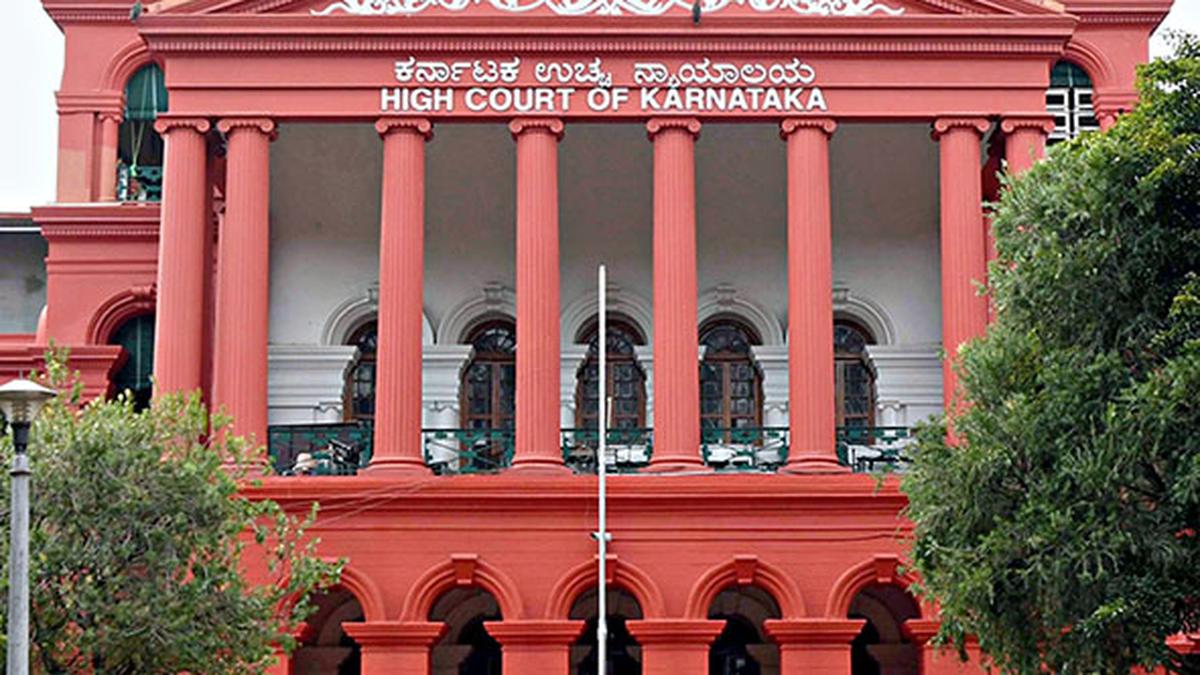
Identify and map risk areas for mishaps due to sagging power lines and illegal electrical fencing to prevent electrocution of elephants: Karnataka High Court
The Hindu
High Court of Karnataka directs Forest Department to identify risk areas for elephant safety, coordinate with Energy Department for maintenance.
The High Court of Karnataka has directed the Forest Department to identify and map the risk areas where there is a possibility of mishaps on account of sagging high-tension power lines and illegal electrical fences within the elephant habitats and fringe areas across the State.
Also, the court said the forest authorities should act in coordination with the Energy Department to check the sagging electrical lines and ensure that proper maintenance is done to see that they remain in adequate height for the safety of the elephants.
The Chief Conservator of Forests has been directed to form area-wise investigating committees for different forest circles to identify the risk areas periodically.
A Division Bench comprising Chief Justice N.V. Anjaria and Justice M.I. Arun issued these directions among a series of other directions while disposing of a PIL petition, which the court had initiated suo motu in June 2024 by taking cognisance of the unnatural death of 38-year-old Dasara elephant Ashwathama, and the electrocution of elephants in Chikkamgaluru and other areas, based on newspaper reports.
The Bench also said that an effective mechanism should be evolved to check, prevent, and destroy illegal electrical fences which the farmers put up for their agricultural fields located near the forestland to prevent the elephants from entering into their fields.
Meanwhile, the Bench said that illegal electrical fences should be replaced by scientific and protective barricades in such areas where farmers grow their crops or where there are residential colonies that are situated close to the elephant corridors.
The norms for erecting electrical cables and telecommunication towers should be scrupulously observed, the Bench said while pointing out that the National Board for Wildlife guidelines specify that the minimum clearance height of power lines should be 20 ft in gentle terrain and 30 ft in steeper areas. Underground cabling should be promoted in the eco-sensitive zones, the Bench said.


Anuradha Jonnalagadda took over as in-charge Vice-Chancellor of the University of Hyderabad, focusing on continuity during the transition.

Telangana government awaits committee report on TGSRTC staff absorption, with decisions to be made at an appropriate time.

Telangana's revised pay scale implementation for employees will take timer. The tenure of Pay Revision Commission extended. Govt likely to take decision on reccomendation based on its report.

Vizianagaram's SP A.R. Damodar highlights 20 accident-prone areas and urges drivers to prioritize safety with helmets and seat belts.

Kerala HC stays disqualification of SNDP Yogam leaders, reversing a single judge's order regarding financial and regulatory compliance issues.

Karnataka announces daily supply of 10,000 LPG cylinders to hotels, easing the commercial shortage for the hospitality industry.

Malayalam superstar Mohanlal will be reuniting with filmmaker Priyadarshan, it was announced recently. It will mark the 100th film of Priyadarshan and is backed by Mohanlal’s longtime collaborator, Antony Perumbavoor

Gautham Vasudev Menon loses Madras High Court appeal, ordered to pay ₹4.25 crore to R.S. Infotainment with interest.

AIADMK faces its toughest challenge in 53 years as it prepares for the crucial 2026 T.N. Assembly elections.

Lakmé Fashion Week x FDCI 2026 in Mumbai: What worked and what didn’t

Telangana CM announces underpass beneath Begumpet Airport runway to alleviate traffic congestion in Hyderabad.

Congress leader Ramesh Chennithala claims an alliance between Pinarayi Vijayan, Modi, and Shah aims to undermine UDF in Kerala elections.

CCB arrests Bengaluru couple for running a fake government job scam, cheating over 100 victims out of crores.