How regulatory gaps turn sanitation work deadly
The Hindu
Explore the deadly consequences of sanitation work due to regulatory gaps and the plight of unrecognized manual scavengers.
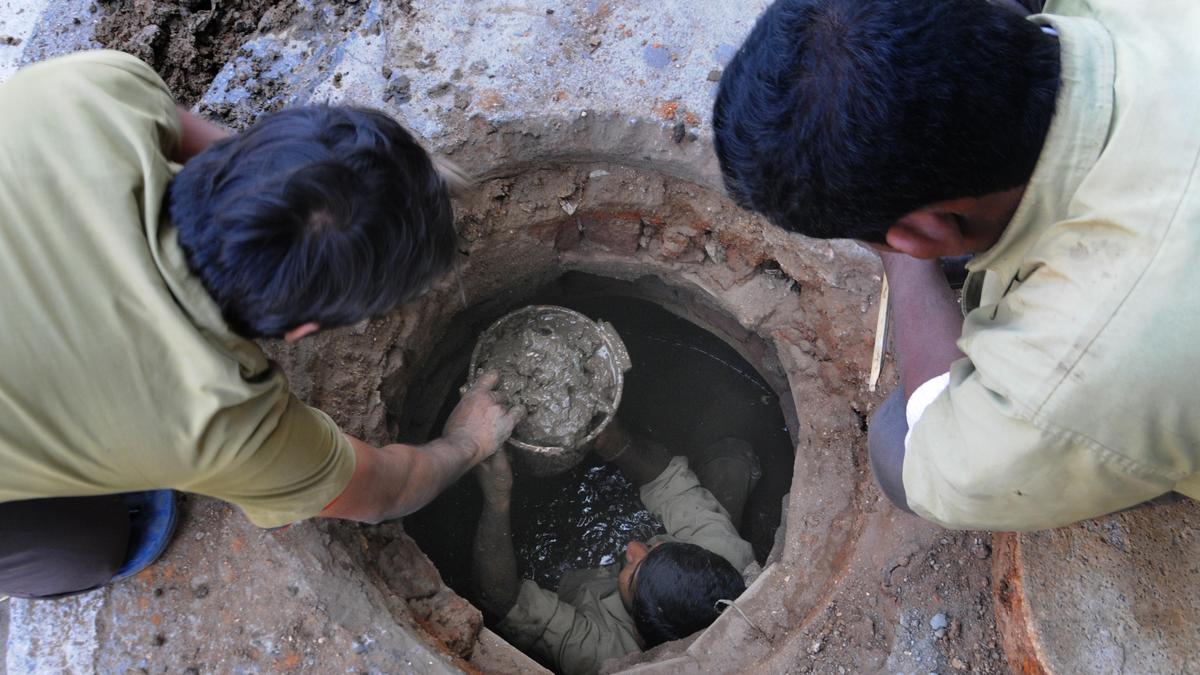
In May 2025, a septic pit attached to a house in Tavarekere village in Sira taluk, Tumakuru, had to be emptied after 12 years. A suction machine operator quoted ₹20,000, saying the hardened sludge would take hours to remove. The house owner, an employee at a government hospital, instead contacted Rangappa, a 55-year-old agricultural labourer who occasionally undertook pit cleaning work in the area. He and two other daily wage labourers agreed to do the work for ₹7,500.
On May 26 and 27, the three entered the nearly eight-foot pit and removed the waste. By the evening of May 27, Rangappa developed breathlessness. Over the next week, his family took him to six hospitals. The family spent close to ₹70,000. Rangappa, who was not recorded as a manual scavenger, died at home on June 2. An FIR was registered on the same day at Tavarekere police station.
Under the Prohibition of Employment as Manual Scavengers and their Rehabilitation Act, 2013, a manual scavenger is defined as a person engaged in manually cleaning human excreta from an “insanitary latrine, railway track or other notified spaces” before the excreta decomposes.
However, Siddarth J., a member of Safai Karmachari Kavalu Samithi (SKKS), said septic tanks and pits — which require periodic emptying — fall into a grey zone. The definitional distinction has created what he describe as a “regulatory” gap. When a person dies cleaning an insanitary latrine, the case falls squarely under the Act. When a person dies inside a septic tank or pit, it is categorised as “hazardous cleaning”. The distinction determines not only how the death is recorded, but also what relief, if any, the family can access. The classification decides whether the death is recognised as a violation of a prohibited practice or treated as an “occupational” accident, he explained.
Families like Rangappa’s, therefore, find themselves outside the narrow framing of “identified manual scavengers”. Without identification, statutory entitlements become inaccessible. Under Section 13(1)(b) of the Act, identified manual scavengers are entitled to ₹40,000 as initial cash assistance, followed by skill development training and financial support for alternative livelihoods. In cases like Rangappa’s, however, even this limited assistance is not there.
Former workers argue that even where compensation is disbursed, it does little to provide security. “While rehabilitation frameworks focus on skill development, self-employment, and livelihood transition, these measures are more accessible to younger workers. Older workers struggle to access loans, complete training programmes, or secure alternative employment,” said Matla Baba, 63, a former sanitation worker. “By the time one reaches 40, many fall outside the practical scope of rehabilitation schemes. The work had already drained us mentally and physically,” he added.


Siddaramaiah dismisses spying allegations by R. Ashok and H.D. Kumaraswamy as baseless claims from a desperate opposition.

D.K. Shivakumar calls on Karnataka MPs to pressure Centre for Almatti dam height approval amid Andhra Pradesh's opposition.

States, stakeholders urged to adopt energy saving initiatives of Mission LiFE

Congress leaders in Puducherry strategize for 2026 Assembly polls, forming committees and preparing for alliance negotiations.

Modi praises Canadian PM Carney's visit, highlighting strengthened ties and key agreements on uranium, minerals, and economic partnership.

NATO welcomes Macron's nuclear expansion, emphasising collaboration while maintaining France's independent nuclear strategy amidst shifting European defence dynamics.

Karnataka HC orders state to create a policy ensuring accurate, current content on government websites to enhance public trust.

Supreme Court affirms IBC's priority on speed and creditor-driven decisions over extensive judicial review in insolvency matters.

Student and community leaders in Vijayawada urge government action to combat the rising drug menace near educational institutions.

Congress and DMK fail to finalise seat-sharing agreement, as both parties remain firm on their demands for the Tamil Nadu elections.

NHAI begins partial removal of the median at TVS Tollgate bus stop to alleviate traffic congestion and improve vehicle flow.

Mamata Banerjee champions secularism amid Suvendu Adhikari's Hindutva push, highlighting the political divide ahead of Bengal Assembly polls.

Meta removes social media accounts of Jammu and Kashmir news outlets, raising concerns over censorship and freedom of expression.