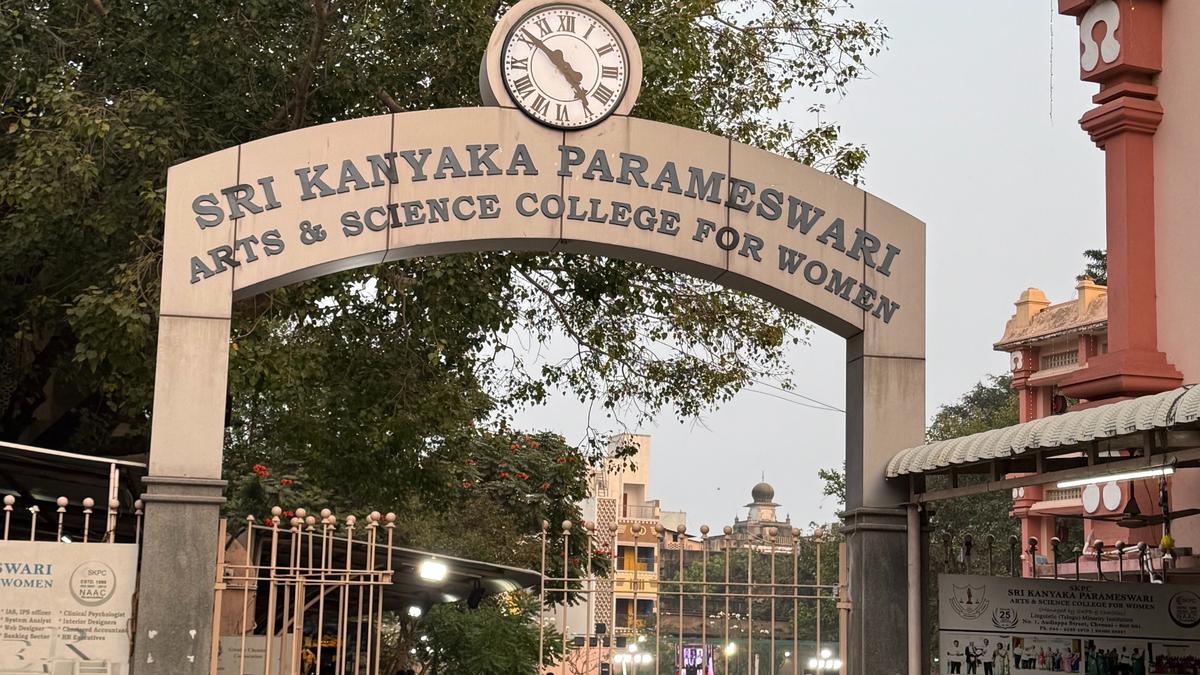
From a market to a college: a Madras transformation Premium
The Hindu
Explore the transformation of Madras from a bustling vegetable market to the esteemed Sri Kanyaka Parameswari College for Arts and Science.
Last week, I was invited to preside over the annual day of the Sri Kanyaka Parameswari College for Arts and Science (SKPC). I accepted at once. It is not often that you get to visit a space in Madras that has a continuous recorded history from 1708 onwards. The college occupies land belonging to the Sri Kanyaka Parameswari Devasthanam (SKPD). Readers will be aware of the area’s better-known name – Kotwal Chavadi.
For centuries, it was the city’s vegetable market, until it was shifted to Koyambedu. Its history begins in 1708 when it was mentioned as the Komatla Thotta in a property document. The full name was Kooragayala Komatla Thotta – the vegetable garden of the Komatis or the Arya Vysyas. This group of Telugu-speaking businessmen had their heyday during the East India Company (EIC) and British Raj days. The garden was a community property that was dedicated to the “general body of the Vysya caste people for the performance of the festivals, ceremonies and charities of the caste,” as per historian Mattison Mines.
The Vasavi Kanyaka Parameswari Temple | Photo Credit: Sriram V.
It was administered by leading members of the Arya Vysya community and in the 1790s, the responsibility lay with Sunku Krishnamma Chetty. The EIC, either wilfully or under the mistaken notion that it was his personal property, took over all 44 grounds of it, and the dispute lasted over 10 years. When in 1803 it was returned, the community elders pondered over how to protect it. Colla Muthurama Chetty, then the head, decided to build in one part of the land a temple to the community’s tutelar deity Vasavi Kanyaka Parameswari. Thus came up the shrine and the SKPD.
The origins of the market on the rest of the land are somewhat hazy. Even in the 1750s, we read of the Kotwal’s Market, though it is not clear if it was in the same place. That was an era when the Indian law officer, designated the Kotwal, was also responsible for the markets and so it got its name. By the early 1800s, the market was within the SKPD land. And it probably doubled as the space where the Kotwal held court and so became a community centre of sorts. It thus borrowed a Marathi term, Chavadi, and made it its own.
Kotwal Chavadi, circa 1996. | Photo Credit: The Hindu Archives


Siddaramaiah dismisses spying allegations by R. Ashok and H.D. Kumaraswamy as baseless claims from a desperate opposition.

D.K. Shivakumar calls on Karnataka MPs to pressure Centre for Almatti dam height approval amid Andhra Pradesh's opposition.

States, stakeholders urged to adopt energy saving initiatives of Mission LiFE

Congress leaders in Puducherry strategize for 2026 Assembly polls, forming committees and preparing for alliance negotiations.

Modi praises Canadian PM Carney's visit, highlighting strengthened ties and key agreements on uranium, minerals, and economic partnership.

NATO welcomes Macron's nuclear expansion, emphasising collaboration while maintaining France's independent nuclear strategy amidst shifting European defence dynamics.

Karnataka HC orders state to create a policy ensuring accurate, current content on government websites to enhance public trust.

Supreme Court affirms IBC's priority on speed and creditor-driven decisions over extensive judicial review in insolvency matters.

Student and community leaders in Vijayawada urge government action to combat the rising drug menace near educational institutions.

Congress and DMK fail to finalise seat-sharing agreement, as both parties remain firm on their demands for the Tamil Nadu elections.

NHAI begins partial removal of the median at TVS Tollgate bus stop to alleviate traffic congestion and improve vehicle flow.

Mamata Banerjee champions secularism amid Suvendu Adhikari's Hindutva push, highlighting the political divide ahead of Bengal Assembly polls.

Meta removes social media accounts of Jammu and Kashmir news outlets, raising concerns over censorship and freedom of expression.