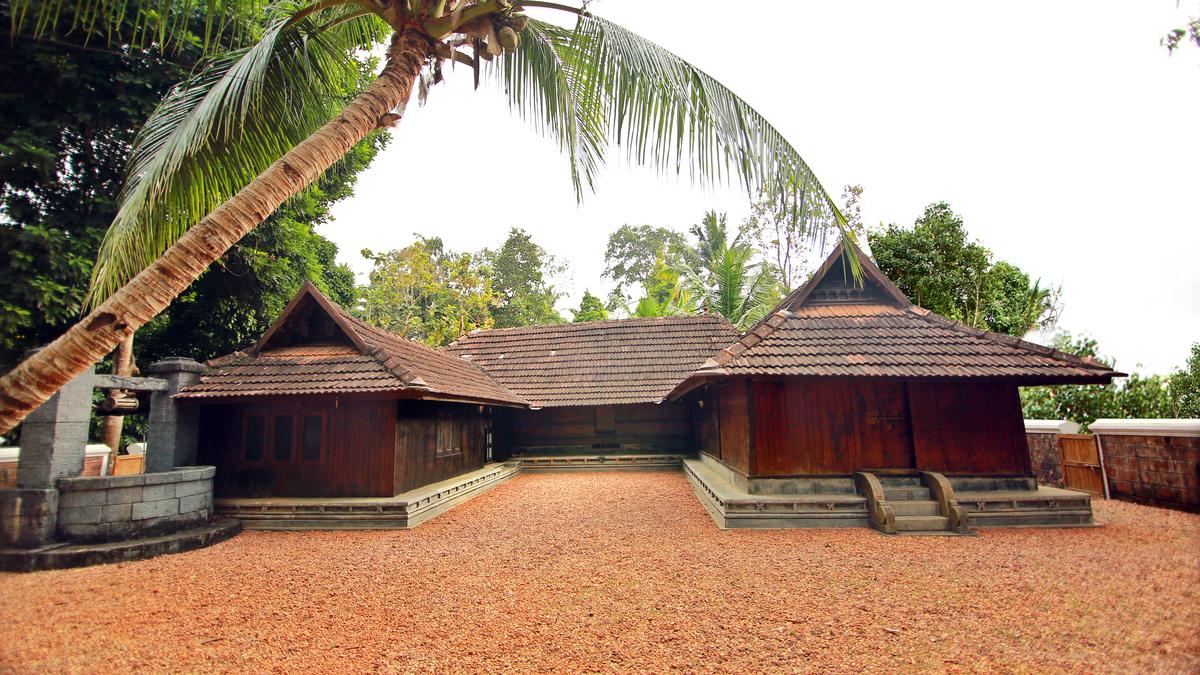
Homes that house heritage
The Hindu
Kerala’s ancestral homes, some as old as 300 years, are getting a makeover as heritage homestays and aesthetic party venues
A decade or so ago, Mathew George Sankaramangalam decided to restore his family’s nearly 100-year-old ancestral home or tharavadu, in Thiruvalla, located in Kerala’s Pathanamthitta district. “I inherited this place in the late 1990s after my grandfather passed away, but it ended up lying unused for nearly 25 years,” says the Bengaluru-based businessman. During this process, the home, “a traditional Syrian Christian house” with finely-hewn woodwork, red-oxide floors and a tiled roof, went through various changes: the red-oxide floors were replaced with rustic tiles, modern attached toilets were added, and several rooms were repurposed.
“We kept the outer structure the same as the old house and made changes inside,” says Mathew, who spent three years and a considerable amount of money restoring his ancestral home. “If you want to bring in the original splendour as well as have modern amenities, it will cost you a lot,” he remarks, adding that the restoration cost of a heritage villa could go up to a crore, or even more.
While the satisfaction of having restored his family home more than made up for the significant capital costs of the project, he realised that “it needs revenue to sustain. It is very expensive to maintain a heritage home... like buying an elephant,” says Mathew, who decided to let out his ancestral home, CVM House, as a homestay in 2017, in an attempt to create a business model that could generate enough money for its upkeep.
The property, which charges from ₹16,000 a day for an individual’s stay to ₹41,000 a day if a function is held on its premises, offers all modern amenities, round-the-clock housekeeping service, free WiFi and security. While CVM House does not provide food, it offers nearby hotel recommendations that deliver, he says, adding that the bulk of their revenue comes from weddings. According to him, many people like the idea of hosting “their receptions in the gardens with this heritage house in the backdrop,” says Mathew, who gets a lot of NRIs wanting to experience “hotel services in a heritage home”.
Like Mathew, many Syrian Christians, also called Saint Thomas Christians or Nazaranis, are choosing to rent out their ancestral homes to travellers in an attempt to preserve these old buildings, which are an important legacy of one of the oldest Christian communities in the world. It is believed that the earliest Syrian Christians were Hindus who embraced Christianity in 52 AD when St. Thomas, one of Jesus Christ’s 12 apostles, arrived at the ancient port city of Muziris. “He came to preach to the Jews who were already here,” says Thressi John, who runs the 260-year-old Nazarani Tharavad, in Pala, Kottayam.
The Kottukapally family that Thressi got married into were successful traders who moved to Pala from Mevada in 1737 when Angadi Pala, the town’s commercial hub, was set up. The family, considered one of the founding families of modern Pala, was in the pepper trade, and the first house it built in the area also doubled as a shop. As the town grew, making it harder to live in this commercial centre, they relocated to the house that is now called Nazarani Tharavad, “a stunning heritage home built in a unique fusion of Kerala and Dutch architectural styles,” as the homestay’s website puts it.
This home was used by the family till the death of Thressi’s brother-in-law around six years ago. “We had to shut down the house... the first time that house was ever locked,” she says. For three years, it stayed that way until the family decided to restore it and open it up to the public, says Thressi, who offers the full house, including breakfast for her guests, and housekeeping services for ₹20,000 per night. The main motive of this homestay, she says, is to promote the her community’s culture, cuisine, and architecture. In keeping with this core premise, the family has also moved and rebuilt part of the very first home constructed by the family nearly 300 years ago, restored it using the original materials used to create it, such as laterite stone, lime and egg white, and converted it into a museum “to showcase the old-style living,” informs Thressi.


MLC Kishore Kumar Puttur criticizes the State for poor implementation of the Centre's health scheme for senior citizens.

Karnataka's Health Minister announces redeployment of specialists to taluk hospitals to reduce neonatal mortality rates effectively.

Celebrate IPL's start and Polly Umrigar's legacy, reflecting on cricket's evolution and the enduring impact of its pioneers.

BJP accuses Congress and Rahul Gandhi of endorsing an ‘anti-India’ USCIRF report undermining India's global image.

Education Ministry proposes UGC-like funding under Shiksha Adhishthan, raising concerns about centralization and public university financing.

Shivraj Singh Chouhan defends the new rural jobs Act, dismissing opposition protests as ineffective and highlighting increased funding and worker protections.

Supreme Court questions why heirs can't access unclaimed funds of deceased depositors, urging government to develop a disclosure policy.

Karnataka High Court demands LPG supply details amid state restrictions, threatening Bengaluru's restaurants and livelihoods.

Shorts News:UN body investigating deadly strike on Iranian girls school

Moodbidri police inspector suspended pending inquiry over allegations of misbehaviour and inappropriate conduct towards women.

The State currently hosts more than 880 GCCs, up from around 500 GCCs in 2021.

Transgender and intersex activists march to Lok Bhavan, protesting the regressive Transgender Persons Bill and demanding its withdrawal.

Hyderabad's LGBTQIA+ community opposes the Transgender Amendment Bill, stressing dignity over identity verification and highlighting economic and medical concerns.