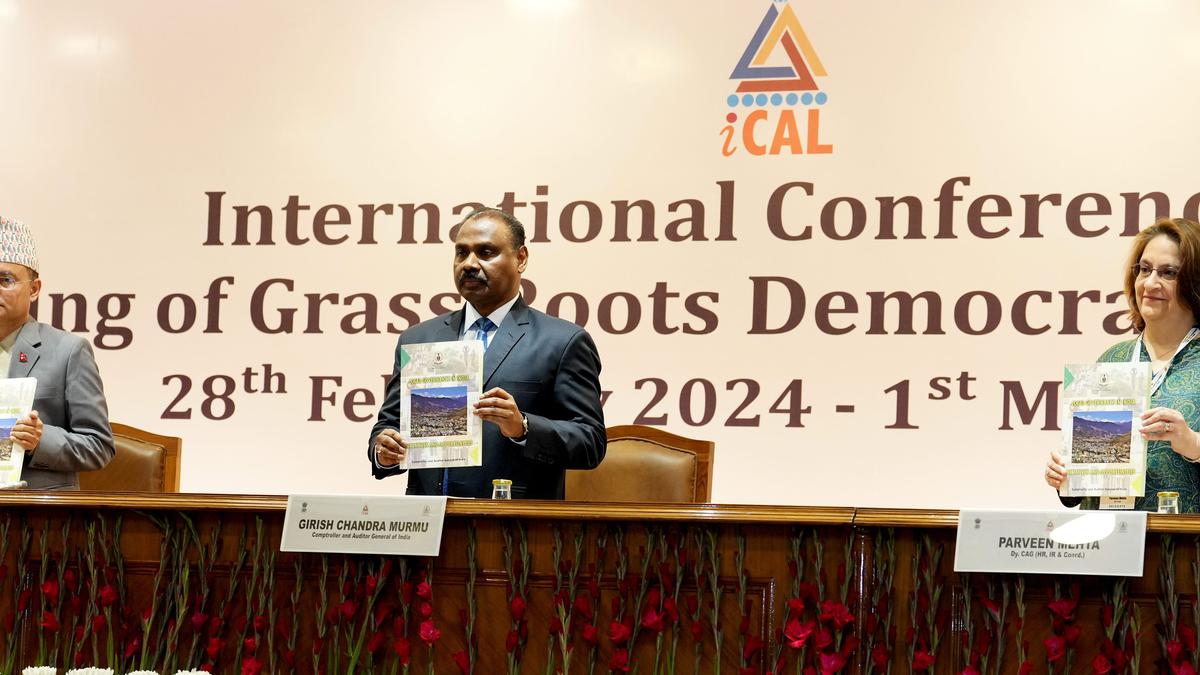
Good local governance cornerstone of grassroots democracy: CAG Murmu
The Hindu
Girish Chandra Murmu, said good local governance that relied on the core principles of transparency, inclusivity, and accountability, was the cornerstone of grassroots democracy.
The Comptroller and Auditor General (CAG) of India, Girish Chandra Murmu, on Wednesday said good local governance that relied on the core principles of transparency, inclusivity, and accountability, was the cornerstone of grassroots democracy.
After inaugurating the three-day international conference on ‘Strengthening of Grassroots Democracy’, Mr. Murmu said that local governments were the most important link in the governance spectrum and that they were necessary for the advancement of society and improving the lives of citizens.
Representatives from supreme audit institutions of Malaysia, Maldives, Malta, Morocco, Nepal, Oman, Poland, South Africa, and Uganda, with India being the host country, are participating in the conference.
“It is at this level that the aspirations, concerns, and needs of the people are most acutely felt and addressed. It is here that local level planning of developmental programmes are undertaken,” Mr. Murmu said adding that “these bodies are the first ones to respond to calamities and pandemics and are vital for the implementation of the Sustainable Development Goals”.
As the country’s local governments depend on the Central and State governments for funds, functions, and functionaries, he said it called for an out-of-box audit approach. India has about 2.62 lakh local institutions. This third tier of government implemented several centrally-sponsored schemes and projects. Given its growing importance, the Union Finance Commission allowed for direct devolution of funds of about 4.20% of the total divisible pool to the third tier, he said.
Mr. Murmu said the supreme audit institutions could play a vital role in strengthening local bodies and establish robust audit mechanisms for compliance monitoring within its respective mandates. Underscoring the importance of carrying out audit impact analyses, he said interventions such as follow-up audits, periodic reviews, and evaluation would ensure that the audit institutions’ recommendations were implemented for oversight and accountability.
“Transparency, inclusivity and accountability are the core principles underpinning the essence of our welfare societies...at the grassroots level, where governance meets the everyday lives of citizens, these principles are not mere ideals, but the bedrock upon which the edifice of good governance stands,” he said.


Civil society urges Amit Shah to direct police vigilance against open threats of communal violence in Uttam Nagar, Delhi.

PMK leader Anbumani blames alcohol and drug abuse for rising suicides in Tamil Nadu, criticising government inaction.

Bifurcation of Dindigul district is a key election issue, promising focused development and administrative improvements.

Election awareness campaigns gather momentum

Pylontech Advances Southeast Asia Strategy with 150MWh Energy Storage Agreement in Vietnam

BJP announces second list of 111 candidates for West Bengal Assembly polls, including Priyanka Tiberewal and Sumana Sarkar.

Traders urge Election Commission to raise the ₹50,000 cash limit, citing inflation and practical challenges during Tamil Nadu elections.

Kerala CM Pinarayi Vijayan to file nomination from Dharmadam, seeking third term amid tough competition in 2026 polls.

Water level in Mullaperiyar dam was 114.05 feet

PM Modi discussed West Asia peace, condemned Oman's sovereignty violation, and emphasized safe navigation through the Strait of Hormuz.

Contact details of election observers in The Nilgiris released for submitting poll-related complaints during Assembly elections.

Collector directs return of seized cash upon valid document verification amid voter enrollment and election preparations in Erode district.

Telangana Deputy CM Bhatti Vikramarka to present 2026-27 budget on March 20, 2026 , likely to balance welfare, development amid huge fiscal and revenue deficits in the State.