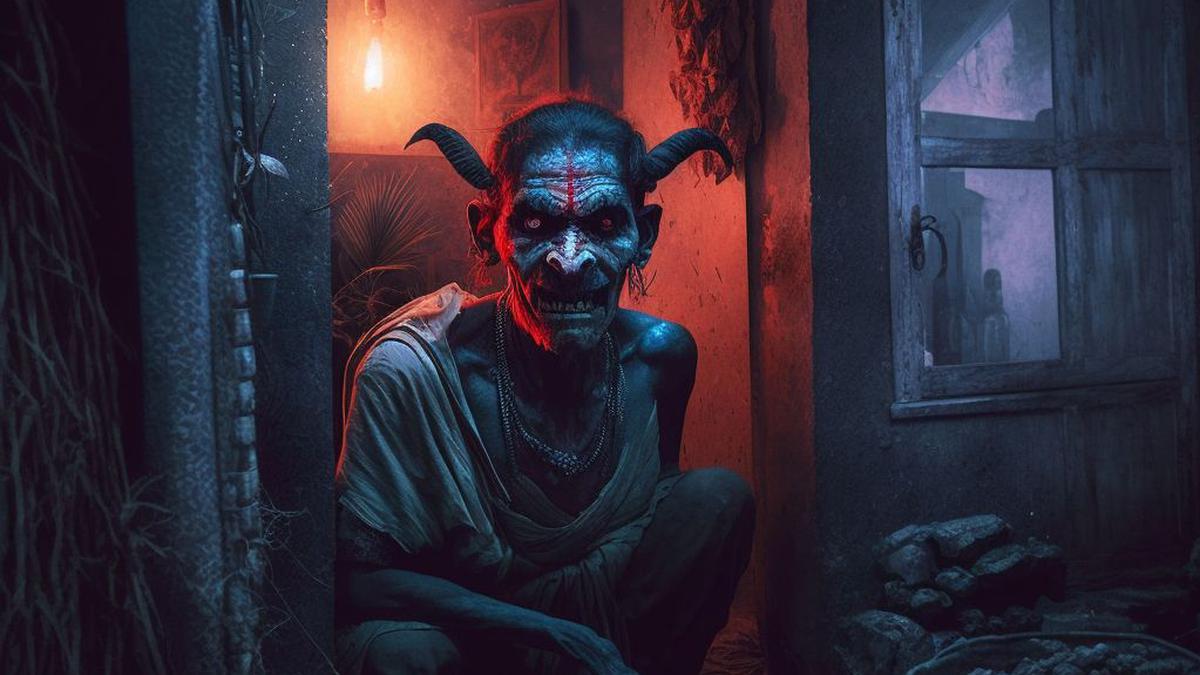
Ghosts of Assamese folklore sighted in digital form with AI art
The Hindu
A mechanical engineer turned short film maker Chinmoy Barma has given a digital shape to some of ghosts and spirits of Assam through artificial intelligence-driven software.
The spooks of Assam have become spookier with a digital makeover.
More than a decade ago, author Pranavjyoti Deka brought out a bilingual thesaurus on all things Assamese. One of the chapters was on some 60 types of ghosts and spirits – some benevolent, mostly evil.
Now, mechanical engineer turned short film maker Chinmoy Barma has given a digital shape to some of these spirits through artificial intelligence-driven software.
Topping his list in an AI art series, titled ‘Assamese folklore legends and ghosts’, is Bira. According to one of the earliest compilations by Pathsala-based Jayanta Kumar Sarma, Bira is among the most dangerous spirits and is usually controlled by sorcerers.
People across the State believe that a male Bira possesses boys or men and a female Bira possesses girls or women. It is also believed that the delirium of a possessed person ends only after a sorcerer or priest drives a Bira away with special rituals and chants.
Among the other spirits Mr. Barma developed digitally are Jokhini, the female spirit said to haunt pregnant women to steal their child; and Kon Bhoot, the king of ghosts sporting three legs and an eye on the chest but who has no neck.
The eerie quotient goes a notch higher with Ghorapak, a part-horse part-human creature, among the most feared in Assamese folklore. Villagers who claim to bump into one say that it is seen on river banks, ponds, and swampy areas at night.


Sean Penn skips the Oscars to meet Ukraine's Zelenskyy, who praises him as a "true friend" amid the war.

The teaser of Tamil star Suriya’s much-awaited film with director Venky Atluri, titled Vishwanath and Sons, was unveiled by the makers on Monday

A 'Golden' moment for a K-pop track at the Oscars.

Parvathi Nayar’s new exhibition, The Primordial, in Mumbai, traces oceans, pepper and climate change
Opened on March 12, the exhibition marks the artist’s first solo show in Mumbai in nearly two decades. Known for her intricate graphite drawings and multidisciplinary practice spanning installation, photography, video, and climate change, her artistic journey has long engaged with the themes of ecology, climate change and the natural world. In this ongoing exhibition, these strands converge through a series of works centred on water, salt, and pepper — materials that carry natural and historic weight across centuries.

Explore the highlights and key winners of the 98th Academy Awards, featuring memorable moments and historic achievements from Oscars 2026.

Spring season celebrated at Ramakrishna Mission Institute, Kolkata, with ‘Evening of Basant’

The Spirit of the Land, a solo show by artist Shivakumar Sunagar, is a vista of Nature-inspired emotions

Tal Fry is all set for an exciting new performance season

Netflix is making a bold move by snagging InterPositive, the AI filmmaking company founded by Ben Affleck, in a deal that could hit $600 million

Watch the eerie trailer for 'Hokum,' where Adam Scott faces a witch haunting in a mysterious Irish inn.

Oscars 2026 security heightened amid FBI warnings of a potential Iranian drone threat ahead of the Hollywood ceremony.

Directed by Rahul Pandey, the series also stars Naila Grewal, Nidhi Bisht, Anant Joshi, Anjum Batra and Kusha Kapila

A tribute to the versatile actor and comedian V.K. Ramasamy in his birth centenary year.