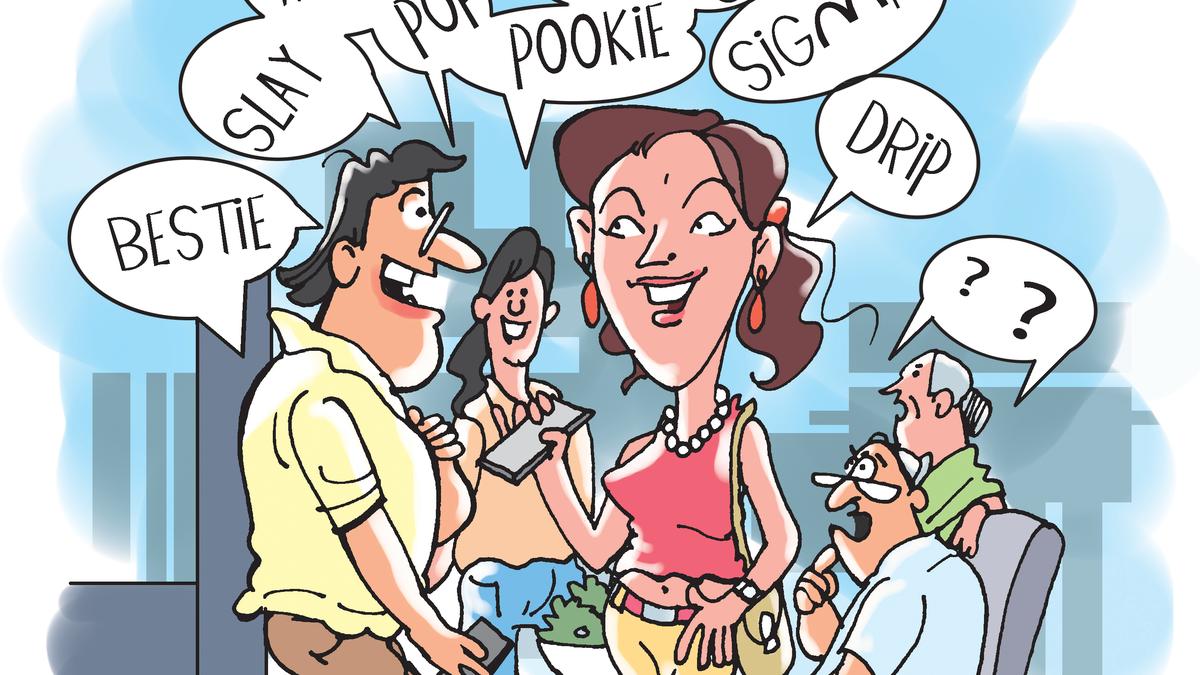
Gen Z slang takes over: are you in or out ?
The Hindu
Generation Z's unique slang and expressions are shaping modern language, leaving older generations struggling to keep up.
From Instagram comments to big screen dialogues, Generation Z (Gen Z) is making it impossible for anyone outside their bubble to keep up with or escape their “unserious” vocabulary. “Unserious” itself is a reference to Gen Z, those born between 1997 and 2012, who call themselves an unserious generation.
Having grown up with smartphones and social media, this generational language gap is clearly reflected in the experience of V. Smitha, a homemaker in Kozhikode, who recalls her confusion when her daughter said, “You slayed.”
“I thought that to slay means to kill; apparently, it means that I did well, or ‘ate and left no crumbs,’ as my kids would say,” she laughs, trying to keep up with the youth. “Ghosting has nothing to do with ghosts either. It means ignoring someone without explanation,” Ms. Smitha adds.
Expressions like pookie (endearment), rizz (charisma), aura (the energy a person emits), mid (average), bussin (delicious), and diva (a confident, attractive woman) dominate their daily conversations. Local slangs thantha-vibe (old-fashioned) and otta-mind (one-mind, when two or more people make spontaneous plans) are in vogue.
Malayalam words such as ‘aynu’ (so what), ‘oola’ (useless), and ‘poli’ (cool) remain common usage even as they do employ phrases like ‘scene annu’ (trouble), ‘oh scene/scene thanne’ ( impressive), ‘vere level’ (super cool), ‘bestie’ (male or female friend seen as a potential threat in a relationship), ‘valli’ ( to get tangled in problems) and ‘vazha’ (useless) in conversations.
While many parents struggle to keep up with the newgen lingo, P. Paul, a father to two Gen Z daughters, in Thripunithura, finds it easy. “Kids think they’re being cool by reusing old terms,” he says, adding that parents should be open to changing times and words.
“I do not understand why they judge us for using slang when they themselves had used them. Many of us still use terms like ‘LOL’ (laughing out loud) and ‘yikes’ (to express surprise, panic or disgust), which they coined and popularised,” says Sreya T, a 23-year-old English literature graduate, in Kozhikode.


Lorry owners in Andhra Pradesh reject government proposal to reduce vehicle fitness test fees by up to 50%.

Watch the thrilling trailer for 'Dune: Part Three,' showcasing epic battles and Paul Atreides' struggle with power and resistance.

TMC announces candidates for 2026 Bengal Assembly elections, contesting 291 seats; BGPM to handle three Darjeeling hill seats.

DMK finalizes a seat-sharing deal with CPI for Tamil Nadu elections, allotting five seats amid ongoing discussions with CPI(M).

Parliament Budget Session LIVE: Follow The Hindu's latest updates on the Parliament Budget Session on March 18, 2026.

Severe storms cause over 1,100 flight cancellations and 7,300 delays across the U.S., exacerbating travel chaos amid a government shutdown.

Three MBBS students tragically died in a scooter accident in Kozhikode, Kerala, early Wednesday morning.

Microsoft said on Tuesday it is reorganising its Copilot teams by unifying its commercial and consumer versions, as the tech giant rushes to improve its artificial intelligence assistant to drive better adoption.

Poco has launched the new X8 Pro series smartphones in India, consisting three phones: the Poco X8 Pro Max, Poco X8 Pro, and the special edition Poco X8 Pro Iron Man Edition

Morocco is crowned African football champion after Senegal forfeits the final due to a controversial walk-off protest.

Israeli tank fire reportedly hit a U.N. base in Lebanon, wounding Ghanaian peacekeepers amid rising tensions with Hezbollah.

LPG shortages in India force schools to revert to firewood, increasing burdens on women workers in mid-day meal schemes.

Discover the dramatic history and significance behind Tamil Nadu's name change from Madras on January 14, 1969.