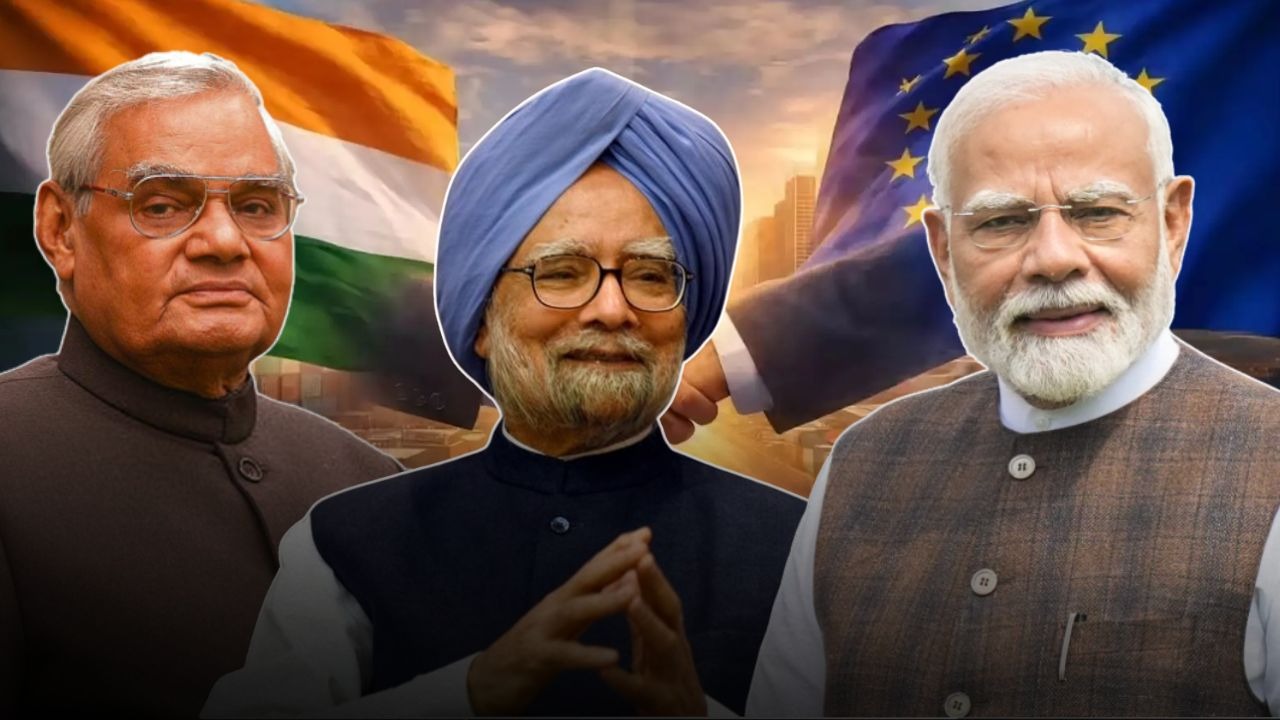
From Manmohan to Modi: Trade deals from 1991 to 2026 that led up to India-EU FTA
India Today
Concluded amid rising protectionism and tariff wars, the India–EU Free Trade Agreement signals a decisive shift toward rules-based partnerships in a fractured global economy.
India and the European Union concluded a historic Free Trade Agreement on Tuesday, 27 January, marking the end of nearly two decades of negotiations and creating the world's largest bilateral trade bloc. The deal, announced jointly by Prime Minister Narendra Modi and European Commission President Ursula von der Leyen, encompasses 2 billion people, represents 25% of global GDP, and creates a combined market worth $27 trillion.
Dubbed the 'Mother of All Deals' by both leaders, the agreement represents a bipartisan triumph spanning multiple Indian governments, from Dr Manmohan Singh's initial negotiations in 2007 to their conclusion under Prime Minister Modi nearly two decades later.
The road to this watershed moment, however, began decades earlier. From Indira Gandhi's early steps towards Asia-Pacific trade cooperation to P.V. Narasimha Rao's liberalisation reforms and Atal Bihari Vajpayee's pioneering bilateral agreements, India's trade architecture has been built through the vision and persistence of successive governments.
The Foundations: From Bangkok to Brussels
The road to Brussels began decades ago. In the mid-1970s, India joined the Bangkok Agreement, a preferential trade arrangement that marked one of India's earliest steps toward Asia-Pacific trade cooperation. In 1995, Prime Minister P.V. Narasimha Rao signed India into the World Trade Organisation, a watershed moment that forced structural reforms and opened India's services sector to global competition. His Look East Policy in 1991 shifted India's entire orbit toward Southeast Asia.


The story began with America as Iran's saviour but ended with America as its Satan. The rivalry written over decades in oil and blood is catastrophically being settled with fire that can singe the world.

According to a report by The Telegraph, Israeli ballistic missiles struck the compound soon after Mojtaba left the building, killing Ali Khamenei along with dozens of senior officials and relatives.

Trump demanded warships. He threatened allies. He warned NATO of a very bad future. The whole world watched, nodded politely, and walked away. Here is exactly what that means.

An incident involving a promotional robot in Macau has raised safety concerns after a woman was startled, prompting police intervention and renewed focus on robotics in public spaces.

Laylatul Qadr is considered one of the holiest nights in Islam. The Night of Decree, when Muslims keep up late into the night for prayers, is different this year. It is a sombre Laylatul Qadr night amid fears for life and safety amid the US-Israel-Iran war in the Middle East.

A group of Rajasthani folk artists delivered an impromptu musical performance during a security screening at Jodhpur Airport.

The newspaper, citing officials familiar with the conversations, said the Saudi leader has been in frequent contact with Trump during the conflict and encouraged him to "keep hitting the Iranians hard" as the fighting intensifies across the region.

A video showing a woman holding a child near a moving train window for him to urinate has gone viral, stirring public outrage over safety risks.

Amid the widening US, Israel–Iran war, the cyber front intensifies as the Handala hacker group claims attacks on US companies and Israeli intelligence-linked figures.

A post about a software developer's salary in Bengaluru and savings amount has started a conversation among X users about how to save wisely.

The profiles of at least three of China's leading nuclear, missile and radar experts were scrubbed from the website of the Chinese Academy of Engineering, the country's most prestigious academic body. This comes as a series of purges under Premier Xi Jinping's anti-corruption campaign have decimated the upper echelons of China's military and scientific community.

The aircraft had also been used by senior Iranian officials and military figures for both domestic and international travel, and for coordinating with allied countries, the Israeli military said. Meanwhile, Dubai International Airport has resumed flight operations after a temporary suspension of about seven hours caused by a drone strike near a fuel tank facility.

A government school teacher's gesture of buying a new uniform for an orphaned student has received widespread attention after a video of the act was shared on Instagram.