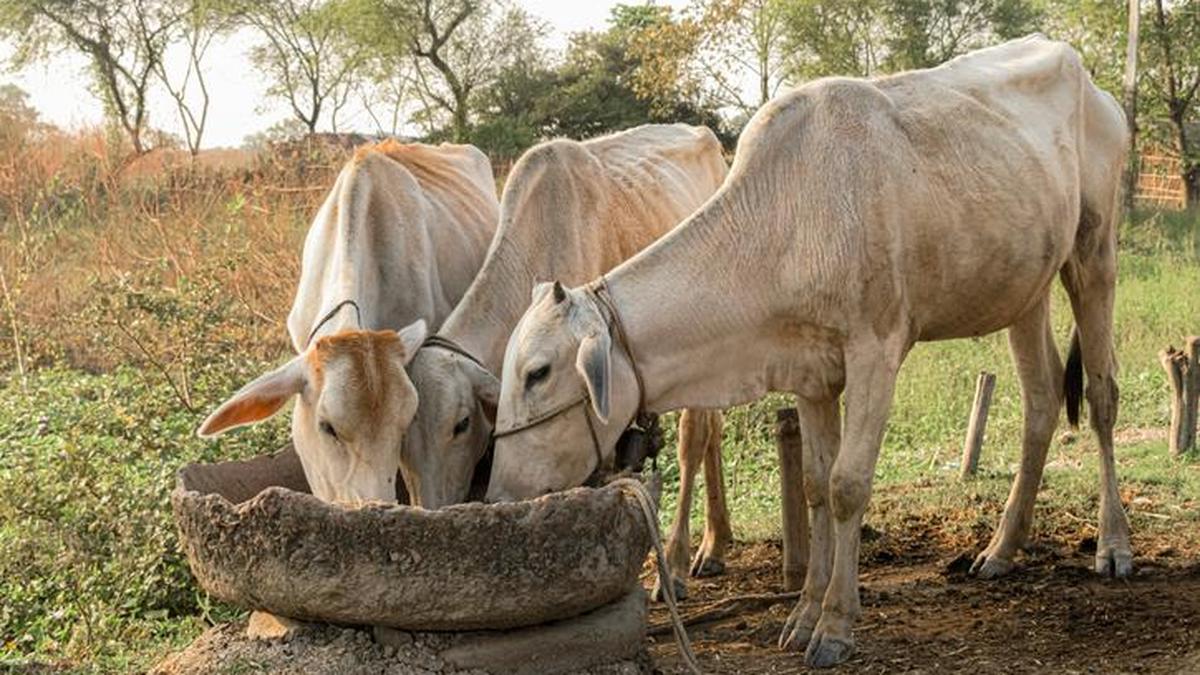
Fodder shortage major hurdle for livestock sector: Economic Survey
The Hindu
Economic Survey highlights fodder shortages as key challenge for India's livestock and fisheries sectors, impacting growth and production costs.
Issues such as feed and fodder shortages, dependence on a narrow export basket, and infrastructure gaps are the major stumbling blocks for the livestock management and fisheries sectors in the country, according to the Economic Survey tabled in Parliament on Thursday (January 29, 2026). Despite these challenges, the Survey notes that both sectors expanded strongly over the last decade
Economic Survey 2025-2026: Follow LIVE updates on January 29, 2026
Between 2014-15 and 2023-24, the livestock sector registered a compound annual growth rate (CAGR) of 12.77% at current prices, with its gross value added (GVA) increasing by nearly 195%. “The fisheries sector has also performed well, with fish production increasing by more than 140% (by 88.14 lakh tons) during 2014-2025, compared to the increase from 2004-14,” the Survey said, adding that these allied sectors are increasingly emerging as important growth engines and key contributors to enhancing farm incomes.
However, it pointed out that feed and fodder shortages, which account for a significant share of milk production costs, are the most critical constraint, as livestock growth has outpaced fodder expansion, thereby increasing input costs. “This is because the area under fodder crops is estimated at 9.13 million hectares, accounting for about 4.61% of the gross cropped area. Feed and fodder account for over 70% of the cost of milk production, and persistent shortages and quality constraints continue to affect livestock nutrition,” the Survey said citing a study by the Indian Council of Agricultural Research (ICAR) that estimated demand-supply gaps of 11 to 32% in green fodder, 23% in dry fodder, and 28 to 40% in concentrates, “underscoring the need for targeted interventions to ensure feed and fodder security.”
In the fisheries sector, the Survey stated that value addition and processing capacity need to expand faster to reduce dependence on a narrow export basket. “Infrastructure gaps persist in post-harvest handling, cold chains, and logistics, particularly in inland and remote regions. Strengthening aquatic animal health, biosecurity, and quality standards will be critical as production intensifies,” it added.
Within the livestock sector, the Survey noted, growth has been supported by measures that include indigenous technological capabilities to accelerate genetic improvement, reduce costs for farmers, and enhance herd quality. “The Artificial Insemination (AI) programme has expanded, with annual inseminations rising from 76.23 million in 2017–18 to 88.32 million in 2024–25, enabling 126 districts to achieve 50% AI coverage and increasing AI coverage of breedable bovine females from 25% to 40%,” it added.


Stock markets recover as Sensex and Nifty bounce back following a three-day slump, driven by value-buying in blue-chip stocks.

U.S. President Donald Trump’s administration is set to receive a roughly $10 billion fee from investors in the recently completed deal to take control of TikTok’s U.S. business, the Wall Street Journal reported

Meta is planning sweeping layoffs that could affect 20% or more of the company, three sources familiar with the matter told Reuters

Learn how to choose the best personal loan lender by evaluating eligibility, interest rates, and borrowing experience.

Discover why pension planning is essential in modern India to ensure financial security and peace during retirement.

The U.S. has launched two investigations under Section 301 of the Trade Act of 1974 against India and other economies to examine practices that may be ‘unreasonable or discriminatory and burden or restrict U.S. commerce’. One probe examines whether countries, including India, are using excess manufacturing capacity to export to the U.S. in a manner that hurts American businesses, while another looks at whether countries have taken ‘sufficient steps’ to prohibit imports of goods produced with forced labour.

NHAI raises annual pass fee to ₹3,075 from April 1, 2026, streamlining toll payments for FASTag users.

The U.S. probes forced labour in global supply chains, scrutinizing China and India's exports, warns the Global Trade Research Initiative.

The Hindu collection of images of the LPG crisis: War lights a kitchen fire

The company, which launched its IPO in 2020, is now listed on the National Stock Exchange as well as the Bombay Stock Exchange.

Explore the Essential Commodities Act's role in addressing India's gas crisis and its impact on various sectors.

Star Health Insurance plans to boost AI-driven claim settlements from 20% to 50% within two years, investing heavily in technology.

The iron ore production has increased by nearly two-thirds since 2015