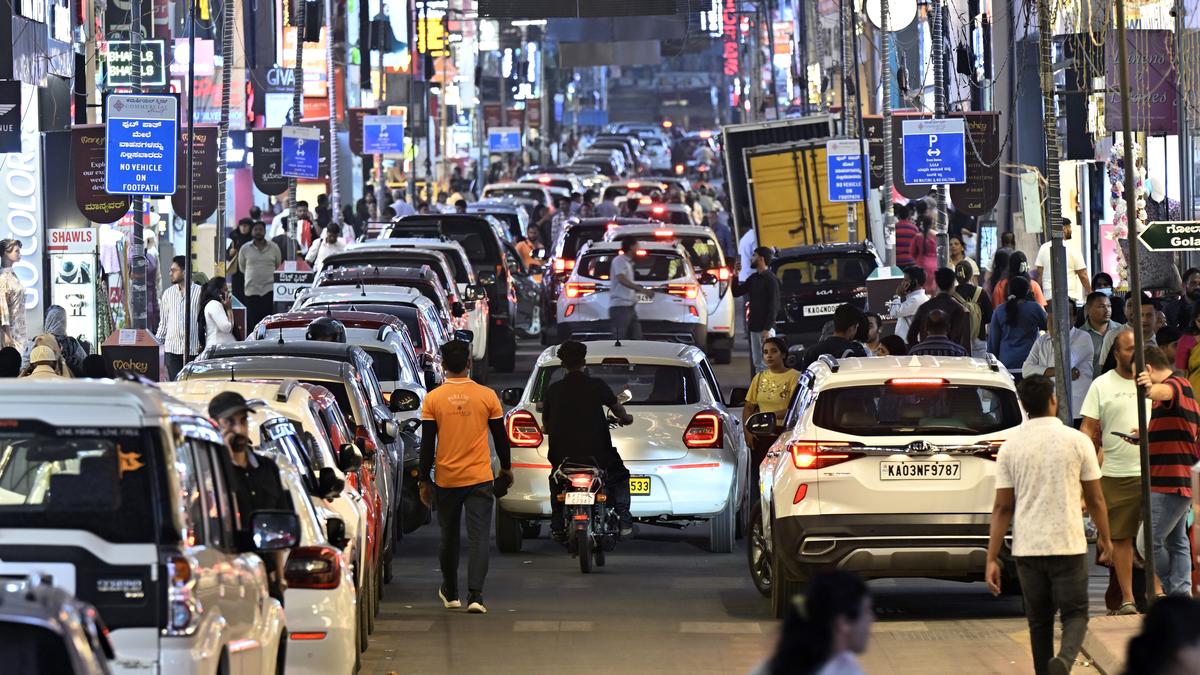
Fixing Bengaluru’s parking problem: The need to bell the cat Premium
The Hindu
Bengaluru's parking crisis highlights urban planning failures, with inadequate infrastructure and enforcement exacerbating congestion and commuter woes.
Every Saturday evening, Sudarshan Yadav, a real estate broker living in J.P. Nagar in south Bengaluru, sets off for Church Street in the city centre with a sense of dread — not for the long commute, but for the final hurdle: finding a parking slot. “It takes me over 10 minutes just to circle around for parking. Some days, I have had to park half a kilometre away and walk,” he says.
Prajwal Kumar, a software engineer, says, “By the time I leave for work, the minimal parking space available at Peenya Metro Station is full. Sometimes, I go one or two stations ahead and find parking. Otherwise, I end up driving to work. With no proper last-mile connectivity, the lack of adequate parking space around metro stations is also discouraging many from using the service for commuting.”
Across Bengaluru, the struggle for parking has become an everyday ordeal, affecting office-goers, traders, shoppers, and residents alike.
Bengaluru’s rapid transformation into India’s tech capital and unplanned growth have brought with them a surge in vehicles, overwhelming the city’s infrastructure. According to official data, Bengaluru is now home to over 1.23 crore registered vehicles, with two-wheelers accounting for more than 70%. The growing affluence of the middle class has also played a role, with more households owning multiple vehicles. However, the city’s parking infrastructure has failed to keep pace, leading to unregulated on-street parking and resultant traffic congestion.
Parking woes in Bengaluru are a symptom of deeper urban issues. The city has grown in an unplanned and fragmented manner, with residential areas transforming into commercial hubs without accompanying changes in infrastructure. Many areas have narrow roads that can barely accommodate two vehicles side by side, let alone offer parking for hundreds of visitors. The failure of the city’s civic body, the Bruhat Bengaluru Mahanagara Palike (BBMP), to implement zonal regulation for commercial activities has worsened the situation. In places such as Indiranagar in east Bengaluru and J.P. Nagar, owing to commercial activities in residential areas, vehicles are illegally parked on roads with some even blocking entrances to residences.
“Parking woe is just one of the symptoms of the rampant illegal commercialisation, especially in residential areas. The law is clear. It prescribes an adequate parking space that each commercial establishment should provide. But nobody is following these norms, trade licences are being doled out without an inspection of the business premises and in several cases, huge businesses are running even without trade licences,” says Sneha Nandihal of I Change Indiranagar, a citizen initiative.
Public transport options — though improving — remain inadequate or poorly integrated. Metro connectivity is still limited, and last-mile connectivity continues to be a major challenge. As a result, dependence on private vehicles remains high.


The government plans to amend the FCRA, introducing new regulations for NGO asset management and accountability for key functionaries.

The draft policy for “Responsible Digital Use Among Students”, released on Monday by the Department of Health and Family Welfare, has recommended that parents set structured routines with clear screen-time rules and prioritise privacy, safety, and open conversation with children on digital well-being.

Police Observer Sushant Kumar Saxena conducts surprise inspection at Shencottai police station, reviewing warrants and security arrangements ahead of elections.

Andhra Pradesh government to launch key projects in April, focusing on industrial growth and infrastructure development, says Nara Lokesh.

Lok Sabha refers the Corporate Laws (Amendment) Bill to a JPC amid opposition concerns over CSR provisions dilution.

SHG members in Kanniyakumari use snakes and ladders to raise election awareness and boost voter turnout.

Government accelerates consultations for early implementation of the Women’s Reservation Act to ensure women’s representation in 2029 elections.

CM A. Revanth Reddy distributes ₹1 crore insurance cheques to families of deceased Electricity department employees, enhancing financial security for workers.

The Bengaluru Traffic Police (BTP) registered 634 cases of drunk driving during a week-long special enforcement drive conducted across the city between March 16 and March 22.

GHMC intensifies action against property tax defaulters, seizing properties and offering a One Time Settlement scheme for payments.

CCB arrests three drug peddlers in Mangaluru, seizing ₹2.5 lakh worth of MDMA and other valuables.

TVK's 28 candidates in Puducherry include former BJP MLAs, a sitting Independent, and a retired police IG.

BRS submits notice on private member bill to Speaker