Farmers of the sea: India’s dugongs must stay a conservation priority Premium
The Hindu
Discover the gentle giants of the sea, the dugongs, and the urgent need to protect their fading habitats.
Waving meadows of emerald grasses part as a portly shape drifts through the shallow waters. Like a blimp led astray, the creature uses its front flippers to paddle gently as it nibbles on the seagrass that makes its home. Silt stirs from the shallow seafloor, coral reefs reveal themselves in a riot of colours, with shoals of fish scurrying out of the way, and an entire ecosystem comes into view.
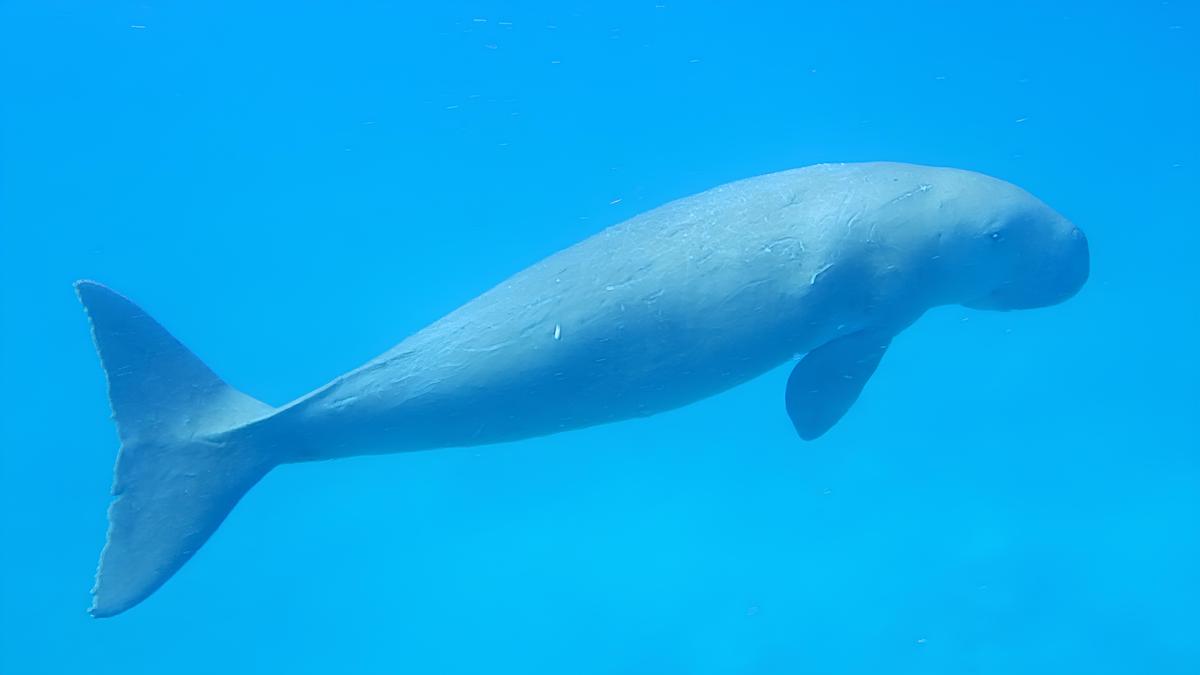
Meet the dugong — the farmer of the sea.
May 28 is celebrated every year as World Dugong Day. Dugongs (Dugong dugon) are the only herbivorous mammals found in India’s marine ecosystems. This gentle giant — known as the sea cow but resembling a cross between a seal and a whale — is distributed through the Indo-Pacific region. Due to their dependence on seagrass beds for habitat and food, dugongs are restricted to shallow waters, where they spend the day feeding on seagrasses of the genera Cymodocea, Halophila, Thalassia, and Halodule. They root at the base of shorter seagrass species, eating rhizomes, stems, and leaves, thus clouding the shallow waters. This is how they earned their epitaph. (Also see the addendum.)
Seagrass is low in nutrients, so dugongs feed extensively throughout the day to meet their daily requirements. They can consume 20-30 tonnes of seagrass per day, crushing leaves and stems against their horned teeth before swallowing. Unlike other marine mammals, the way they eat allows dugongs to digest cellulose, although the process wears down their teeth quickly. For this reason, dugongs rapidly regrow teeth in multiple iterations throughout their lives.
Unlike manatees, their close relatives, dugongs are more strictly marine, preferring waters a few metres deep. They are found along the Indian coastline, primarily inhabiting warm waters around the Andaman and Nicobar Islands, the Gulf of Mannar, Palk Bay, and the Gulf of Kutch. The dugong is a long-lived species, able to live up to 70 years.
Dugongs are also generally solitary or found in small mother-calf pairs. Researchers have occasionally observed small groups, but large herds — as are common in Australian waters — are rare in India.
Individuals reach reproductive maturity after only nine or ten years and can give birth at intervals of around three to five years. Due to its slow reproductive cycle, extended time to maturity, and infrequent calving, a dugong population’s maximum potential growth rate is estimated to be just about 5% per year.


Minimum temperatures rise in Kashmir as Chillai Kalan ends, signaling the start of Chillai Khurd and potential wet weather ahead.

NCP leaders meet CM Fadnavis amid uncertainty over the party's future following Ajit Pawar's tragic death in a plane crash.

Mangaluru's Kankanady bypass road will soon be upgraded to concrete, with utility lines being shifted to facilitate construction.

Chakrasiddh’s CSET Protocol Reverses AVN Stage III in 35 Days – Published Proof

After mandating pet dog licensing and microchipping, Greater Chennai Corporation (GCC) bids to do the same for cattle to curb stray cattle issues and man-animal conflicts in the streets. The civic body has moved to make it compulsory for cattle owners to obtain licenses for their animals across all zones.

BJP assures justice for all following Supreme Court's stay on UGC Equity Regulations, emphasizing fairness in higher education.

Amit Shah accuses Rahul Gandhi of disrespecting the North East by refusing to wear 'gamosa' at a Republic Day event.

iQOO on Friday announced that it is going to use Snapdragon 8 Gen 5 processor in its upcoming launch of iQOO 15R. The Chinese smartphone maker also confirmed the Dark Knight colour of the phone

Tragic elopement leads to husband and uncle's suicides; woman and lover arrested for abetment in Karnataka.

British Deputy High Commissioner Gareth Wynn Owen visits Medaram's Sammakka-Saralamma Maha Jatara, participating in traditional rituals and learning about its significance.

At just 15, Rhea Nadkarni aims high in cricket as she prepares for the Speed Queen finals in Mumbai.

Shashi Tharoor clarifies his stance on issues, emphasizing pro-India views while affirming loyalty to Congress amidst party tensions.

Karnataka contractors threaten a strike over ₹37,370 crore in unpaid bills, alleging increased kickback demands under the Congress government.