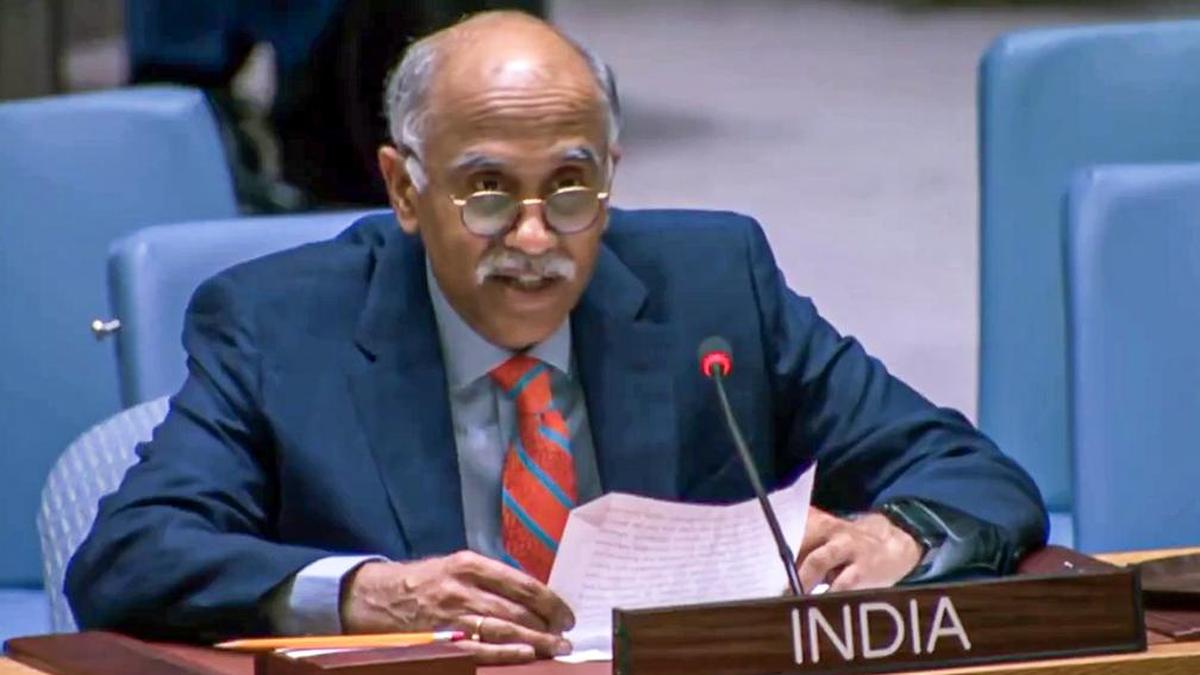
Express appreciation to the U.S. in addressing long-standing issue of Gaza conflict: India
The Hindu
India appreciates the U.S. efforts in addressing the Gaza conflict, highlighting progress on UN resolution implementation and humanitarian support.
India voiced appreciation to the U.S. towards addressing the “long-standing” conflict in Gaza as New Delhi noted the recent progress with regard to the implementation of the U.N. Security Council resolution on the issue.
These remarks were made by India's Permanent Representative to the U.N., Ambassador Parvathaneni Harish on Wednesday (January 28, 2026).
“India takes note of recent progress with regard to the implementation of U.N. Security Council Resolution 2803 to end the Gaza conflict. India also takes this opportunity to express appreciation to the United States in addressing this long-standing issue,” Mr. Harish said in his remarks to the U.N. Security Council open debate on the Situation in the Middle East.
The U.N. Security Council resolution 2803, adopted in November last year, endorsed U.S. President Donald Trump’s ‘Comprehensive Plan to End the Gaza Conflict’ of September 29 that entails that “Gaza will be a deradicalised terror-free zone that does not pose a threat to its neighbours” and will be redeveloped for the benefit of the people of Gaza.
The resolution also welcomed the establishment of a ‘Board of Peace’ (BoP) as a "transitional administration” with international legal personality that will set the framework, and coordinate funding for, the redevelopment of Gaza as per the Comprehensive Plan.
Mr. Harish said that the reconstruction and economic recovery of Gaza and the resumption of delivery of public services and humanitarian assistance is a herculean task calling for sustained support and commitment of the international community to alleviate the pain and suffering of the Palestinian brothers and sisters.


Discover why pension planning is essential in modern India to ensure financial security and peace during retirement.

The U.S. has launched two investigations under Section 301 of the Trade Act of 1974 against India and other economies to examine practices that may be ‘unreasonable or discriminatory and burden or restrict U.S. commerce’. One probe examines whether countries, including India, are using excess manufacturing capacity to export to the U.S. in a manner that hurts American businesses, while another looks at whether countries have taken ‘sufficient steps’ to prohibit imports of goods produced with forced labour.

NHAI raises annual pass fee to ₹3,075 from April 1, 2026, streamlining toll payments for FASTag users.

The U.S. probes forced labour in global supply chains, scrutinizing China and India's exports, warns the Global Trade Research Initiative.

The Hindu collection of images of the LPG crisis: War lights a kitchen fire

The company, which launched its IPO in 2020, is now listed on the National Stock Exchange as well as the Bombay Stock Exchange.

Explore the Essential Commodities Act's role in addressing India's gas crisis and its impact on various sectors.

Star Health Insurance plans to boost AI-driven claim settlements from 20% to 50% within two years, investing heavily in technology.

The iron ore production has increased by nearly two-thirds since 2015

Benchmark indices fell 2% as high crude oil prices and FII selling pressures impacted market sentiment on March 14, 2026.

Follow The Hindu LIVE for updates on LPG crisis and crude oil prices due to the escalating Iran-Israel war in West Asia.

ICRA projects integrated sugar mills will see 5-8% revenue growth in FY26 due to improved cane supply and stable prices.

Benchmark indices fell 2% as high crude oil prices and FII selling pressures impacted market sentiment on March 14, 2026.