Explained | The NASA spacecraft-asteroid collision
The Hindu
What is the ‘kick’ method which was used to deflect an asteroid headed towards earth? How can the technique be further utilised for space mining technologies?
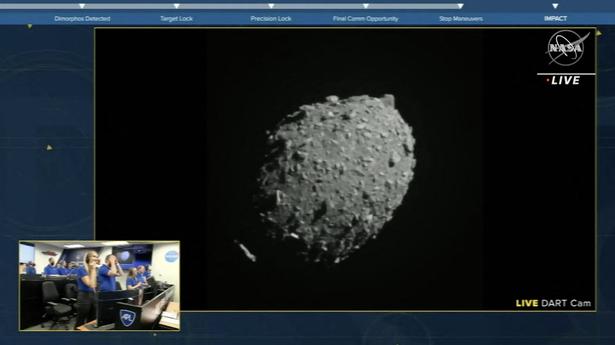
The story so far: On September 27, at 4:44 am IST, the DART (Double Asteroid Redirection Test) spacecraft collided with the space rock Dimorphos (just 160 metres wide). NASA has confirmed that the collision of the auto-rickshaw sized 600 kilogram weighing DART, on the football stadium-sized Dimorphos, about five billion kilogram in mass (orbiting around the 780 metres wide primary asteroid Didymos), has deflected the trajectory of the pair of space rocks. This kinetic impact technique, which appears as the climax of Hollywood sci-fi movies like Deep Impact and Armageddon, is also known as the ‘kick’ method. It could one day save humanity from a potential cataclysmic collision by safely deflecting a killer asteroid on its course towards earth. It could also fuel space mining technologies and unleash the space economy in decades to come.
Around a construction site, bits and pieces of leftover bricks, unused steel rods, and emptied paint canisters are usually strewn. Likewise, leftover materials from the formation of the sun, earth and planets, through the accretion and agglomeration of giant gas and rocks, are scattered as comets, asteroids and meteoroids in the solar system. Some of these cross their path and collide with earth from time to time, resulting in a spectacular meteor shower. Most rocks are so small that they burn up completely in the atmosphere due to frictional heating. If they are large enough, the charred piece falls through as a meteorite. The falling piece from a meteoroid 140 metres wide or more will be capable of completely wiping out a city like Chennai. The impact would be devastating if it was one or more kilometres wide.
Neither the plot nor NASA’s Planetary Defense Coordination Office, made famous by the blockbuster Netflix movie Don’t Look Up is imaginary. About 66 million years ago, an asteroid about 10-15 kms struck earth. The tsunami, volcanic eruptions and thick dust clouds ensuing from the blow decimated dinosaurs and nearly 75% of all species. What happened in the past can occur in the future. The chances of a giant asteroid striking earth are small; however, if it did occur, the devastation would be cataclysmic, wiping out the entire human civilisation. While dinosaurs were mute spectators, humans can prepare themselves to face the imminent threat. NASA tracks and keeps a close watch on the nearly 26,115 asteroids whose orbits are dangerously close to earth.
NASA, to put it simply, undertook the ‘kick’ technique. Compared to the massive Dimorphos, DART is a tiny Goliath. Yet crashing at a breakneck speed of 23,760 kilometres per hour, the momentum is adequate to slash the angular momentum of Dimorphos, making it speed up and move closer to Didymos. All of these reduce the orbital period and the time taken for the moonlet to go around the primary asteroid. The pair’s trajectory is thus deflected as the net result of these dynamics. Consider it like this: a fast-moving moped slamming into a truck is sure to undergo a massive crash and burn, yet will veer the massive truck a bit. This is the essence of the ‘kick’ technique.
The extent of the trajectory change depends on the context. Compare throwing a ball against a solid wall and a sand pit. If the Dimorphos were solid, the crashing craft would make a dent on its surface and skim a tiny bit of its angular momentum, reducing the orbital time by about 75 seconds. However, close-up images transmitted by the DART moments before the fatal collision indicate that Dimorphos is more like a pile of rubble loosely held by gravity. If true, the impact will eject a cascade of debris, each piece carrying away a bit of momentum and energy. And as a net result, the asteroid will suffer a considerable loss. It will speed up more, and the orbit will become nearer to Didymos. The orbital period will then reduce by as much as 10 minutes.
The DART craft carried a high-resolution DRACO (Didymos Reconnaissance and Asteroid Camera for Optical navigation) camera to observe the collision and its consequences. The close-up images until its fatal crash are being analysed. In addition, like a kangaroo with a baby in its pouch, a tiny toaster-sized Italian Space Agency-built Light Italian CubeSat for Imaging of Asteroids (LICIACube) took a piggyback ride with the DART. The CubeSat was released and deployed two weeks before the impact. Hovering 50 kilometres from the asteroid, the two cameras aboard the CubeSat have captured the plume of the debris ejected by the collision. At 11 million kilometres, the asteroids appear like a blip of dot even through the best of telescopes. As they waltz around each other, once in 11 hours and 55 minutes, Dimorphos and Didymos line up, eclipsing one another. The total brightness of the pair darkens when Dimorphos passes in front of and behind Didymos.
Astronomers will now spend weeks and months observing the periodic change in the brightness using the telescopes to tease out the altered orbital period. All this data is still in process and will help fine-tune the technology.


76-year-old Kurian Jacob from Kerala triumphs with seven medals, including five golds, at the Open Masters Games in Abu Dhabi.

Can nations unite to protect the endangered Hudsonian godwit and address the challenges of climate change and habitat loss?

Discover the Minor Planet Centre, the key hub for tracking and verifying observations of small solar system bodies.

Discover the Minor Planet Centre, the key hub for tracking and verifying observations of small solar system bodies.

In this week's Science for All newsletter, XX explains

Test your knowledge with the quiz on Science films at the Oscars through history

Set between the Siwalik hills and the plains, Butwal offers travellers a mix of regional cuisine, pilgrimage trails to Lumbini and the comfort of Hyatt’s new hospitality landmark

Explore 2026's wallpaper trends in India, highlighting botanicals and handmade designs that enhance modern homes with nature-inspired aesthetics.

Mercedes-Benz CLA 250+ with EQ Technology review: design, performance, range and features explained. Discover how the new electric CLA combines advanced AI, long range, fast charging and futuristic styling for the next generation of luxury EVs.

AI tool for sparrow conservation

BTS’s comeback with ‘Arirang’ marks a major global music event. When does the album release, and where can you watch their concert live stream? We have all the details

The 2026 U.S. cholesterol guidelines urge starting screening and treatment at 30 to prevent cardiovascular disease effectively.

Olam Festival 2026 in Thiruvananthapuram returns March 27-29 with 120+ vendors, music, art, and cultural zones.