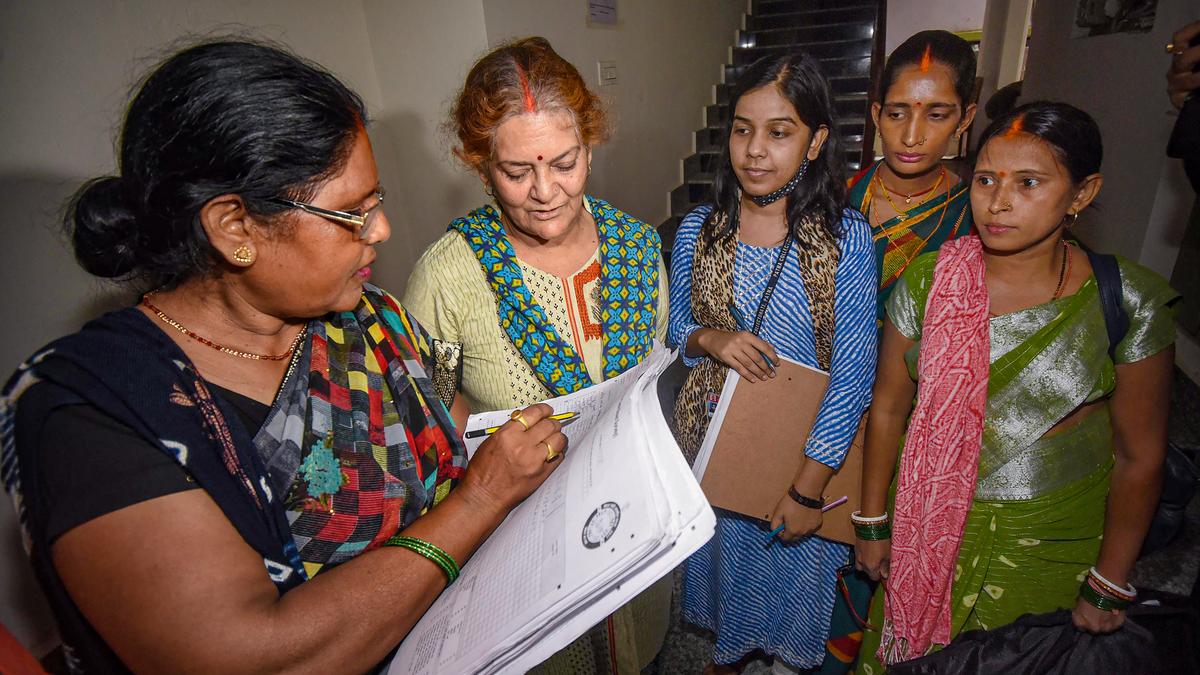
Experts say listing of castes will be first challenge in Census
The Hindu
Top anthropologists and population scientists discuss challenges in enumerating castes for the upcoming Census exercise in India.
With the Union Government deciding to enumerate caste in the forthcoming Census exercise, top anthropologists and population scientists in the country have argued that the first and foremost challenge in undertaking this exercise will be to list the total number of castes/communities in the country. At present, there is no comprehensive repository of such groups apart from the Constitutional lists of the Scheduled Castes (SCs), the Scheduled Tribes (STs), and the Other Backward Classes (OBCs).
The 1931 Census of India, the last one to enumerate castes in the country, had counted over 4,147 different castes and sub-castes across the country, which included over 300 caste groups that had Christianity as their religion and 500 that followed Islam, according to a review of the Census reports and scholarly articles that have analysed this particular Census.
Notably, the 1931 exercise had asked enumerators not to insist on caste information of “Moslems, Christians, Sikhs, Jains, Buddhists, and Aryan or Brahman Hindus” but record it if provided.
Today, there are over 3,651 communities classified as OBCs, 1,170 communities classified as SCs, and around 850 communities categorised as STs (including repetitions, given that many groups are found across multiple States and regions).
Apart from this, the only record of total castes or communities living in India is contained in the Anthropological Survey of India’s People of India volumes, published after a seven-year-long project that had tabulated 4,635 “communities” and hundreds of their sub-castes and sub-groups. This list included communities classified as SC, ST, and OBC, apart from which it had counted 2,203 castes and communities (mostly General category).
“The only first step here is to start with listing the castes and communities that need to be enumerated. The Office of the Registrar General of India and the Census Commissioner must consult with academics, people, caste groups, political groupings and the public at large to arrive at this listing. This is one of the failures of the SECC (2011 Socio Economic and Caste Census),” Professor Ram B. Bhagat, former Head of Migration and Urban Studies at the International Institute for Population Sciences, told The Hindu.
In the absence of a concrete listing of castes and communities to be enumerated, the SECC in 2011 had yielded as many as over 46 lakh different “castes”, with many citizens entering their surnames under the field for caste, thereby inflating the numbers.


CPI-M accepts DMK's five-seat offer for Tamil Nadu Assembly elections, prioritizing INDIA bloc unity over seat demands.

Ricky Rai, son of former underworld operative Muthappa Rai, on Monday appeared before the Bengaluru Traffic Police for questioning in connection with a case involving a Lamborghini performing dangerous stunts at Anil Kumble Circle on March 21.

The Dispur election heats up as 'CongBJP' defections shape a high-stakes contest between veteran candidates from BJP and Congress.

Bengaluru's M. Chinnaswamy Stadium conducts readiness drill ahead of IPL 2026, ensuring upgrades and technical preparations are complete.

First-level randomisation of EVMs completed in Nagapattinam for upcoming elections, ensuring transparency and security.

A district-level committee in Krishnagiri has been formed to assess and verify seizure claims of goods and cash.

Minister Anam Ramanarayana Reddy pledges government support for local fishermen and farmers facing challenges in Andhra Pradesh.

MP M. Sribharat urges collective efforts to revive Visakhapatnam Steel Plant, highlighting key reforms for crucial recovery and growth.

141 candidates have filed nominations for Kozhikode's Assembly elections, with scrutiny on March 24 and campaigning intensifying.

BJP's Vijayendra accuses Congress of using money to influence Bagalkot bypolls, urging voters to reject their tactics.

First randomization of electronic voting machines completed in Tirunelveli and Tenkasi districts for upcoming Assembly elections.

RPF seizes 10.12 kg of unclaimed cannabis worth ₹5.06 lakh from a train in Mangaluru.

Kolar's groundwater levels rise to 50-100 ft due to the K.C. Valley project, ensuring clean water and improved health outcomes.