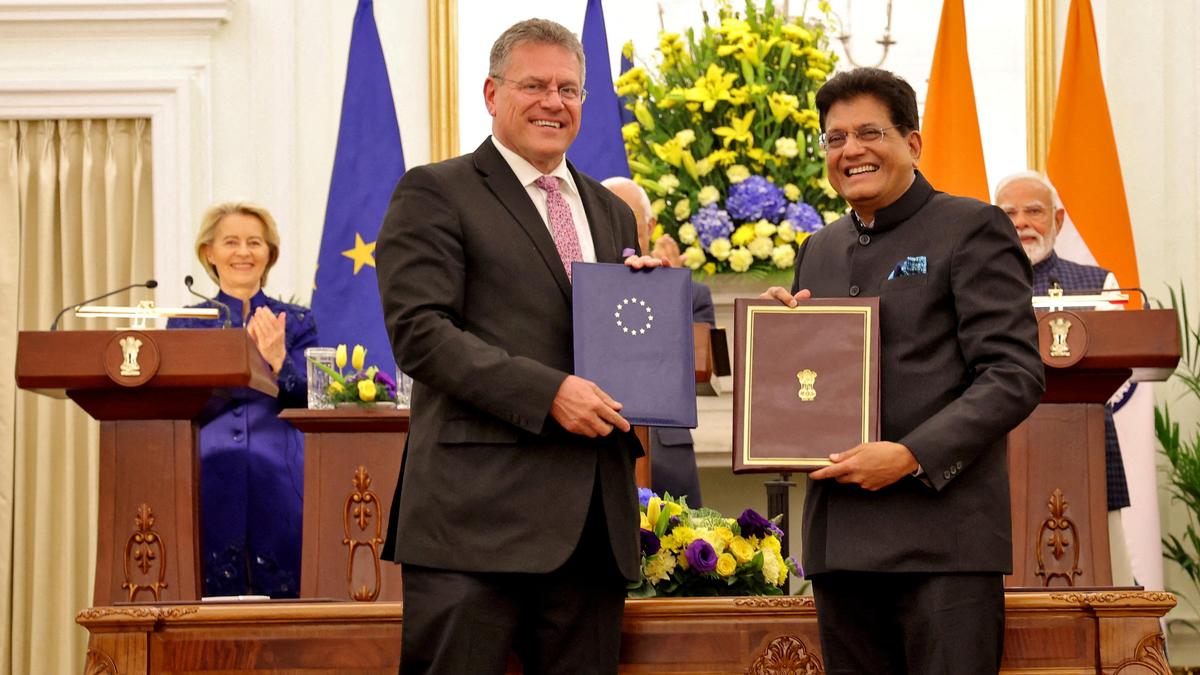
EU FTA puts India on a level playing field against competitors in labour-intensive sectors: chief negotiator
The Hindu
The EU-India FTA levels the playing field for India in labor-intensive sectors, benefiting various States and enhancing competitiveness.
The free trade agreement (FTA) between India and the European Union puts India on a level-playing field with a number of its competitors in a number of labour-intensive sectors such as textiles, apparel, leather goods, footwear, engineering goods, and marine products, India’s chief negotiator on the FTA Darpan Jain explained on Wednesday (January 28, 2026).
In addition, while emphasising that the overall FTA will benefit all States in India, Mr. Jain also highlighted several sectoral benefits to States such as Tamil Nadu, Andhra Pradesh, Karnataka, Kerala, Gujarat, Maharashtra, Rajasthan, Uttar Pradesh, Bihar, Odisha, and West Bengal.
India and the EU on Tuesday (January 27, 2026) signed a document marking the conclusion of negotiations on an FTA that both sides have dubbed the ‘mother of all deals’.
“Duty-free access from an earlier duty of up to 12% in textiles, apparel and clothing provides a level playing field for exporters and boosts India’s competitiveness in the EU vis-a-vis competitors such as Bangladesh, Vietnam, and Turkey, which enjoy duty-free or preferential access under EU trade agreements,” Mr. Jain said.
Under the deal, duties on leather goods, footwear, textiles, apparel, and clothing will be entirely removed as soon as the FTA comes into force.
“Key clusters in Tamil Nadu, Gujarat, Maharashtra, Rajasthan, Uttar Pradesh, Bihar, and West Bengal are set to see capacity expansion and development,” Mr. Jain asserted.


The booming market for artificial intelligence servers brought Taiwan's Foxconn a 24 percent jump in annual net profit, the company said

In a statement on its website, Adobe said it has in recent years streamlined its sign-up and cancellation processes and made them more transparent.

Stock markets recover as Sensex and Nifty bounce back following a three-day slump, driven by value-buying in blue-chip stocks.

U.S. President Donald Trump’s administration is set to receive a roughly $10 billion fee from investors in the recently completed deal to take control of TikTok’s U.S. business, the Wall Street Journal reported

Meta is planning sweeping layoffs that could affect 20% or more of the company, three sources familiar with the matter told Reuters

Learn how to choose the best personal loan lender by evaluating eligibility, interest rates, and borrowing experience.

Discover why pension planning is essential in modern India to ensure financial security and peace during retirement.

The U.S. has launched two investigations under Section 301 of the Trade Act of 1974 against India and other economies to examine practices that may be ‘unreasonable or discriminatory and burden or restrict U.S. commerce’. One probe examines whether countries, including India, are using excess manufacturing capacity to export to the U.S. in a manner that hurts American businesses, while another looks at whether countries have taken ‘sufficient steps’ to prohibit imports of goods produced with forced labour.

NHAI raises annual pass fee to ₹3,075 from April 1, 2026, streamlining toll payments for FASTag users.

The U.S. probes forced labour in global supply chains, scrutinizing China and India's exports, warns the Global Trade Research Initiative.

The Hindu collection of images of the LPG crisis: War lights a kitchen fire

The company, which launched its IPO in 2020, is now listed on the National Stock Exchange as well as the Bombay Stock Exchange.

Explore the Essential Commodities Act's role in addressing India's gas crisis and its impact on various sectors.