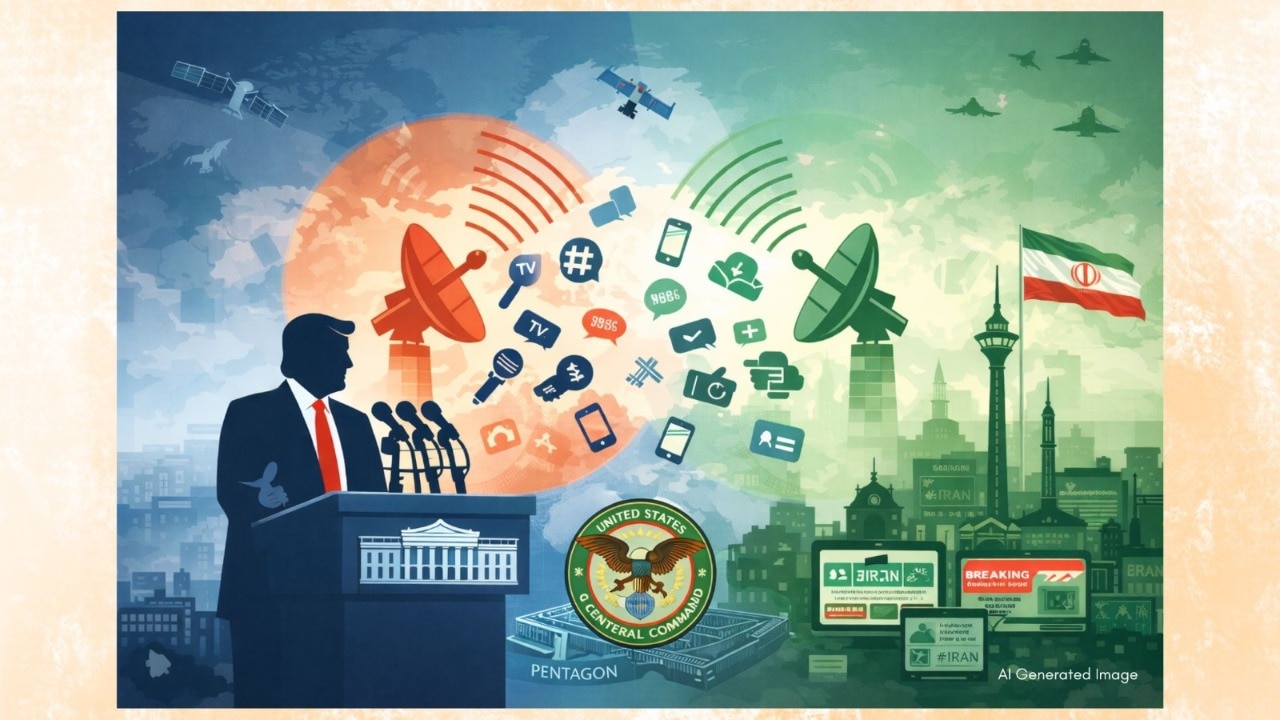
Epic Fury vs Op Sindoor: The battle of wartime messaging
India Today
India Today's OSINT team analyses wartime communication during the US Operation Epic Fury and India's Operation Sindoor. A comparison of messaging, speed, and institutional involvement in two modern conflicts.
Wars are devastating, and no country or military wishes a war upon itself. Yet they remain a reality of the modern world, and no leadership can simply wish a conflict away. When the world’s most technologically advanced and well-funded military goes to war, however, it inevitably becomes a case study for others. For militaries around the world, such conflicts offer lessons to observe and analyse. It may be impossible for most forces to match the technological sophistication or vast resources of the United States Armed Forces. But there is one aspect of warfare that does not necessarily require an unlimited budget or cutting-edge technology: communication during conflict.
Wars, conflicts, and skirmishes often differ in magnitude, intensity, and objective, but what should remain constant, however, is communication. Not merely to hype a narrative, but to achieve operational success and minimise “fatal” misunderstandings. What we are seeing in the case of the United States in its ongoing war with Iran is, if not perfect, the communication from Washington has been clear, concise, effective, and timely so far. However, the question is: Did India do the same during its Operation Sindoor, a war on terror that lasted for over five days? Did India keep the BLUF, Bottom Line Up Front? How often each side communicated during conflict times
India Today’s Open Source Intelligence (OSINT) team tracked communications issued by US officials during the ongoing Operation Epic Fury and compared them with India’s messaging during Operation Sindoor. We examined the data from the first five days of the West Asia conflict and compared it with India’s five-day conflict of May 2025.
What we found is that although India had a sublime edge militarily, it lacked effective communication, giving space for speculation to flourish and avoidable narratives to gain momentum. On the other side, US communication has been comprehensive and precise. While not necessarily perfect or instantaneous, the developments are being communicated effectively.
One of the clearest distinctions between the United States’ communication amid the ongoing Operation Epic Fury and India’s communication during Op Sindoor lies in the degree of institutional participation in official public messaging. While both countries display political, diplomatic and military presence in their communication apparatus, the difference lies in what these layers actually communicate.
In the US case, communication is distributed across multiple institutional levels. Messaging comes from the President and the Vice President, the White House, the Department of War, the Secretary of War, the Secretary of State and CENTCOM. Most of these actors regularly communicate operational progress, acknowledge losses and outline objectives achieved. This multi-layered structure allows developments on land, at sea and in the air to be addressed simultaneously at both political and military levels.


The victim, identified as Naitik Kumar, allegedly rammed his speeding Bullet motorcycle into a scooter near Janeshwar Mishra Park in Lucknow, triggering a crash that left him dead and two others injured.

RJD MLA who skipped Bihar Rajya Sabha poll voting cites mother's illness

West Bengal Chief Minister Mamata Banerjee led a protest march in Kolkata against the alleged LPG shortage, accusing the PM Narendra Modi-led Centre of failing to ensure adequate supply.

Himayani Puri, daughter of Union Minister Hardeep Singh Puri, has moved the Delhi High Court over "false and malicious" reports linking her to convicted sex offender Jeffrey Epstein.

The family, a resident of Thyagaraju Street in Punganur town, had recently repaired the engine of their two-wheeler vehicle. A local mechanic advised the family to keep the engine running overnight to "set" the newly installed parts. However, this turned out to be fatal for the family.

The Supreme Court closed criminal proceedings against Ashoka University professor Ali Khan Mahmudabad after the Haryana government said it would not grant sanction to prosecute him over social media posts related to Operation Sindoor.

Three Congress MLAs in Bihar are reportedly out of contact as voting for five Rajya Sabha seats is underway, with the INDIA bloc and the BJP-led NDA locked in a tight contest for the fifth seat that could hinge on cross-voting.

Bunty Solanki stabbed his wife to death following a quarrel at their residence in Vadodara's Bakrawadi area. Rita died on the spot.

The girl's family members were angered over the friendship, and as a result, they called Jadhav last Saturday evening and allegedly beat him.

External Affairs Minister S Jaishankar has said that direct talks with Iran to restore shipping through the war-hit Strait of Hormuz have yielded results, stressing that direct engagement with Tehran is the most effective way to address the disruption.

This moment comes days after the Supreme Court allowed Harish Rana to die with dignity – a historic first court-ordered case of passive euthanasia in India. The court acknowledged the medical opinion that Rana will never recover and that the tubes that feed him and keep him alive are only prolonging his pain.


Ground videos from Shopian showed snow-draped pine trees as the weather brought joy for tourists. Speaking to reporters, a tourist from Bihar said she was unable to contain her happiness over the unexpected snowfall.