EMRS Bhopal Principal who turned school around is among National Teachers’ Award recipients
The Hindu
EMRS Bhopal Principal who turned school around is among National Teachers’ Award recipients.
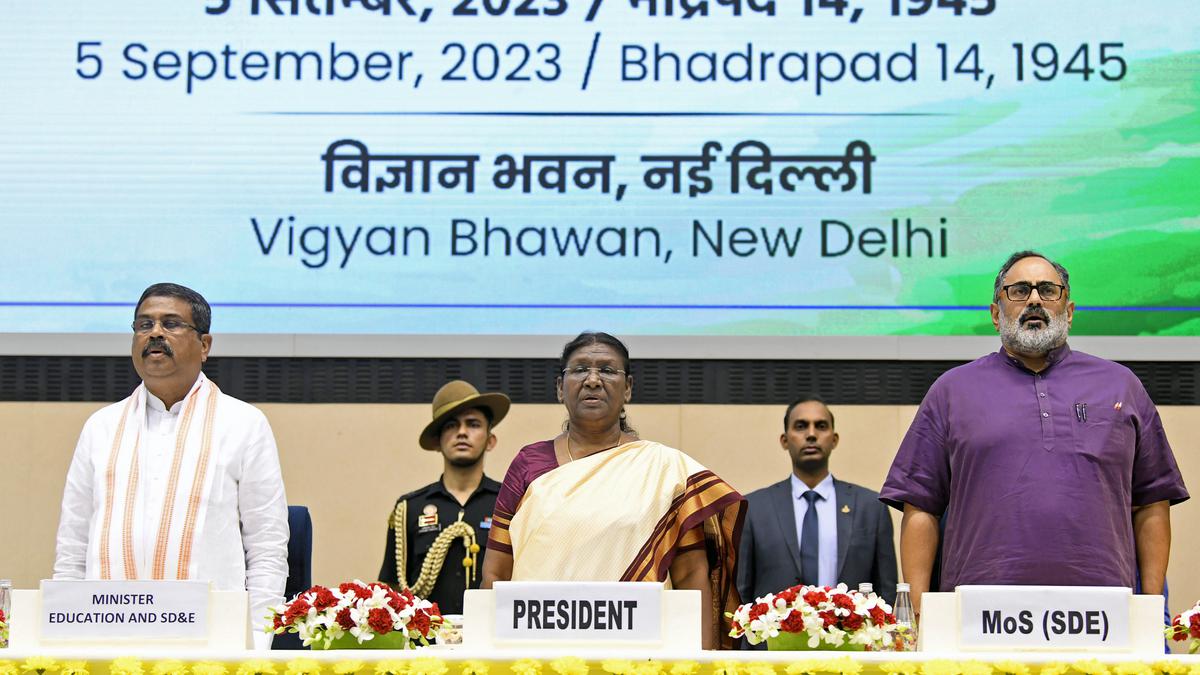
Among the 50 school teachers who were awarded the National Teachers’ Award by President Droupadi Murmu on Tuesday was Yashpal Singh, Principal of the Eklavya Model Residential School, Bhopal. Dr. Singh ensured near full-capacity attendance from first generation school-going tribal children with simple approaches, including students’ have a say in deciding meals, and recreating what they liked about their forest homes at the residential school.
Dr. Singh, along with 74 other teachers from across the country, received the award from the President of India on September 5, and also met with Prime Minister Narendra Modi at his residence for tea. After being felicitated by Tribal Affairs Minister Arjun Munda on Wednesday, the 61-year-old Principal spoke to The Hindu on the school’s transformation.
“All I had to start with were chalks and dusters. Now, we have a world-class library, smart classrooms, and state-of-the-art labs,” he said, adding that when he took charge in 2018, just 61 students had taken admission, and the school had seen two Principals in two years.
EMRSs are residential schools for Scheduled Tribe (ST) children run as a Central scheme under the supervision of the National Education Society for Tribal Students. Each school has a capacity of 480 students from Classes 6 to 12.
“There are currently 465 students at EMRS Bhopal, but most of the time, it is at full capacity of 480,” Dr. Singh said, adding that he took help from the State and Union governments, the public, and students to make this happen. The school has recorded a zero-dropout rate in the last five years, and Dr. Singh said a large part of that came from involving the students in decision-making processes.
“We certainly improved the food quality but more importantly, I took meetings with the students and they would tell us what they wanted to eat in the mess for meals. We would accommodate dishes that they usually eat at home as well,” said Dr. Singh, who has a Ph.D. in Mathematics from Bhopal University.
The decision-making process originates with student representatives, above whom are teacher representatives, following which Dr. Singh reviews the arrangement and signs off on it.


Peace talks between fishermen from Rameswaram and Karaikal aim to resolve fishing territory disputes and ensure maritime harmony.

Telangana's Food Safety Department inspects 122 establishments in a statewide drive, enforcing compliance on cereal products and safety standards.

The Greater Bengaluru Authority expands to 86 members, enhancing representation with key political figures included.

Civil Aviation Minister Rammohan Naidu Kinjarapu on Friday e-inaugurated (virtually) the Udan Yatri Cafe at Mangaluru International Airport and digitally launched DigiYatra at the facility.

Tension in Bagalkot as stones are thrown during Shivaji Jayanti procession; police ensure safety and investigate the incident.

Uday Bala Krishnan emphasises the vital role of compassionate teachers in nurturing young minds amidst the rise of Artificial Intelligence.

A.K. Jayasankaran Nambiar appointed executive chairman of Kerala State Legal Services Authority by the Governor and Chief Justice.

Shorts News:Watch: Youth Congress workers hold ‘shirtless protest’ at AI Summit

Hakki Pikki people from Karnataka detained in Ghana raise concerns among families about their safety and the legality of their herbal sales.

Anakapalli police arrest habitual offender, recovering gold worth ₹30 lakh after a swift investigation into a house break-in.

NABARD projects ₹19,382.81 crore credit potential for Dharmapuri in 2026-27, emphasizing agriculture and MSME growth.

Raijor Dal's Akhil Gogoi urges Congress to clarify seat-sharing for Assam Assembly polls, highlighting alliance tensions.

Commuters face delays and congestion on the first day of reduced suburban train services due to Egmore station redevelopment.