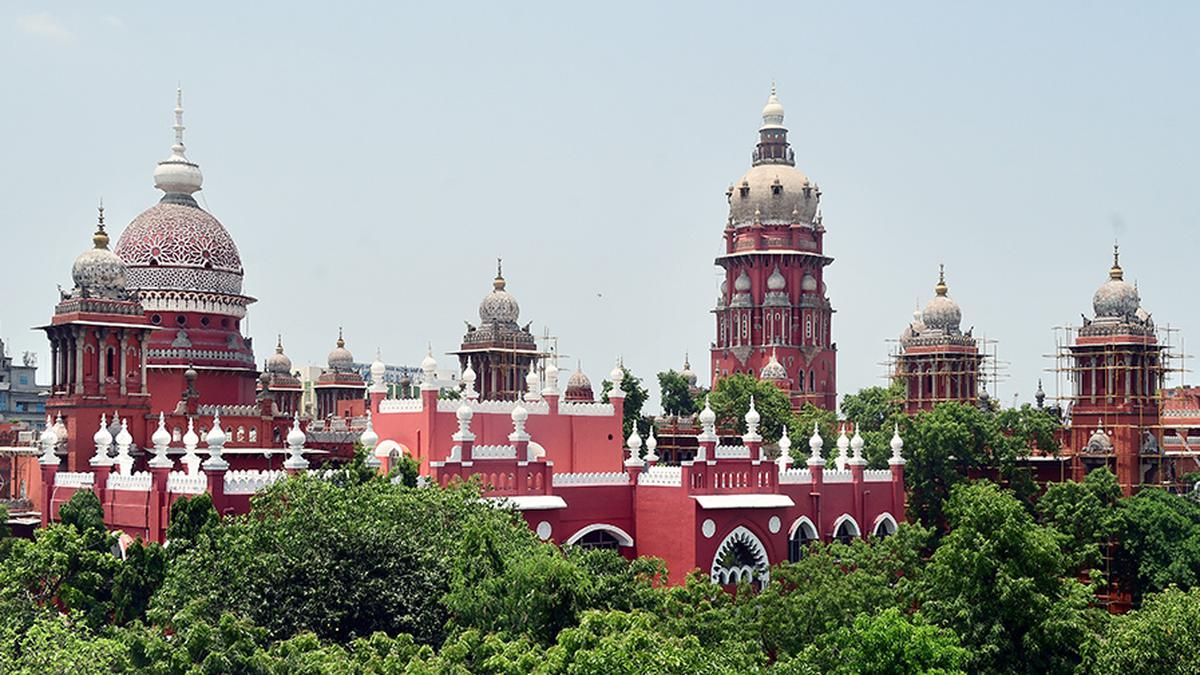
Educational institutions run by religious, linguistic minorities need not provide reservation for SCs, STs and OBCs: Madras High Court
The Hindu
Madras HC rules minority institutions need not follow reservation rule; govt can't compel them to provide reservation. Status granted by NCMEI to continue until cancelled on valid grounds. Govt can insist 50% of sanctioned intake be filled by minorities, excluding those admitted on merit.
In a significant judgement, the Madras High Court has ruled that educational institutions run by religious and linguistic minorities need not follow the rule of reservation with respect to the Scheduled Castes, Scheduled Tribes and Other Backward Class students. It has also held that the government cannot compel such institutions to provide reservation to such candidates.
Partly allowing a couple of cases filed by Justice Basheer Ahmed Sayeed College for Women in Chennai, Chief Justice S.V. Gangapurwala and Justice P.D. Audikesavalu wrote: “We have no hesitation to hold that the concept of communal reservation or reservation for Scheduled Castes, Scheduled Tribes and Other Backward Classes of citizens would not apply to minority institutions.”
The judges also ruled the State government would not have any right to restrict the minority status of an institution to a particular period. They held the status, once granted, would continue until the National Commission for Minority Educational Institutions (NCMEI) cancels it on valid grounds such as the institution having lost the character in view of a change in its objective.
However, the first Division Bench, upheld the right of the State government to insist that the minority institutions could admit students from the religious and linguistic minorities concerned only up to 50% of the sanctioned intake and that the rest must be filled up on the basis of merit. The minorities who gain admission on merit should be excluded while calculating the first 50% of students, the Bench clarified.
The petitioner college had approached the court assailing a Government Order (GO) issued on November 20, 2021 rejecting the plea for extension of religious minority status to it since it had admitted 52% minority students in the academic years 2018-19 and 2019-20. Advocate General R. Shunmugasundaram contended such admission had been made in violation of a 1998 GO which restricts admission of minorities to 50%
On the other hand, senior counsel Vijay Narayan, representing the college, claimed minority educational institutions should be granted a permanent status without being forced to get it extended from time to time. He also argued the Tamil Nadu Backward Classes, Scheduled Castes and Scheduled Tribes (Reservation of Seats in Private Educational Institutions) Act, 2006 would not be applicable to minority institutions.
Finding force in his submissions, the judges said, Article 15(5) of the Constitution, introduced through the 93rd amendment in 2005, specifically excludes minority institutions while enabling the State Government to make special provisions by law for the advancement of any socially or educationally backward classes of citizens or for the Scheduled Castes or Scheduled Tribes relating to their admission to educational institutions.


MLC Kishore Kumar Puttur criticizes the State for poor implementation of the Centre's health scheme for senior citizens.

Karnataka's Health Minister announces redeployment of specialists to taluk hospitals to reduce neonatal mortality rates effectively.

Celebrate IPL's start and Polly Umrigar's legacy, reflecting on cricket's evolution and the enduring impact of its pioneers.

BJP accuses Congress and Rahul Gandhi of endorsing an ‘anti-India’ USCIRF report undermining India's global image.

Education Ministry proposes UGC-like funding under Shiksha Adhishthan, raising concerns about centralization and public university financing.

Shivraj Singh Chouhan defends the new rural jobs Act, dismissing opposition protests as ineffective and highlighting increased funding and worker protections.

Supreme Court questions why heirs can't access unclaimed funds of deceased depositors, urging government to develop a disclosure policy.

Karnataka High Court demands LPG supply details amid state restrictions, threatening Bengaluru's restaurants and livelihoods.

Shorts News:UN body investigating deadly strike on Iranian girls school

Moodbidri police inspector suspended pending inquiry over allegations of misbehaviour and inappropriate conduct towards women.

The State currently hosts more than 880 GCCs, up from around 500 GCCs in 2021.

Transgender and intersex activists march to Lok Bhavan, protesting the regressive Transgender Persons Bill and demanding its withdrawal.

Hyderabad's LGBTQIA+ community opposes the Transgender Amendment Bill, stressing dignity over identity verification and highlighting economic and medical concerns.