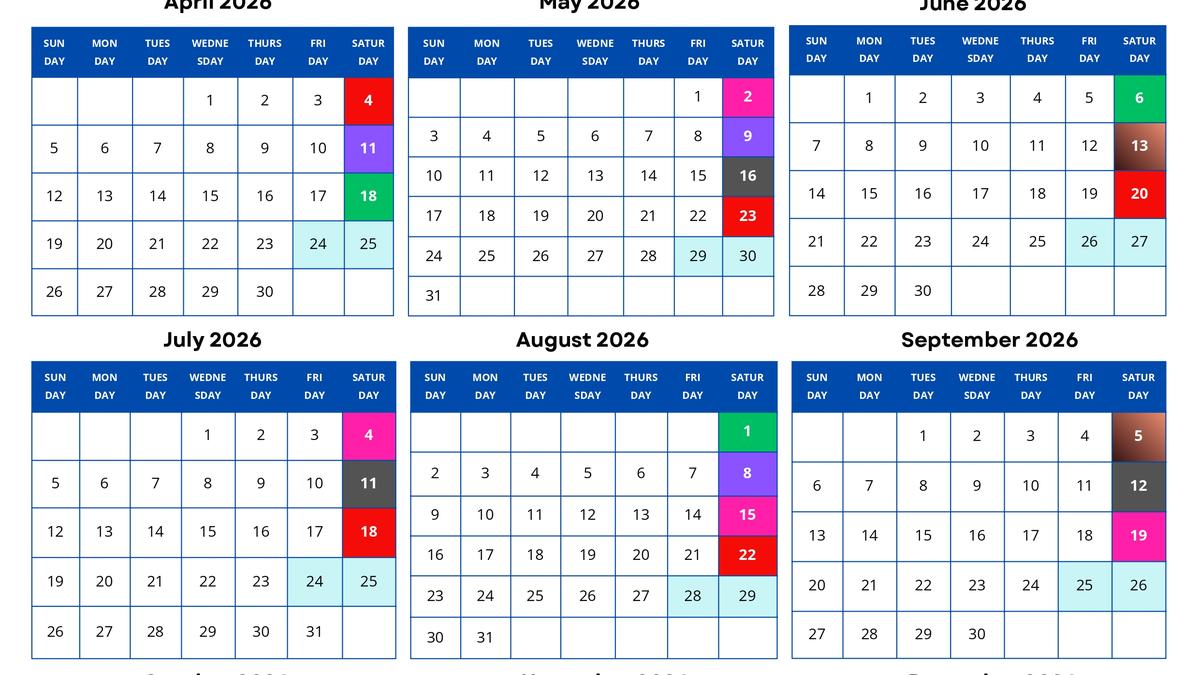
Download your dry waste collection calendar
The Hindu
Thooimai Mission seeks to make segregation a daily routine for residents by introducing a calendar that earmarks every Saturday for collection of a particular category of dry waste
What would pop up first in a head that tries to wrap itself around the notion of “habit formation”? That is a no-brainer; obviously “daily routine”. Would “calendar” show up next, and would the two be tied together in a blood bond? In its head, Thooimai Mission (launched by Tamil Nadu Government in March 2025 and kitted out with the Clean Tamil Nadu Company Limited as its executive arm) went through this sequence in a case of serious vertical thinking while trying to make sense of the poor response to its early dry waste collection drives. These early drives had seen limited response, not because people were unaware of them, but because careless dumping had long become a habit. The bad habit needed to be replaced with a good one, which should be reinforced by a special calendar.
The Mission has designed a year-long, material-specific waste collection calendar aimed at making segregation more of a routine than a one-off activity (in response to a collection drive). “People are not used to this kind of habit,” explains Hariharan B., C Cube Manager at Thooimai Mission CTCL. “So instead of making it a one-time collection, we decided to make it continuous.”
Based on household waste patterns, the calendar schedules weekly and date specific collection drives for different waste streams such as plastics, paper, glass, e waste, textiles, thermocol, footwear, and expired medicines. “People’s questions are always material specific,” says Hariharan . “What do I do with plastic? What do I do with old slippers? Going-material specific helps people develop the habit of depositing instead of dumping.” Going by where the shades have landed on the calendar, different shades for different forms of dry waste, one might assume the routine in question is weekly by nature, but it is not. Segregation is a daily routine and every Saturday is earmarked for the collection of particular category off dry waste. “Every Saturday, people are reminded that they need to deposit their waste,” Hariharan says.
The system is supported by the Circular Collective, a network of NGOs, RWAs, government officials, self-help groups, and conservancy staff driving decentralised collection at the ward level. The calendar also functions alongside a growing network of permanent collection centres. While ward level drop off points remain primary, zonal centres act as secondary hubs. Bringing these centres closer to neighbourhoods lowers effort and makes regular depositing more practical.
Primarily circulated in digital format to avoid paper waste, the calendar has been shared with local bodies across the city through BOV announcements and social media reminders.
Residents who organise dry waste collection drives regularly in their corner of the planet welcome this calendar, but are worried about one factor that might override its effectiveness.


Assembly polls 2026: Follow updates from The Hindu on the upcoming elections in five States on March 24, 2026

Delhi's per capita income is projected to grow 7.09% by 2025-26, highlighting the city's economic progress and infrastructure challenges.

Review meeting held in Dharmapuri with election observers and nodal officers to discuss upcoming Assembly elections.

Execution of development projects, infrastructure augmentation to occupy centre stage in electioneering

Telangana Cabinet approves Hate Speech and Parents Support Bills, ensuring accountability for neglecting elderly and curbing hate-driven offences.

EU and Australia finalize a free trade agreement and establish a new defense partnership to enhance economic and military cooperation.

U.S.-Israeli war on Iran LIVE: Iran faces deadline of US President Donald Trump warning to open Strait of Hormuz. Follow The Hindu for more LIVE updates on March 23 2026 on Iran-Israel war.

KPCC chief Sunny Joseph emphasizes UDF's focus on Sabarimala and corruption while expressing confidence in winning Kerala's upcoming Assembly elections.

A military plane crash in Colombia leaves 125 aboard, with at least 48 survivors rescued amid ongoing recovery efforts.

‘Symposium’, a new platform to promote lifelong learning and counter misinformation among youth, was launched in Hyderabad.

By using TB as an entry point, integrated healthcare delivery can optimise and improve public health efficiency

Residents of Chettichavadi express concerns over deteriorating groundwater quality due to long-standing garbage dumping issues in Salem West.

Community Health Officers in Vijayawada protest for reduced workload and continued incentives amid growing dissatisfaction over salary changes.