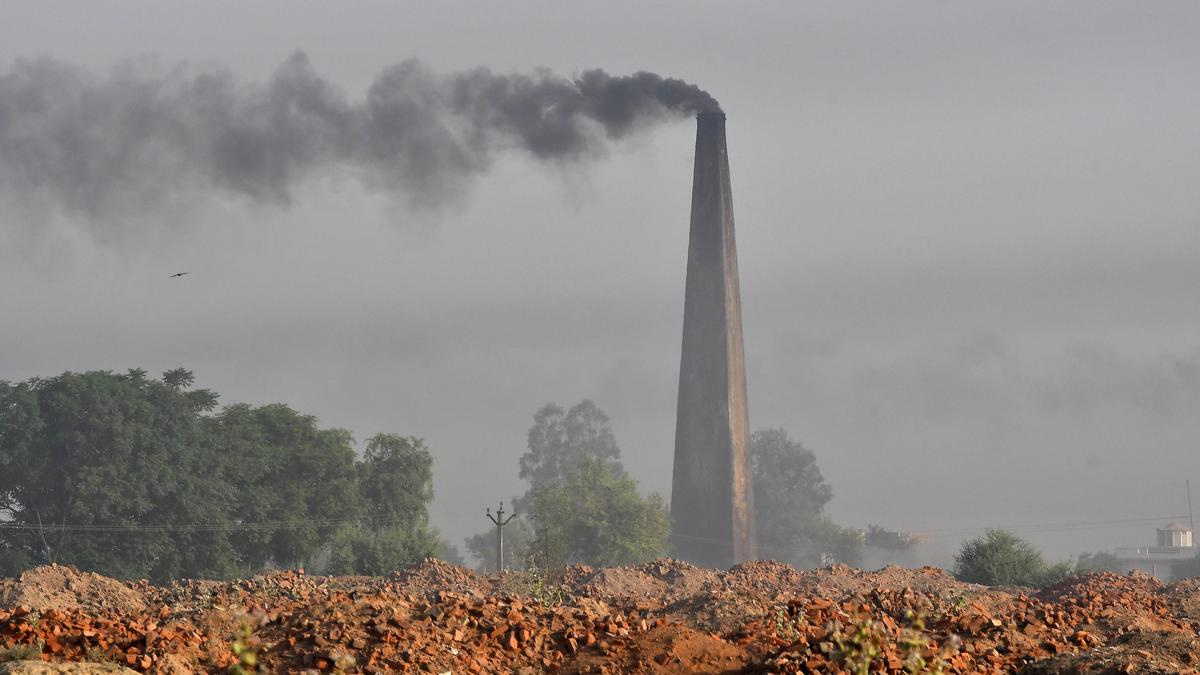
Cutting heat loss in brick kilns found to significantly mitigate emissions Premium
The Hindu
The main idea behind the interventions was to reduce emissions and air pollution and at the same time, reduce fuel costs while increasing revenue through increased efficiency.
Bangladesh is one of the most polluted countries in the world. According to an IQ Air assessment, the country had the second-worst air quality in 2024 worldwide, with PM2.5 concentration more than 15-times the World Health Organisation’s suggested limit.
Brick kilns are a major contributor to this air pollution crisis. Previous efforts to improve the greenness of the local brick-making industry have resulted in limited success – but if a new study is to be believed, there is room for low-cost interventions to make a difference with these kilns.
The study, published in Science on May 8, was conducted by researchers from the U.S., Bangladesh, and India. They performed a randomised control trial involving 276 kilns in Bangladesh, in the brick-firing season of November to May in 2022-2023.
The experiment had three parts: one control arm and two interventions. One intervention was solely technical and the other included both a technical intervention and incentive information.
The main idea behind the intervention arms of the trial was to reduce emissions, air pollution, and fuel costs while increasing revenue by increasing efficiency. While both arms provided information, training, and technical support on efficient coal feeding and brick-stacking practices, the incentive information arm also guided workers with incentives so that they stuck to their newly learned practices.
For the incentives, the researchers informed the kiln owners on various strategies like bonuses, higher wages, and better working conditions that included meals, housing, and clothing, but left it up to the owners and managers to decide which approach best fits their business.
The team also noted that the interventions were careful to not worsen the workers’ conditions in the industry, given the nature of work here is often precarious and exploitative.


Perundurai's industrial growth faces challenges of pollution, water scarcity, and healthcare, impacting residents ahead of the 2026 elections.

The Travancore Devaswom Board asserts that courts should respect community beliefs in its Supreme Court submission on Sabarimala's entry issue.

Karnataka cancels Deendayal Upadhyay event at KSOU due to protocol violations, citing inconsistency with university objectives.

Illegal pickle unit busted in Hyderabad, one arrested; unhygienic stock worth ₹3 lakh seized

Karnataka has entered a state of demographic transition where a large working-age population will no longer be enough to drive economic growth, and future gains will depend on how productively people are employed, the ‘State of Working India 2026’ report said.

Key demands in Sulur Assembly constituency include reviving the powerloom sector, addressing farmers' needs, and protecting River Noyyal.

Kodihalli urges Karnataka CM to allocate ₹10,000 crore revolving fund for seamless procurement of farm products under MSP scheme.

Kerala's political parties continue to marginalize women candidates, highlighting a troubling disconnect between gender demographics and representation.

The High Court of Karnataka on Tuesday ordered the issue of a notice to the State government on a PIL petition, which had complained about disturbances caused to people residing in the localities around the National Public School situated in Rajajinagar 5th block due to use of loudspeakers with high volume in the school and parking of school buses in residential areas.

China is extensively mapping ocean floors to enhance submarine warfare capabilities against the U.S. and allies across key oceans.

AIADMK's 2026 manifesto promises free rations, women's benefits, education reforms, and economic growth initiatives for Tamil Nadu.

The vehicle towing drive will soon resume in the city to ease traffic congestion. The Bengaluru Traffic Police (BTP), in coordination with the Greater Bengaluru Authority (GBA), is set to relaunch the vehicle towing drive across the city shortly to tackle traffic congestion and illegal parking.

Panic buying, not shortage, is leading to long queues at Hyderabad petrol pumps.