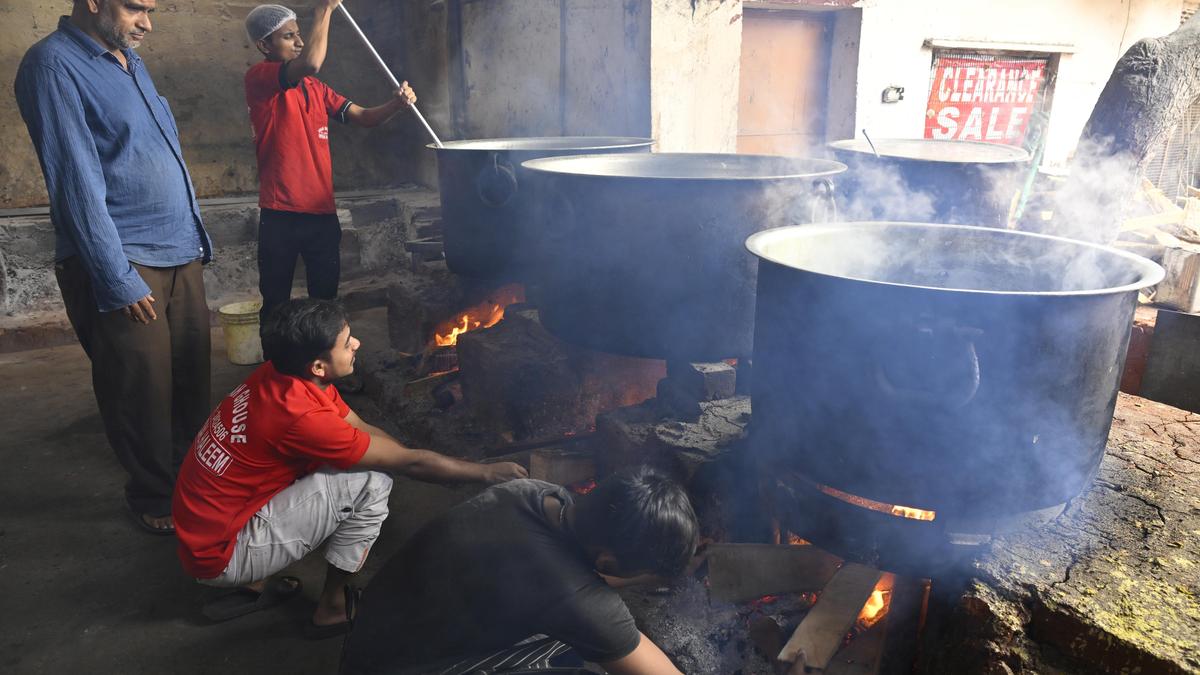
Cooking gas crisis on the boil across Telangana Premium
The Hindu
A cooking gas crisis in Telangana is disrupting restaurants, households, and industries amid rising prices and panic bookings.
At Donne Biryani in Hyderabad’s S.R. Nagar, the crisis didn’t arrive with a warning. It crept in slowly, one dish at a time. By last Friday, chicken drumsticks, chilli prawns and mutton pepper dry had vanished from the menu. The indulgent starters were the first casualties. “We are a large restaurant and there is a limited stock of LPG cylinders. We have dropped all starters and dry dishes from the menu to save gas,” says the franchise owner of the restaurant which has increased prices by ₹30 per item.
The strain is being felt even by temple kitchens. A notice pasted at the Hanuman Temple in Chikadpally announced a halt to cooked prasadam. Few would have imagined an interruption of this kind, triggered not by tradition but by an emptying fuel supply.
The unease crept in elsewhere too. When his phone rang at an odd hour, estate manager Vikram (name changed) expected the usual complaints about water, electricity or security at a gated community in West Hyderabad. Instead, he faced enquiries about piped gas stock.
For something so routinely taken for granted, LPG had suddenly become the talking point. The trigger lay far beyond city limits: a conflict in West Asia disrupting key marine routes that feed into India’s LPG lifeline, and meets a substantial requirement. The disruption travelled fast, setting off anxiety, frantic bookings and a system struggling to keep pace with demand.
The government moved to ring-fence domestic supply. Refineries were asked to prioritise propane and butane production for LPG and supply it to public sector oil marketing companies Indian Oil Corporation, Bharat Petroleum and Hindustan Petroleum, with clear instructions to serve domestic consumers first. The flip side was instant as commercial users were squeezed out.
Restaurants, cloud kitchens, streetside kiosks, hostels and PG messes felt the heat first. Households followed, as panic bookings surged beyond what automated systems could handle.


Uttarakhand CM Pushkar Singh Dhami expands his cabinet, inducting five MLAs to reach the maximum strength of 12 ministers.

Congress and Raijor Dal finalize their alliance for the Assam Assembly polls, sharing 11 seats and aiming to defeat the BJP.

BJP announces 112 candidates for West Bengal Assembly polls, including former MPs, lawyers, but excludes Abhaya’s mother’s candidature.

A man dies after a bar brawl in Alappuzha, Kerala; police detain five suspects for investigation.

Trainee veterinary officer dies from hippopotamus attack at Shivamogga safari during health check, prompting investigation into safety protocols.

The Voice of Hind Rajab, a film about a Gaza war tragedy, faces an oral ban in India by CBFC.

K. Sudhakaran returns to Kannur to ensure Congress victory, while T.O. Mohanan prepares to launch his campaign.

Qaffeine Bistro in Hyderabad has Baaghini, a six-coffee blend

Stock markets rebound as Sensex and Nifty recover early losses, driven by cooling crude oil prices and positive geopolitical signals.

A cooking gas crisis in Telangana is disrupting restaurants, households, and industries amid rising prices and panic bookings.

Taiwan warns of China's military threat, emphasizing the need for strong deterrence to prevent potential invasion plans.

A folktale from Australia tells how the crane and kangaroo rat discovered fire.

Lockie Ferguson will miss the start of IPL 2026 with Punjab Kings, prioritizing family after the birth of his son.