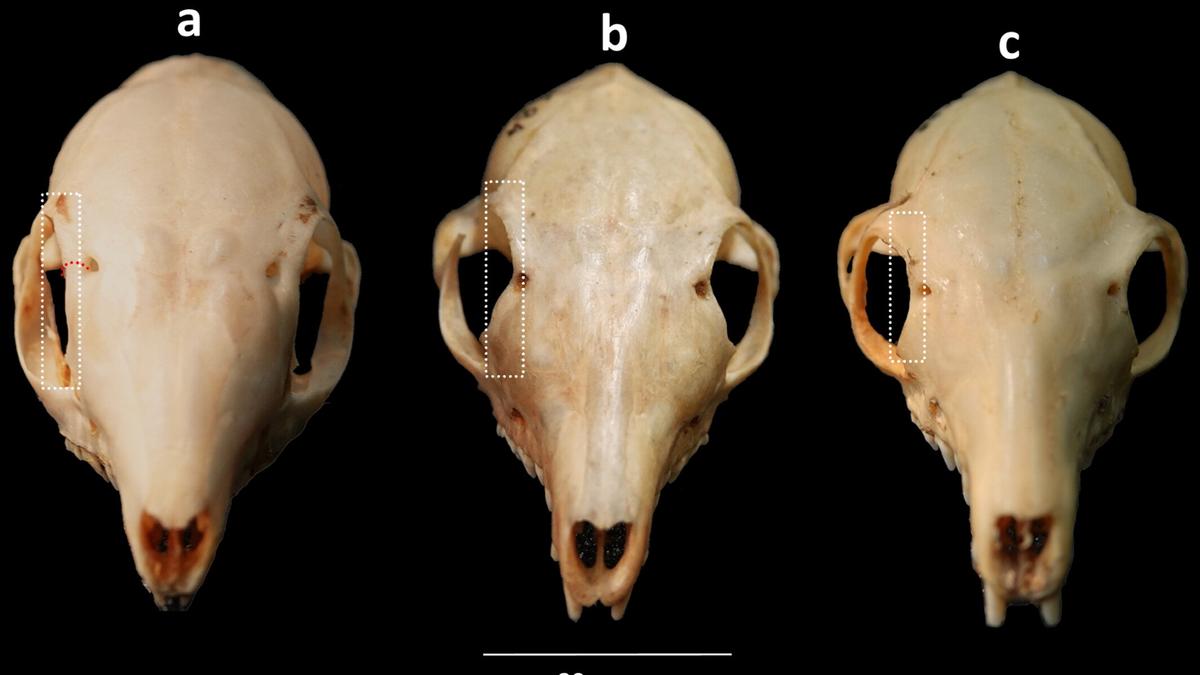
Centuries-old museum specimens unlock mysteries of South Asian treeshrews
The Hindu
ZSI scientists resolve taxonomic ambiguities surrounding South Asian treeshrews, highlighting morphological diversity and distinctiveness in new study.
GUWAHATI
Scientists from the Zoological Survey of India (ZSI) have resolved longstanding taxonomic ambiguities surrounding South Asian treeshrews - small, insectivorous mammals often misidentified due to their superficial resemblance to squirrels. Drawing upon century-old specimens housed in national collections, the study offers fresh insight into the morphological diversity of these elusive creatures.
Their study was published in Ecology and Evolution, an international journal, on Friday (April 25, 2025). The authors of the study are Manokaran Kamalakannan, Mukesh Thakur, Nithyanandam Marimuthu, Subhojit Pramanik, and Dhriti Banerjee.
Treeshrews are neither true shrews nor squirrels, but belong to a distinct order called Scandentia. While they share a similar size and arboreal lifestyle with squirrels, treeshrews can be easily distinguished by their elongated snouts, reduced whiskers, moist nasal pads, and insectivorous or frugivorous diet.
Historically misclassified as primates, the treeshrews – some arboreal, some semi-arboreal, and others terrestrial – are now recognised as an ancient lineage of mammals endemic to South and Southeast Asia.
Dr. Kamalakannan, the lead author and scientist at the ZSI’s Mammal and Osteology Section, conceptualised and led the study from data collection to the final morphological analysis. “By examining decades-old museum specimens, we have shed light on how these fascinating mammals differ from one another,” he said.
“This clarity is essential for accurate species identification and for shaping effective conservation policies. When analysed with modern techniques, museum specimens reveal patterns of variation that were previously hidden, helping us address long-standing taxonomic ambiguities,” he said.


For most patients with TB who are severely underweight, nutritional support is an essential and not optional part of treatment

Family of custodial death victims demands harsh punishment for nine convicted policemen to prevent future abuses of power.

Rajinikanth refutes TVK leader's claims about DMK threats preventing his political entry, expressing gratitude to supportive political figures.

CM announces Cabinet Sub-Committee on Musi rejuvenation; rehabilitation for all displaced

Ramanathapuram identifies 145 polling stations as sensitive, ensuring security with paramilitary forces ahead of assembly elections, says DEO.

BJP Puducherry president V. P Ramalingam files nomination for Raj Bhavan, joined by Union Minister Mandaviya and Khushbu Sundar.

History-sheeter 'Thoppai' Ganesh shot dead by police in Chennai after attacking officers during attempted escape.

The government plans to amend the FCRA, introducing new regulations for NGO asset management and accountability for key functionaries.

The draft policy for “Responsible Digital Use Among Students”, released on Monday by the Department of Health and Family Welfare, has recommended that parents set structured routines with clear screen-time rules and prioritise privacy, safety, and open conversation with children on digital well-being.

Police Observer Sushant Kumar Saxena conducts surprise inspection at Shencottai police station, reviewing warrants and security arrangements ahead of elections.

Andhra Pradesh government to launch key projects in April, focusing on industrial growth and infrastructure development, says Nara Lokesh.

Lok Sabha refers the Corporate Laws (Amendment) Bill to a JPC amid opposition concerns over CSR provisions dilution.

SHG members in Kanniyakumari use snakes and ladders to raise election awareness and boost voter turnout.