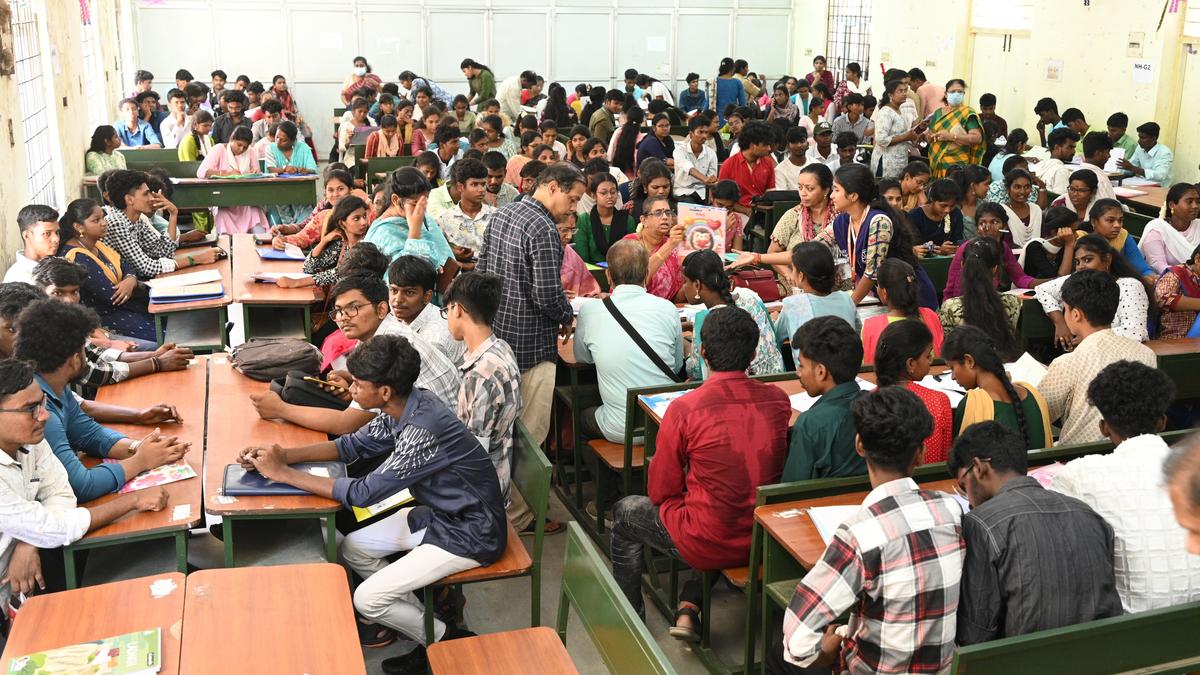
Campus portraits | Review of Perumal Murugan’s Students Etched in Memory
The Hindu
Perumal Murugan's heart-warming essays on students, translated by V. Iswarya, offer poignant insights into education and privilege.
The essays in Perumal Murugan’s Students Etched in Memory(translated from the Tamil by V. Iswarya) first appeared in 2017 as part of a weekly column in theVetrikodi supplement of theHindu Tamil Thisai. Contrary to the meaning of Vetrikodi (flag of victory), Murugan’s stories about the students he taught during his three decades as a government college Tamil teacher in Attur weren’t always success stories. “As a teacher, my attention is not always on those who have done well,” writes Murugan and we warm up to him instantly.
The side most people know of Murugan is the writerly one but follow his work closely and you will see that this self is firmly rooted in his experiential world. As a free thinker who has taught Tamil to first generation learners in rural India, Murugan comes face-to-face with an educational system choked by an oppressive and feudal worldview, caste-class inequities, and outmoded pedagogical practices.
The essays in this book, ably translated by Iswarya, are heart-warming, poignant sketches of Murugan’s students. Through his stories of their exploits, a picture emerges of Murugan himself, of a teacher who is warm, generous, compassionate and thoughtful. Murugan holds that the work of a teacher does not end with the classroom but rather, that it must extend even to the inner lives of students. He is a teacher who is constantly learning how to be one.
There is not a trace of self-consciousness or self-glorification in the essays. Murugan tells it like it is. This is what makes the book such a wonderfully engaging memoir.
Reading the essays is an immersive experience and we meet some of Murugan’s most interesting students. The list is long: Maanvizhi, a female student who decides to stand for student union elections but is forced to back out; the brilliant Kalaichelvi who presents a critical paper on theMahabharataand ends up earning the wrath of a professor for being too bold; Sudhakar who lives in Murugan’s house for some time and loves to cook; Kumaresan who, prompted by Murugan, starts reading fiction; Prabhu with his quirky haircut; Chinnadurai the amazing performer who sings anopparaias part of a college competition; ruffian Ramu who turns out to be a poet and a talented kabbadi player; Rasu who has a green thumb; the mischievous Rajkumar who ultimately pipes down; Jhansi who knits a beanie for Murugan’s daughter; Sarala who ends up as a policewoman in Valparai; the handsome Balamurugan who ultimately commits suicide because of failure in love; the dynamic Venkatachalam who is the joint secretary of the literary forum; the outlier Prabhakaran and his gang whom Murugan eventually wins over; Nandakumar who insists on prostrating before Murugan; Suresh from Javvadhu hills who has political ambitions; the hair-flipping Silambarasan; cycle Soosai; parotta master Gopalakrishnan; Koushik, the barber who cuts Murugan’s hair when the latter is under house arrest; and research scholar Seenivasan whom Murugan mentors.
Through his finely etched portraits, Murugan raises some fundamental and difficult questions. How does one teach and learn in an environment which is deeply feudal, so much so that students and their parents hesitate to sit in the presence of professors? How does one respond to class inequality and income inequities? (Many of Murugan’s students work day jobs to support themselves and their families.) What work-arounds can one employ in the face of outdated curricula and pedagogical methods? How does one replace the old system of disciplining and punishing students with a new one based on respect and love?
Murugan draws our attention to the tyranny that is English when it comes to first generation learners from rural, small town Tamil Nadu. He recounts stories of students who clear all their papers but are held back only on account of the English paper. He also writes of the difficulty he faces when it comes to female students. Unlike in the case of male students, Murugan must keep a distance from them because of social dictates and so cannot mentor them to the extent he would like to. He also critiques the corrupt practice of research students buying their degrees.


Lorry owners in Andhra Pradesh reject government proposal to reduce vehicle fitness test fees by up to 50%.

Watch the thrilling trailer for 'Dune: Part Three,' showcasing epic battles and Paul Atreides' struggle with power and resistance.

TMC announces candidates for 2026 Bengal Assembly elections, contesting 291 seats; BGPM to handle three Darjeeling hill seats.

DMK finalizes a seat-sharing deal with CPI for Tamil Nadu elections, allotting five seats amid ongoing discussions with CPI(M).

Parliament Budget Session LIVE: Follow The Hindu's latest updates on the Parliament Budget Session on March 18, 2026.

Severe storms cause over 1,100 flight cancellations and 7,300 delays across the U.S., exacerbating travel chaos amid a government shutdown.

Three MBBS students tragically died in a scooter accident in Kozhikode, Kerala, early Wednesday morning.

Microsoft said on Tuesday it is reorganising its Copilot teams by unifying its commercial and consumer versions, as the tech giant rushes to improve its artificial intelligence assistant to drive better adoption.

Poco has launched the new X8 Pro series smartphones in India, consisting three phones: the Poco X8 Pro Max, Poco X8 Pro, and the special edition Poco X8 Pro Iron Man Edition

Morocco is crowned African football champion after Senegal forfeits the final due to a controversial walk-off protest.

Israeli tank fire reportedly hit a U.N. base in Lebanon, wounding Ghanaian peacekeepers amid rising tensions with Hezbollah.

LPG shortages in India force schools to revert to firewood, increasing burdens on women workers in mid-day meal schemes.

Discover the dramatic history and significance behind Tamil Nadu's name change from Madras on January 14, 1969.