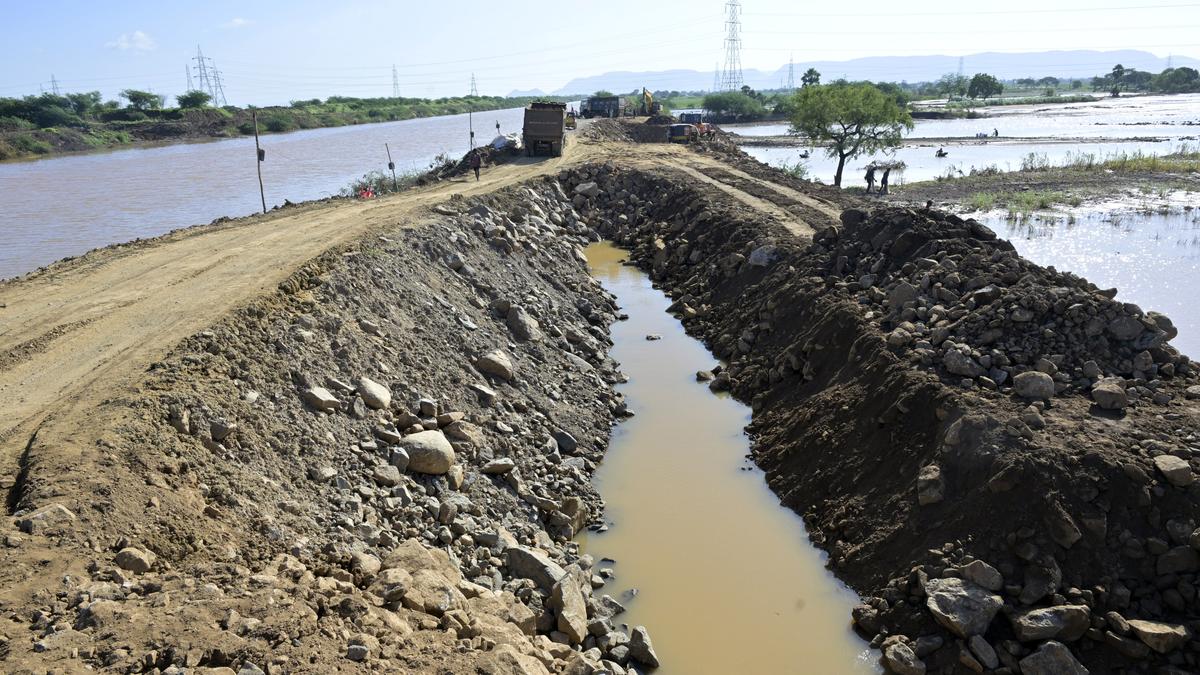
Budameru flood crisis: Tracing the causes of a catastrophe Premium
The Hindu
Vijayawada floods expose government neglect, lack of commitment, and encroachments, with no permanent solution in sight.
The devastating floods in Vijayawada city, caused by breaches in the Budameru rivulet, has highlighted a multitude of issues ranging from government neglect and lack of commitment on the part of successive governments to finding a permanent solution. What is most telling is the fact that the State government still lacks comprehensive data on the encroachments along the drain, despite a recurring pattern of the rivulet inundating entire swathes of farmland and residential areas along its course over the years.
In 1956, leaders from the Socialist Party and the Congress Party launched a movement to draw attention to the hardships faced by the people whenever the Budameru overflowed. Since then, every political party has staged protests and agitations while in the opposition, but has done little to address the issue once in power. The recommendations of expert committees, such as the Mitra Committee in 1966, were largely ignored, with the exception of the construction of a head regulator at Velagaleru in G. Konduru mandal in 1970.
For decades, officials of the Water Resources Department (WRD) ignored the encroachments on the Budameru drain and its floodplains. Other government departments, such as revenue and local administration, have also failed to act, allowing these illegal developments to continue. Residential areas have been built with the tacit approval of these government agencies.
To circumvent legal issues, survey numbers from land parcels near the Budameru floodplain were used in land registrations, rather than from within the floodplain itself, in areas like Ramakrishnapuram, parts of Ajith Singh Nagar, Rajarajeswaripeta, and Ayodhya Nagar. With flood levels remaining below 15,000 cusecs over the last two decades, encroachments have become increasingly widespread, and rapid urbanisation has taken hold in these floodplain areas.
The consequences of unchecked greed have been severe, as the Budameru drain reclaimed its floodplains, which have gradually shrunk over the decades. For the first time since 2005, the waters of Budameru surged into the city, flooding streets and inundating homes and other structures built on its plains. The flooding caused losses amounting to thousands of crores of rupees in the encroached areas. The diversion channel, constructed in 2006-07, failed to manage the situation. In the first week of September, the Krishna River saw an unprecedented flow of over 11 lakh cusecs. The Polavaram Right Canal could not discharge the Budameru waters because the river’s water level was higher than that of the canal, causing a rebound effect, with around 50,000 cusecs of water rushing back into the city at tremendous speed.
The diversion channel was intended to direct the Budameru floodwaters into the Polavaram Right Canal, which has a capacity of 37,500 cusecs and ultimately empties into the Krishna River. Instead, the Budameru water was diverted to the Krishna River via the Vijayawada Thermal Power Station (VTPS) without constructing a new canal. However, the Polavaram Right Canal is designed to handle a maximum flow of 37,500 cusecs, far less than the 70,000 cusecs of floodwater that inundated Vijayawada this time. With no feasible way to increase the capacity of the existing cooling canal at VTPS, the necessary work has been stalled for the past 20 years.
While the annual average rainfall for the entire Krishna district is 98 cm, the Budameru catchment area received an astonishing 33 cm of rain in just 36 hours this year, leading to severe flooding. The problem typically occurs when the Budameru catchment experiences more than average rainfall within a 24-48 hour period. This causes the reservoir in Velagaleru village to reach critical levels, forcing the irrigation department to release water and triggering floods in Vijayawada. Additionally, there is considerable uncertainty regarding the bathymetry and width of the drain. Significant floods were caused by heavy rains in 1989, 1990, 1991, 2005, and 2009. The total discharges from the Budameru Diversion Channel (BDC) and Budameru course have varied from 3,722 cusecs in 1971 to 39,595 cusecs in 1964, with notable discharges of 26,080 cusecs in 1969, 34,996 cusecs in 1986, and 32,273 cusecs in 1990.


Mumbai court denies discharge plea for Mayor Ritu Tawde in 2016 teachers' assault case, citing sufficient evidence for charges.

RJD announces candidates for Kerala Assembly polls: M.K. Bhaskaran, P.K. Praveen, and P.K. Anil Kumar to contest.

SSLC annual exams begin in Karnataka, with over 8.65 lakh students participating across 2,871 centers amid tight security.

Dhurandhar 2 earns an 'A' certificate after 21 modifications, surpassing Rs 100 crore in pre-sales ahead of its March 19 release.

Eid food in India: A look at Bhopali, Bohra and Memon culinary traditions

Hyderabad experiences intermittent rain and IMD forecasts more thundershowers, bringing relief from rising temperatures.

Real Madrid and PSG eliminate Manchester City and Chelsea, while Bodø/Glimt's fairytale Champions League run ends against Sporting Lisbon.

Tragic fire in Palam residential building claims at least 7 lives, including 3 children; rescue operations ongoing.

Lorry owners in Andhra Pradesh reject government proposal to reduce vehicle fitness test fees by up to 50%.

Watch the thrilling trailer for 'Dune: Part Three,' showcasing epic battles and Paul Atreides' struggle with power and resistance.

TMC announces candidates for 2026 Bengal Assembly elections, contesting 291 seats; BGPM to handle three Darjeeling hill seats.

DMK finalizes a seat-sharing deal with CPI for Tamil Nadu elections, allotting five seats amid ongoing discussions with CPI(M).

Parliament Budget Session LIVE: Follow The Hindu's latest updates on the Parliament Budget Session on March 18, 2026.