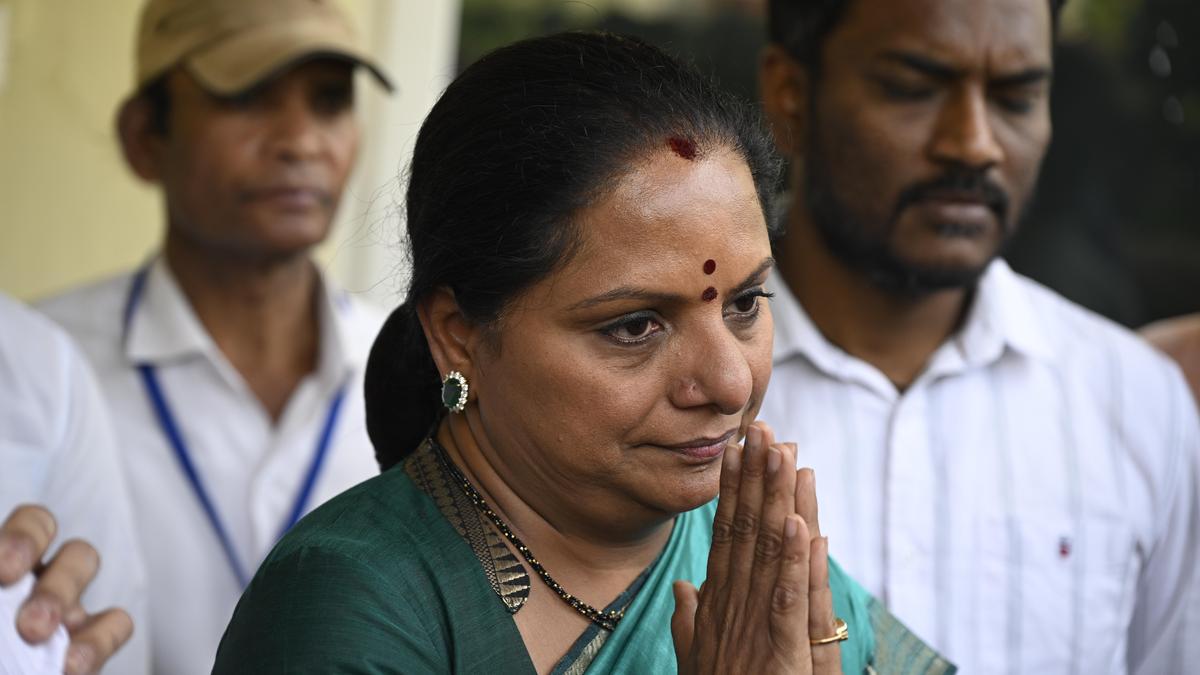
BRS's criticism of KCR’s questioning reflects a feudal mindset, says Kavitha
The Hindu
Kavitha criticizes BRS's feudal mindset, urging cooperation with investigations and advocating for transparent political accountability in Telangana.
Telangana Jagruti founder K. Kavitha argued in favour of leaders appearing before the Special Investigation Team (SIT) in the phone tapping case, and said phone tapping occurred during Mr. K. Chandrashekhar Rao’s tenure and that anyone summoned for inquiry must cooperate.
“No one is above the law. I myself have faced ED and CBI inquiries despite doing no wrong,” she said adding that she was willing to cooperate with the SIT if it plans to question her as she too was a sufferer. She wanted a transparent investigation but expressed scepticism over whether it would be taken to its logical conclusion.
However, she criticised BRS working president KT Rama Rao’s argument that KCR should not even be summoned for inquiry, calling it a “feudal mindset”. She also targeted BRS MLA Harish Rao, alleging that he had colluded with the Congress government to defame KCR.
Ms. Kavitha also criticised remarks attributed to KTR, alleging that voters were being asked to vote based solely on KCR’s image, irrespective of whether the candidate was good or bad. “Asking people to vote blindly based on a label reflects feudal and authoritarian thinking,” she said, urging voters to elect candidates who stand by people in times of need rather than those who seek money or exploit caste, religion or relationships.
She also alleged that the Congress government had entered into “match-fixing” with the BJP and accused it of deliberately dragging the phone-tapping case for political gains, particularly ahead of municipal elections. “If the Congress had genuine intent, why has the case not progressed in the last two years?” she asked.


People who distribute food to poor and needy in Hyderabad are concerned of potential LPG cylinder shortages, risking meal preparations for the poor and needy they serve daily.

Vishu Mahajan assumes office as Thoothukudi Collector

Rangayana's 'Chinnara Mela' summer camp for children runs from April 14 to May 10, 2026, in Mysuru.

West Bengal is gearing up for assembly elections. Mamata Banerjee will face her toughest challenge, given the anti-incumbency factor of three terms. The BJP, in 2021, had cemented its position as the primary opposition, winning 77 seats to the Trinamool’s 215 seats. This time, unusually, but no longer surprisingly, the Election Commission has become a key character in the political narrative. The Special Intensive Revision (SIR) ended up deleting more than 60 lakh voters. And in many constituencies, the number of voter deletions is greater than the margins of victory in previous elections. Another issue is the mass transfers in the state bureaucracy, which are unprecedented, and were challenged in court by the TMC. Mamata has used these developments to frame the polls as a fight between a besieged Bengal and Bengali ‘asmita’ on one side, and a BJP-led Centre on the other. The BJP has been playing the anti-migrant card to polarise voters, and has also sought to target the TMC on corruption and misgovernance. Whose narrative will gain the upper-hand? What is happening with the lakhs of voter deletions? How will the SIR impact the outcome?

India quietly commissions the INS Aridhaman, its third nuclear-powered submarine, enhancing its strategic defense capabilities.

Karnataka governor asks State to “re-examine” switch from marks to grades for third language in SSLC
Karnataka Governor urges re-evaluation of the state's move from marks to grades for SSLC third language, citing educational concerns.

Mumbai will soon host electric boats for a luxury commute to Alibaug, revolutionising travel with silent, eco-friendly rides.

Trial one-way traffic around KBR Park in Hyderabad on Sunday; no U-turns, follow diversions for smoother movement.

Israel under fire as Trump warns of destroying Iranian infrastructure; BJP, Congress release candidate lists for T.N. Assembly polls, and more in The Hindu’s top news of April 3, 2026.

YouTuber Salman Khan attempts self-harm live, alleging harassment by Bidar police officials over his journalistic work.

Conservationists urge documentation of freshwater fish species in Tamil Nadu's waterbodies, highlighting the importance of native species preservation.

Revival of Amaravathi sugar mill and drinking water shortages are critical issues in Madathukulam constituency, impacting farmers and residents.

Yadgir DC issues show cause notices to two LPG agencies for selling cylinders above government prices and violating distribution rules.