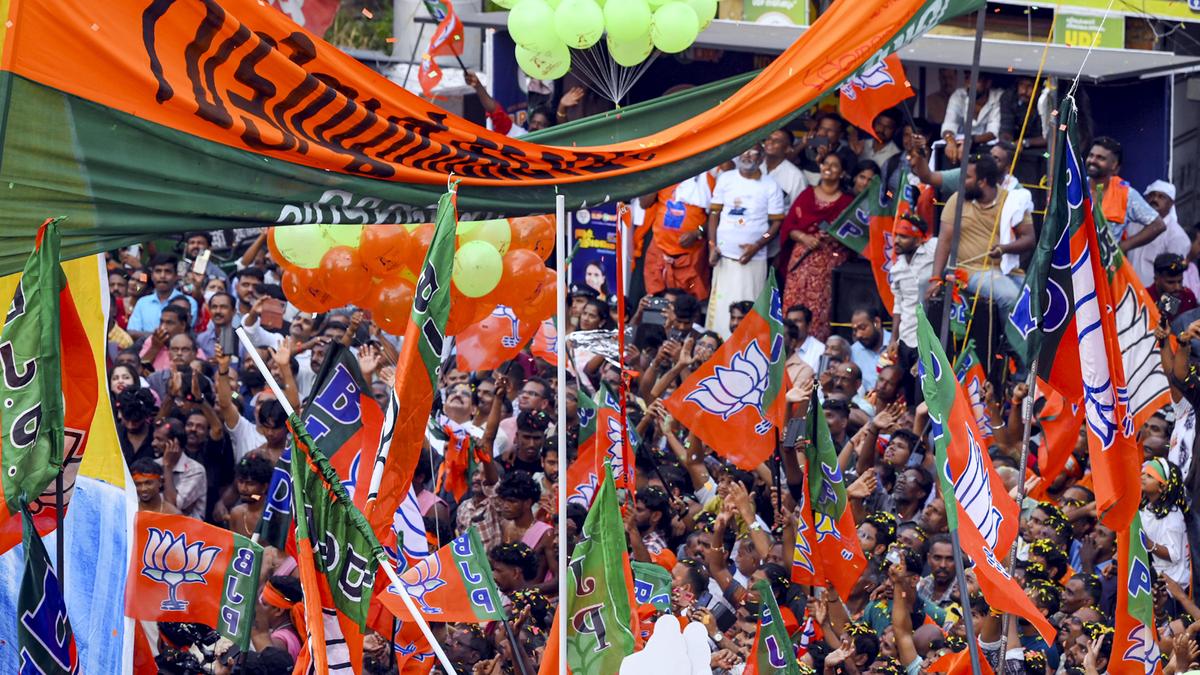
BJP, the known unknown in Kerala 2026
The Hindu
Explore the BJP's evolving role in Kerala's 2026 elections as traditional parties redefine their strategies amid shifting voter dynamics.
The BJP’s emergence has turned around Kerala’s political balance, as indicated in the following two facts:
First, traditional regional rivals, the Congress-led UDF and the CPI-M-led LDF are defining their contest with reference to the BJP. Both accuse each other of being weak in fighting the BJP or even colluding with it. The BJP, meanwhile, says the UDF and the LDF are in a fake fight in Kerala while they are partners everywhere else across the country.
Second, all three formations— the UDF, the LDF and the BJP — agree on a key question that roiled the State’s politics over the last eight years, stirring a Hindu consciousness: the entry of women of menstruating age into the Sabarimala shrine. All three now agree that they should not be entering. As the Supreme Court took up a batch of petitions that will revisit its earlier Sabarimala verdict that allowed the entry of women of menstruating age, Kerala’s LDF government and the BJP government at the Centre took similar views, favouring a continuation of the practice. The LDF has abandoned its strident position in favour of women’s entry, in response to the strong backlash among Hindu communities.
The emergence of an identifiable Hindu vote is unmistakable in the State, but how that will influence the electoral dynamics remains an open question. The performance of the BJP in recent elections provides context. Its vote share fell from 16% in the 2016 Assembly elections to 11.5% in the 2021 Assembly elections, before recovering to 16.7% in the 2024 Lok Sabha elections. It won its first Assembly seat in 2016, when O. Rajagopal won from Nemom, but lost it in 2021. In the 2024 Lok Sabha elections, the BJP won the Thrissur seat and came second in Thiruvananthapuram and Attingal, while also finishing second in Assembly segments across Alappuzha.
The communal composition of the State is the biggest speed-breaker for the BJP. According to the 2011 Census, Kerala has 54.7% Hindus, 26.6% Muslims and 18.4% Christians, who are split across multiple denominations. The BJP is banking on an apparent tension between Christians and Muslims to make its way in the State. The party has fielded several leaders from the community. Campaigning for Anoop Antony Joseph, the BJP candidate in Thiruvalla — a region of Syrian Christian influence — Prime Minister Narendra Modi said the Hindus and Christians were victims of communal fanaticism, asking them to unite. “In the Northeast, with a significant Christian population, the NDA has formed governments in six states. We have delivered on work that was pending for decades. In Goa too, with a sizeable Christian community, we continue to serve and drive development,” Mr. Modi said.
The UDF’s chances are dependent on its success in avoiding a split between its Christian and Muslim supporters, while stopping an erosion of its Hindu voters. Christians are sceptical of the influence of the Indian Union Muslim League (IUML) within the UDF. There are demographic and economic reasons for the tensions. The birth rates among Christians and Hindus are lower compared to those of Muslims in the State. While a large number of Christian and Hindu youths are migrating permanently to the West, the migration of Muslims is temporary. Christian community leaders lament property alienation and the expanding presence of Muslims in local businesses in traditional strongholds. Sensing the danger of a Christian-Muslim split, the IUML has said it would not be looking for the post of deputy chief minister or making any specific claims over portfolios or ministerial berths. IUML leaders also met with Church leaders in recent years to ease the tensions between the communities.


Solve The Hindu Sunday Crossword No. 51 with intriguing clues across and down for puzzle enthusiasts.

Congress criticizes the Modi government for withdrawing India's bid to host COP33, questioning its commitment to climate goals.

Karnataka Minister Eshwar Khandre proposes sterilisation of select wildlife species, advocating for public debate on this controversial measure.

Philippines establishes a new coast guard command on Thitu Island to enhance security in the disputed South China Sea.

Shorts News:Visited Maa Kamakhya, prayed for development of Assam’s people: Assam CM Himanta Biswa Sarma

Voting is underway in Karnataka's bypolls for Bagalkot and Davanagere South, following the deaths of senior Congress MLAs.

Telangana Health Minister says the State supports 1.14 lakh HIV patients with free care through extensive testing and ART centres

Morning yoga enhances sleep quality and well-being more than evening sessions, according to a randomised controlled trial conducted by researchers of NIMHANS-Bengaluru, Swami Vivekananda Yoga Anusandhana Samsthana (SVYASA), and Central University of Rajasthan.

Filmmaker and photographer Rohit Varma on Some Like it Wild, a podcast focusing on stories of India’s wildlife champions

Delhi L-G emphasizes urgent rejuvenation of Yamuna and pollution control as top priorities during ghat inspections with the Chief Minister.

Former Maoist leader Devuji returns to his native Telangana after 44 years underground, receiving a warm hometown welcome.

IISER Tirupati will hold the Indian Symposium on Advancements in Chemical Science from May 9 to 10. Registration is open until April 20 .

Belagavi traders request permission for retail petrol sales in cans to support power generation amid frequent outages.