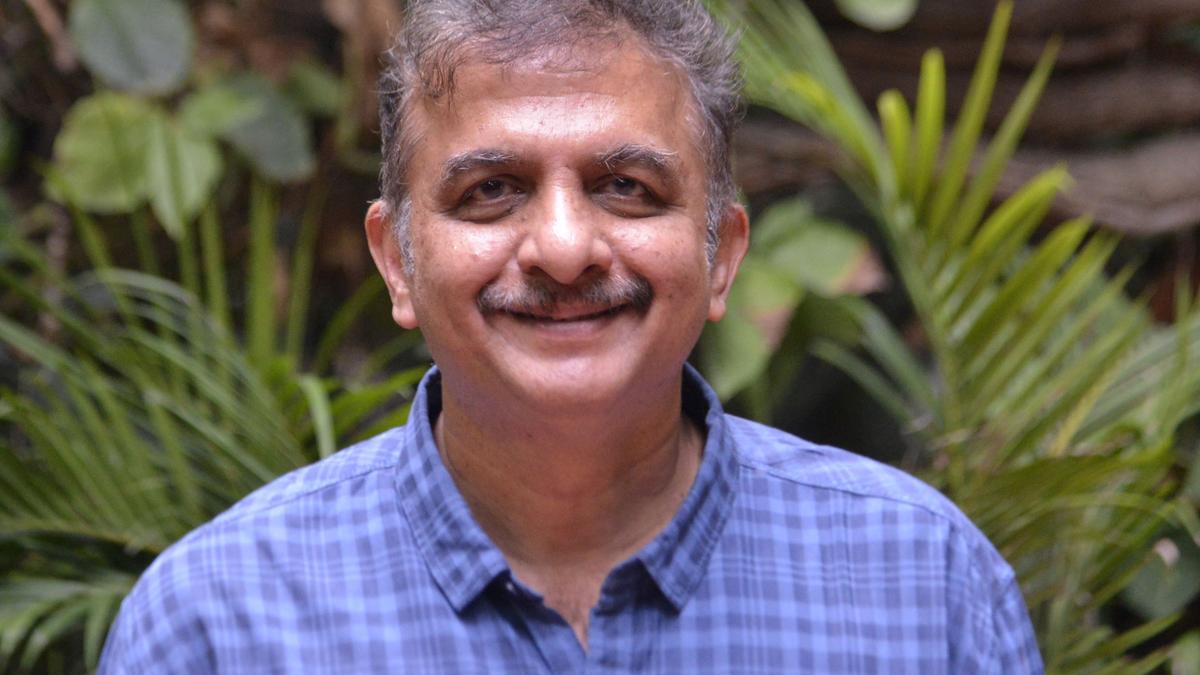
Between a temple town and a metropolis: The inner journeys of Jayant Kaikini Premium
The Hindu
The reason for this haste? A film written and directed by P. Lankesh, one of his literary heroes, had just been released, and Kaikini scurried from the campus to watch it that afternoon. “For that afternoon show, he was supposed to be at the theatre, so I wanted to go and meet him after the show,” recalls the award-winning writer at a lecture series called Paraspar, an initiative of IISc’s Office of Communications. “I literally ran to it,” he says, with a smile.
Back in 1976, Jayant Kaikini did not get the research assistant’s job he had applied for at the Indian Institute of Science (IISc).
The Kannada writer and lyricist began his recent talk at the same institute, titled My Literary Journey, with the story of how he missed the job. He filled in the application and took the written test needed to get the job, but in a hurry.
The reason for this haste? A film written and directed by P. Lankesh, one of his literary heroes, had just been released, and Kaikini scurried from the campus to watch it that afternoon. “For that afternoon show, he was supposed to be at the theatre, so I wanted to go and meet him after the show,” recalls the award-winning writer at a lecture series called Paraspar, an initiative of IISc’s Office of Communications. “I literally ran to it,” he says, with a smile.
Unfortunately, the meeting with Lankesh appears to have left him disappointed. “My idol, my hero, had already published some of my poems in his magazine, at that time, and I thought he would talk to me about my poems,” recalls Kaikini. Instead, Lankesh asked him about the film, specifically a scene that involved one of the characters running. “It was like a hotelier asking me if the chutney was good. He was the director of a brilliant film, which later won the national award, and he asked me if I liked the scene,” he says, wryly.
Kaikini’s deeply engaging storytelling skills were on full display through this talk, as he recounted anecdotes and observations drawn from his own life. The talk, he says, is a reflection “of things that have enriched my sensibilities in my life… whatever has pushed, moved, stayed with me.”
Kaikini was born in the temple town of Gokarna, as “a premature baby in a hurry to come to this planet. I was always restless,” he says. He describes his father, Gourish Kaikini, as “an atheist and radical humanist, who wrote about everything and everybody,” adding that while his father could have used his writing skills to become a great novelist or poet, he, instead, used it to open the minds of people. “My house was a hub of students, art lovers, poets,” he says. “So I grew up in that kind of environment.” His mother, on the other hand, was a fighter who had to run a household on her husband’s meagre salary. “She did everything to run a small home… take a lottery agency, do LIC agency,” he says, describing her as “very dominant, which was good.”
As a child, he did not like writers, because they would come home and just keep talking. “I thought writers were useless because they only talk. So, I never thought I would write at all,” confesses Kaikini, now a distinguished writer who has published seven short story anthologies, six poetry compilations, four essay collections, three plays and written countless superhit songs for Kannada films.


The government plans to amend the FCRA, introducing new regulations for NGO asset management and accountability for key functionaries.

The draft policy for “Responsible Digital Use Among Students”, released on Monday by the Department of Health and Family Welfare, has recommended that parents set structured routines with clear screen-time rules and prioritise privacy, safety, and open conversation with children on digital well-being.

Police Observer Sushant Kumar Saxena conducts surprise inspection at Shencottai police station, reviewing warrants and security arrangements ahead of elections.

Andhra Pradesh government to launch key projects in April, focusing on industrial growth and infrastructure development, says Nara Lokesh.

Lok Sabha refers the Corporate Laws (Amendment) Bill to a JPC amid opposition concerns over CSR provisions dilution.

SHG members in Kanniyakumari use snakes and ladders to raise election awareness and boost voter turnout.

Government accelerates consultations for early implementation of the Women’s Reservation Act to ensure women’s representation in 2029 elections.

CM A. Revanth Reddy distributes ₹1 crore insurance cheques to families of deceased Electricity department employees, enhancing financial security for workers.

The Bengaluru Traffic Police (BTP) registered 634 cases of drunk driving during a week-long special enforcement drive conducted across the city between March 16 and March 22.

GHMC intensifies action against property tax defaulters, seizing properties and offering a One Time Settlement scheme for payments.

CCB arrests three drug peddlers in Mangaluru, seizing ₹2.5 lakh worth of MDMA and other valuables.

TVK's 28 candidates in Puducherry include former BJP MLAs, a sitting Independent, and a retired police IG.

BRS submits notice on private member bill to Speaker