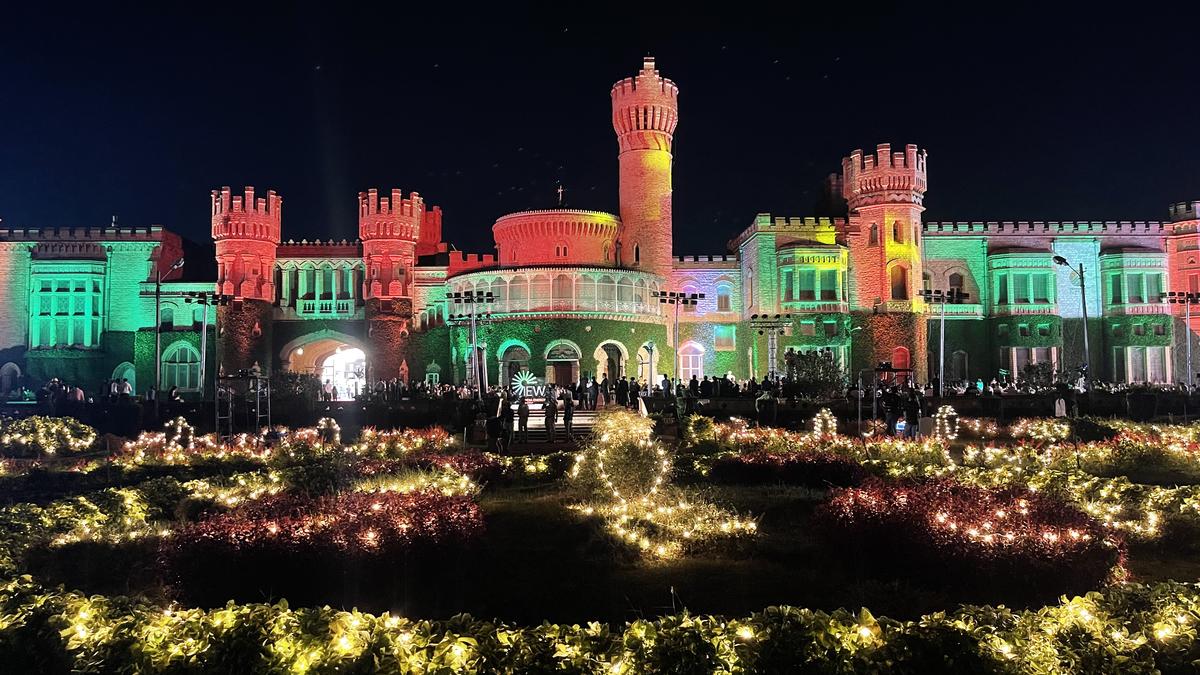
Bangalore Palace Grounds case: Karnataka moves SC questioning May 22 order to hand over TDR certificates
The Hindu
Advocate T. Harish Kumar, who appeared for the legal heirs of the erstwhile royal family of Mysuru, said the application was infructuous. The TDR certificates had already been handed over on May 23. He said the case had gone through three separate rounds of litigation.
The Supreme Court on May 26 agreed to hear on May 27 an application filed by the State of Karnataka questioning a direction to release Transferable Development Rights (TDR) certificates worth over ₹3,000 crore for 15 acres and 17.5 guntas of Bangalore Palace ground, acquired for widening the Ballari and Jayamahal roads, to the legal heirs of the erstwhile Mysuru royal family.
The direction was passed in an order pronounced by the apex court on May 22.
Though Chief Justice of India B.R. Gavai agreed to list the case on May 27, the top judge asked senior advocate Kapil Sibal, appearing for the State, how a direction in a judgment of a Coordinate Bench of the apex court could be appealed this way.
Mr. Sibal, who made an oral mentioning, said the application was not an appeal. “How can TDR for ₹3,011.66 crore be given for just 15 acres of land when appeals challenging the acquisition of the larger extent of land measuring 472 acres under the Bangalore Palace (Acquisition and Transfer) Act, 1996 are still pending here? Many of the points raised by us did not even come up [in the May 22 order],” Mr. Sibal submitted.
Advocate T. Harish Kumar, who appeared for the legal heirs of the erstwhile royals, said the application was infructuous. The TDR certificates had already been handed over on May 23. He said the case had gone through three separate rounds of litigation.
“The State has been directed to part with nearly ₹3,011.66 crore of valuable TDR for land (purported use of 15 acres 17.5 guntas) it does not seek to, or has ever utilised (except for 1,271 sq. m.). The Bangalore Palace (Acquisition and Transfer) Act, 1996 fixes an amount of ₹11 crore as compensation for an extent of 472 acres. The BPAT Act 1996 has been upheld by the High Court of Karnataka,” the State’s application, prepared by senior advocate V.N. Raghupathy, states.
Mr. Sibal argued that while the appeals against the BPAT Act were pending, the Supreme Court had set aside the 1996 law in ‘parallel proceedings’, and by applying a procedure for payment of compensation under Section 14B of the Karnataka Town and Country Planning Act, 1961.


Palla urges NDA leaders to unite for grassroots outreach, enhancing public trust through balanced welfare and development initiatives.

Horses shone at Auroville's 2026 event, showcasing equestrian talent through dressage, derby, and show jumping competitions.

Telangana Governor Shiv Pratap Shukla attends Bihar Foundation Day celebrations in Hyderabad, honoring Bihar's historical and cultural contributions.

Samsung workers protest for the reinstatement of 27 suspended employees, citing unfulfilled promises from the Labour Minister.

The Vice-Chancellor of Rajiv Gandhi University of Health Sciences (RGUHS) B. C. Bhagavan said on Sunday that the university will soon open a research centre on Yoga and Naturopathy on 60-acre land in Bengaluru.

UT Matters: Construction of Uppar drain road overbridge in Puducherry to be completed in four months, amid traffic regulations.

Union Minister Dharmendra Pradhan highlights Bharat Innovates' aim to elevate Indian deep-tech startups to the global stage.

In an exclusive interview, DMK MLA Ezhilan discusses Tamil Nadu's 2026 elections, party structure, and local governance challenges.

Minister Satish Jarkiholi asserts confidence in retaining Davangere and Bagalkot seats in upcoming bypolls amid addressing internal discontent.

Sunil Ambekar of RSS emphasizes national unity, defending road prayer restrictions and promoting awareness of shared ancestry in India.

Opposition MPs and activists voice strong concerns against proposed amendments to the Transgender Persons Act at a Delhi hearing.

Four Assam police commandos injured in an extremist attack during a gunfight in Tinsukia district, officials report.

Campaigning intensifies in Ernakulam district as candidates engage voters ahead of the crucial Assembly polls.