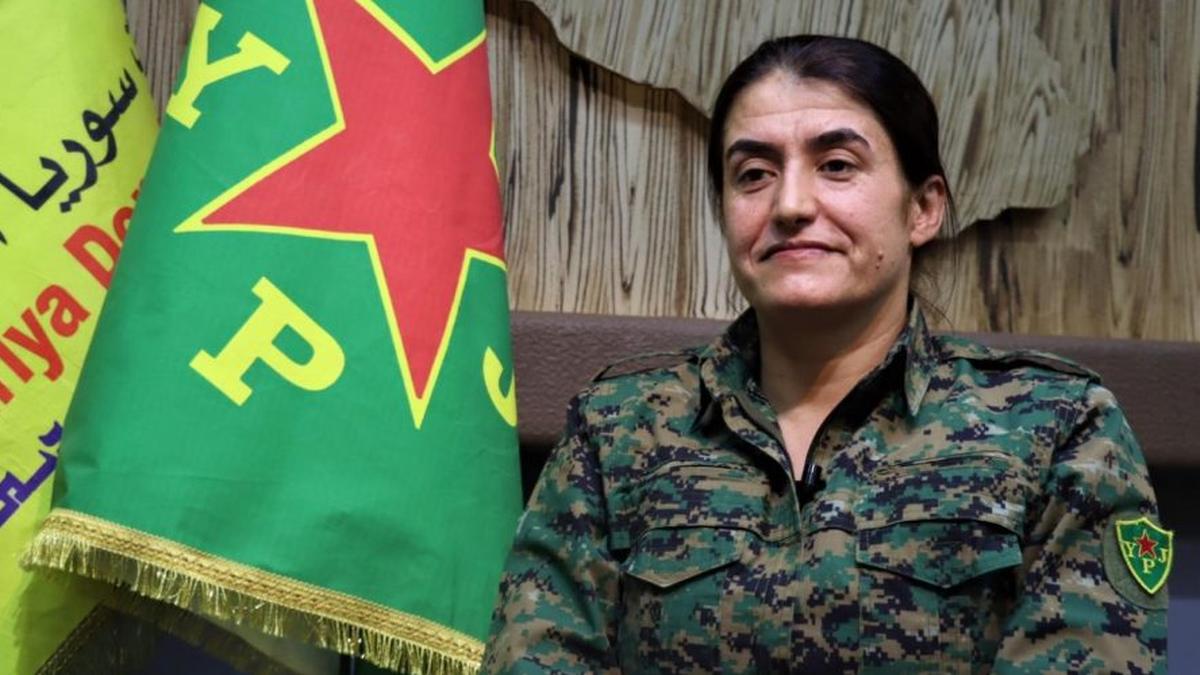
As violence and instability spread in Syria, ISIS is reorganising and regaining strength: Rohilat AfrinPremium
The Hindu
Rohilat Afrin discusses Syria's escalating violence, ISIS resurgence, and the future of Kurdish autonomy amid ongoing conflicts.
When the interim government took power in Syria after the collapse of the regime of President Bashar al-Assad fell in December 2024, many hoped it would bring an end to bloodshed and open a new path towards reconstruction and democratic reforms. But the mistakes made by the new rulers of Syria have considerably increased the violence and instability in all parts of the country, says Rohilat Afrin, the Commander-in-Chief of the Women’s Defence Units (YPJ), a Kurdish armed group, and member of the Syrian Democratic Forces (SDF) General Command. The YPJ and the YPG (People’s Protection Units) are the main constituents of the SDF, which, with support from the U.S., played a pivotal role in the battle against the Islamic State (IS) in Syria from 2014 onwards. In recent months, fighting broke out between the Syrian government troops and the SDF, which led to a fragile ceasefire on January 10. In this written interview with The Hindu, Ms. Afrin talks about the fighting in North and East Syria, prospects for peace and stability in the country and the future of Kurdish autonomy. Edited excerpts:
Can you describe the current dynamics of the clashes between Kurdish forces and Syrian government troops, and what are the primary causes of this escalation?
On January 6, the territories administered by the Democratic Autonomous Administration of North and East Syria (DAANES) and defended by the Syrian Democratic Forces (SDF) came under heavy attacks. These attacks were carried out not just by forces controlled by the Syrian Interim Government (SIG). Brigades which are directly controlled by Turkey, foreign fighters of the Hayat Tahrir al-Sham (HTS) and Islamic State (IS) fighters were also part of these attacks. As the SDF and Women’s Defence Units (YPJ), we decided to pull our forces out of areas such as Tabqa, Raqqa and Deir ez-Zor in order to avoid destruction and bloodshed among the local population. The SDF, YPJ and People’s Defence Forces (YPG) defended the Kurdish-majority areas in North and East Syria with great resolve.
The city of Kobane and its surrounding areas were under a total blockade and daily attacks for several weeks. More to the East, the cities Hasakak, Qamishli and Derik remained under the protection of our forces. We remain absolutely determined to protect our people living in the Kurdish-majority areas. This is our red line. Despite several ceasefires, the above-mentioned forces carried out daily attacks. They were supported by Turkish drones which carried out reconnaissance flights and air strikes. The talks about an implementation of the March 10 memorandum-of-understanding had reached a point where both sides were close to signing a deal on January 4. Then there was intervention from outside forces and the talks broke down. Shortly after, the Syrian interim government alongside the other forces started to attack.
On January 30, a comprehensive ceasefire and timeline for the political and military integration of the DAANES with the institutions of the Syrian state was agreed upon. This includes, among many other points, the establishment of 4 brigades of the SDF in North and East Syria – including the YPJ – as part of the Syrian army, the appointment of the governor of Hasakah by the SDF and the merging of DAANES institutions with state institutions while securing the positions of civil personnel working in these institutions. This gives the peoples of Syria the chance to finally build a democratic, inclusive and peaceful country. The next month will be crucial for the first steps towards a complete integration. What will be absolutely essential for the future of our country is the drafting of a new, democratic constitution.
Does this renewed fighting put the Autonomous Administration model in North and East Syria at risk?


Mamata Banerjee confronts Delhi police, alleging threats to SIR-affected families, condemning heavy security and calling for justice.

Mamata Banerjee meets CEC in Delhi with SIR-affected families to address electoral roll issues and concerns over police presence.

A round-up of events and happenings in colleges in Cauvery delta districts of Pudukottai, Perambalur, Nagapattinam and Karaikal

Lok Bhavan criticises Tamil Nadu's Vice-Chancellor search committees for violating judicial orders and lacking UGC nominee representation.

A round-up events and programmes in colleges in Tiruchi and surrounding region.

Bhumi Pednekar along with writer-creator Suresh Triveni, open up about making their show ‘Daldal’, how Suresh worked on adapting it from a novel, Bhumi’s reading habits and more

Do Culture empowers women in Kochi by providing a supportive space for beginners to explore sports and outdoor activities.

Three members of a family die from severe burns following a kitchen fire caused by a gas stove leak, at Kanakapura near Bengaluru.

Two tigers found dead in Madhya Pradesh's Shahdol district, one from a fight and the other from electrocution.

Karnataka's School Education Department files a complaint over circulation of fake SSLC question papers on Instagram, misleading students during exams.

E. Sreedharan launches an office for a high-speed rail project in Kerala, amidst skepticism from the state government.

Exterro Strengthens Customer Data Protections and Trust with Achievement of ISO 27001 Certification

Property crimes in Nilgiris decreased by 17% in 2025, with high detection rates and successful policing initiatives, say authorities.