Amaranth, brick, coral, and 48 other shades of red
The Hindu
Explore a mass wedding in Delhi, highlighting financial relief, traditional expectations, and the empowerment of marginalized communities.
Rukmini, 19, turns away from the vanity mirror after her makeup and hair has been completed by professionals, to face her mother. “Dulhan nahi, baby doll lag rahi hu na? (I look like a doll, not a bride, right?),” she says. Her mother laughs.
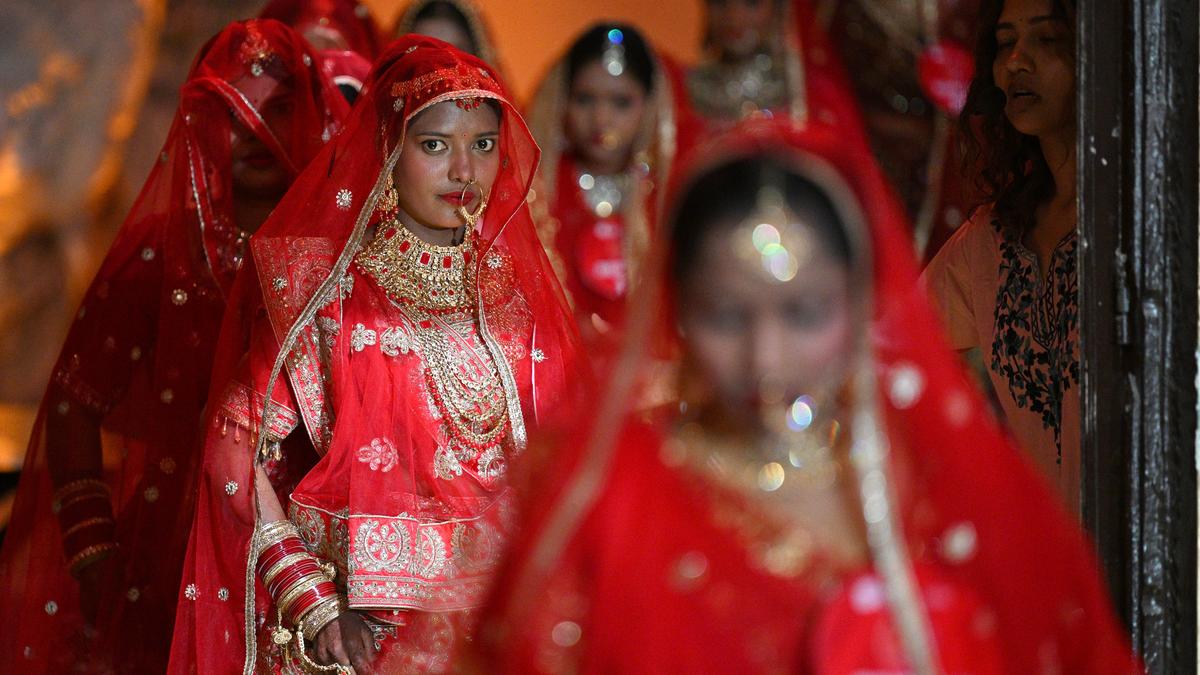
Rukmini is one of 51 brides in a room saturated with tints and shades of red. The brides take their turns to sit in front of mirrors. They pin their lehengas securely, slip on their bangles, and reapply lipstick. One end of the hall in Zora Convention Centre on Delhi’s Lodhi Road is lined with vanity mirrors, and on the other end, the grooms line up to walk towards the main ceremony hall.
Abhishek, 22, is among the grooms walking to the stage, where Rukmini will soon join him. As the evening progresses, the brides and grooms find each other from the numbers pinned onto their outfits. On stage, beneath the flashy lights, the 51 brides and grooms simultaneously exchange garlands and the rituals ensue, with one pandit assigned to each couple. On the loudspeaker, Sanskrit religious chants play on, while smoke is pumped out of a fog machine, and firework go off in the background.
Once the pheras are done, signifying that the couples are now married, Delhi Chief Minister Rekha Gupta takes the stage to remind families: “This is not just a wedding ceremony, but a powerful step towards ensuring dignity, empowerment, and a brighter future for our daughters.” Former President Ram Nath Kovind reiterates Gupta’s comments and congratulates the couples.
Brides and grooms take part in a mass wedding organised by Ladli Foundation in partnership with Avdheshanand G Mission at The Zora Convention Centre in New Delhi on March 30, 2026. | Photo Credit: Shashi Shekhar Kashyap
Beneath the laughs and the smiles, each family has chosen to marry in a sammelan or mass wedding for a plethora of reasons. Almost all are tied to financial troubles at home, and the relief of not having to spend lakhs of rupees on a wedding and dowry. Rukmini’s mother, Godavari, who works as a domestic worker, says that her employer, who is associated with the foundation organising the mass wedding, told her about it.


Illegal billing and manipulated receipts are widespread in MCD parking lots across Delhi, with users overcharged significantly.

Thunderstorm alert issued for 18 Telangana districts on April 6, with rain and gusty winds expected in Hyderabad.

Pakistan's Defence Minister Khawaja Asif warns India of a decisive response in Kolkata to any future false flag operations.

Madurai readers highlight urgent bridge safety issues and call for accountability in political promises to enhance public trust.

Incomplete stretches of NH 75 challenge drivers as NHAI misses promises for a fully operational four-lane highway by Monsoon 2025.

CIC criticises IRCTC for denying RTI data on bidders' disclosures related to the Rail Neer scam and CBI investigations.

Kozhikode police seize 3 kg of MDMA, arresting key suspect; investigation reveals more potential drug pushers under scrutiny.

BJP celebrates victory in Khanapur chairperson election, criticizing Congress tactics and claiming a response to their alleged alliance with MIM.

Delhi Police dismantles interstate spurious medicine racket, seizing counterfeit drugs worth ₹2 crore and uncovering a fake GST network.

AAP's foot march in Hathras highlights unemployment and divisive politics, criticizing the Centre's neglect of core social issues.

Premalatha accuses Palaniswami of breaking a promise regarding a Rajya Sabha seat for DMDK in the 2024 elections.

LSG wins the toss and opts to have SRH bat first in IPL 2026 match at Rajiv Gandhi International Stadium, Hyderabad.

SPMVV Vice-Chancellor V. Uma launches "A Text Book of Food Analysis," enhancing multidisciplinary education in food and pharmaceutical sciences.