Ajanta’s ancient murals decoded in a new children’s book
The Hindu
Discover Ajanta’s ancient Buddhist murals and hidden stories in Ashwin Prabhu’s engaging children’s book, Magnificent Murals.
Two years ago, author Ashwin Prabhu stepped into Ajanta’s dark caves with intension. “I have always had a sense of the fact that this was a spectacular site and held a lot of value. I walked in knowing that I was going to write a book,” he says.
The 30 caves are located somewhere in the middle of nowhere, a few hours away from Aurangabad in Maharashtra’s Sahyadri Hills. His aim was to observe, imbibe, photograph, and note down every detail of Buddhist murals inside the caves. These were recorded in history books in 1819 by a British officer named John Smith while he was hunting for tigers.
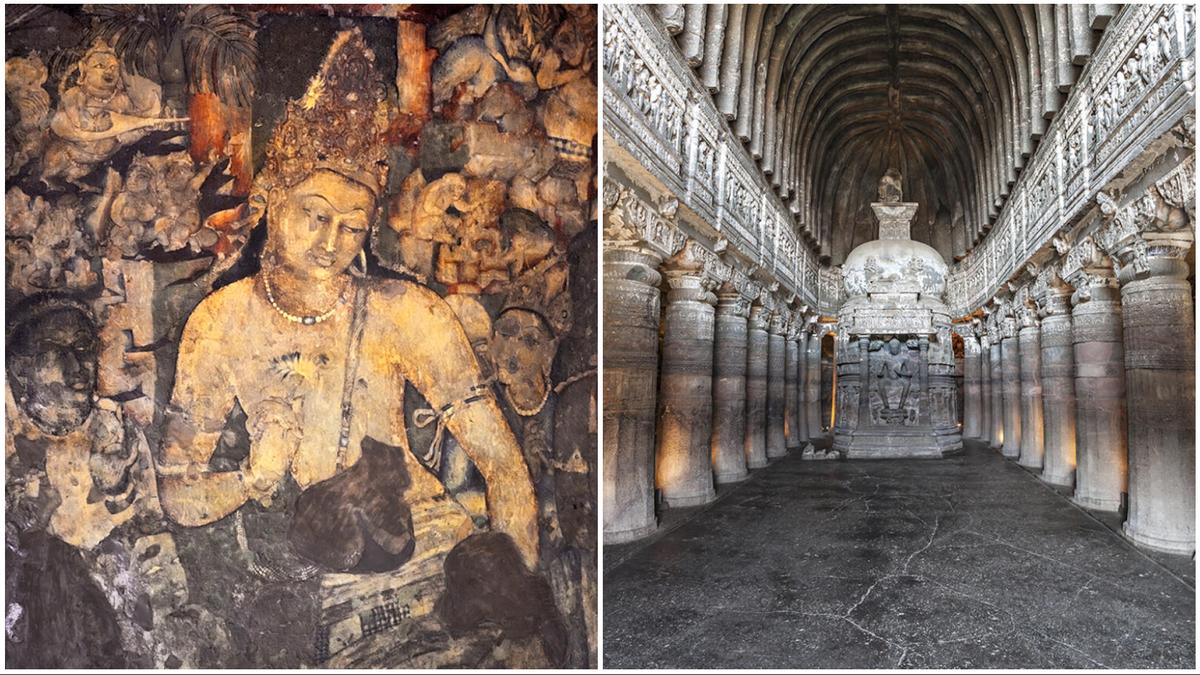
At Ajanta, a Buddhist monument home to perfectly chiseled viharas, well-constructed stupas, and ornate paintings, dating back almost 2,200 years, one requires a keen eye to take in all the details.
The caves are a repository of some of India’s finest ancient art, and home to monasteries, worship-halls and intricate sculptures. Through gestures, colours, and poses alone, one sees a non-linear story, painted by anonymous artists, come alive in darkness. An innate sense of wonder about these rock-cut caves comes alive in Ashwin’s latest, Magnificent Murals – Buddhist Art of Ajanta (published by Tulika Books). Although a children’s book, this text, written concisely without condescension, takes time to run adults and adolescents alike, through what one might find on a visit to this historical site today. More importantly, it makes one want to plan a trip there, to experience the remnants of the caves in all their glory.
Author Ashwin Prabhu | Photo Credit: Special Arrangement
Did you know that the first four major attempts to record and reproduce the murals at the cave, including that of Buddha’s life story, his enlightenment, and the fabled Jataka tales, all fell victim to various fires? One has no choice but to believe that forces, and perhaps a curse was at play. “It was a chance discovery. When something is set so far back in time, we tend to gloss over why some incidents happened. The chroniclers just said that they had gotten destroyed without getting into the details. Piecing it together meant making connections about the disasters,” he says.


Explore the 2021 West Bengal elections' outcomes and the evolving political landscape ahead of the crucial 2026 assembly elections.

T.O. Mohanan is likely the UDF candidate from Kannur after K. Sudhakaran’s exclusion in Kerala Assembly polls 2026.

Kerala CM Pinarayi Vijayan to file nomination from Dharmadam, seeking third term amid tough competition in 2026 polls.

World Happiness Report 2026 reveals heavy social media use lowers youth wellbeing, especially among girls in English-speaking countries.

Barcelona scores 7 against Newcastle, Liverpool and Bayern advance, setting up Champions League quarterfinal clashes with Real Madrid and PSG.

Explore India's frog conservation efforts through citizen science and sanctuaries, highlighting their critical ecological role on World Frog Day.

Assembly polls 2026: Follow updates from The Hindu on the upcoming elections in five States, on March 19, 2026

Forest, Ecology and Environment Minister Eshwar Khandre on Wednesday instructed forest department officials to ensure maintenance of elephant trenches and hanging solar fences, which have been installed in Kodagu district to control human-elephant conflict.

Indian wolf Geetha at Pilikula zoo gives birth to seven healthy pups, marking a first in captivity at the park.

Passengers on an Air India Express flight from Dehradun to Bengaluru were stranded in Chennai for over two hours due to diversion.

Explore India's missed opportunity in establishing a national gas grid amid the ongoing West Asia war's impact on energy supplies.

Maharashtra government plans to ban plastic flowers to protect local floriculture farmers and support sustainable practices.

Join Alva’s Samskrutika Vaibhava on March 21 in Mangaluru for a vibrant cultural showcase featuring over 500 student-artists.