Why is Bengaluru expanding its waste-management capacity? | Explained Premium
The Hindu
Karnataka govt. plans to relocate waste processing facilities outside Bengaluru to address capacity shortfall. Existing plants have faced opposition due to leachate and odour issues. New plants should have composting, material recovery and landfill facilities, with tertiary-level treatment for leachate. Land acquisition and land-use changes are concerns. Engaging farmers and offering free compost can reduce reliance on chemical fertilisers. Converting existing wet-waste plants to dry-waste management can reduce transportation cost. Success of new plants depends on tech, environmental, social and community factors. Waste-processing can benefit city and rural residents.
The Government of Karnataka is contemplating the relocation of waste processing facilities, operational in Bengaluru, to the outskirts of the city. Officials have been tasked with identifying land parcels, each spanning 100 acres, in various directions from the city, preferably in Bengaluru Rural and Ramanagara districts.
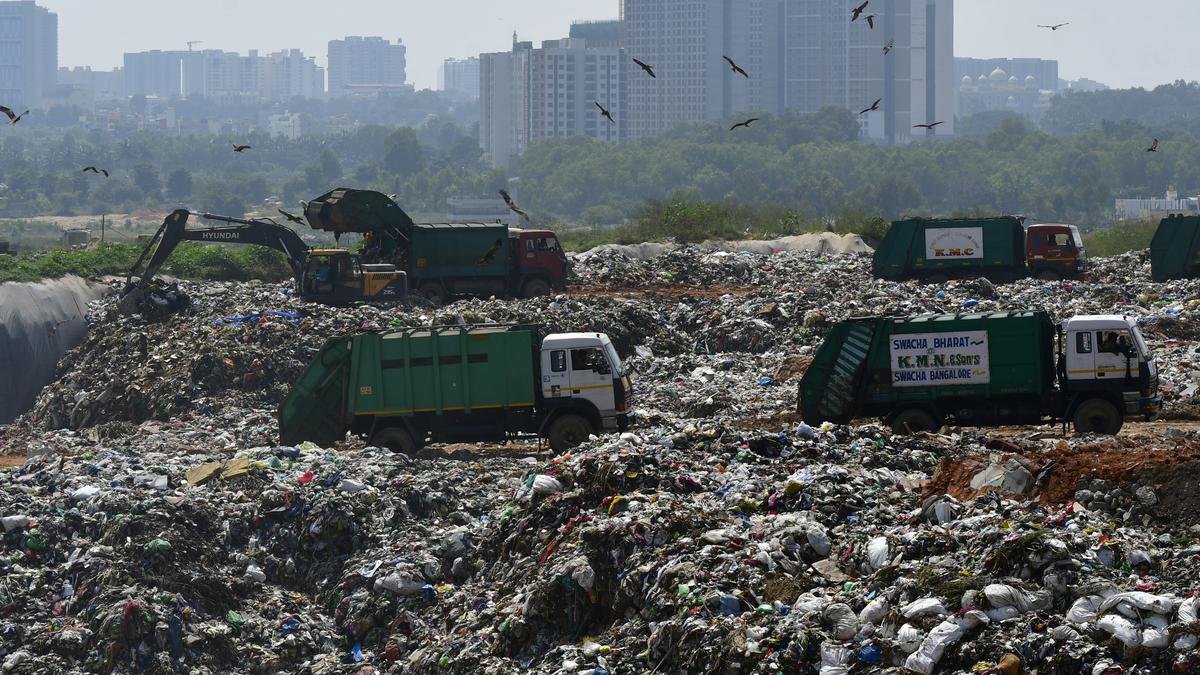
Currently, the city generates approximately 5,000 tonnes per day (TPD) of waste, which is expected to rise to around 6,000 TPD over the next four or five years. The existing waste processing capacity in Bengaluru stands at about 2,000 TPD, including small-scale decentralised ward-level waste processing facilities, leaving roughly 3,000 TPD of waste to be disposed of in landfill quarries without processing.
Due to this capacity shortfall, Bengaluru has made a commendable decision to identify locations for four additional waste-processing facilities outside the city. However, this initiative will face significant challenges, primarily from the villages surrounding the locations.
Historically, composting facilities at most waste-processing sites set up by the Bruhat Bengaluru Mahanagara Palike (BBMP), such as at Kudlu, Mavallipura, Mandur, Lingadeeranahalli, Kannahalli, and Seegehalli, have encountered strong opposition rooted largely in the inefficient operations at these plants. The plants have indeed consistently received more waste than their designed capacities and have operated at less than 50% efficiency.
This excess quantity of material in the process has resulted in leachate and odour issues, affecting the environs and livelihoods of people living nearby.
Given the issues posed by existing plants, it is crucial to make sure that the city’s waste processing capacity is increased to handle 6,000 TPD, through a combination of centralised and decentralised processing systems. This expansion should ensure that no facility receives more waste than its designed capacity. By increasing the capacity and ensuring that waste deliveries are never more than the design capacity, it should be possible to mitigate leachate and odour issues effectively.
The new waste-processing facilities should ideally have the capacity to process 1,000 TPD to ensure that all the 6,000 TPD of waste generated in the city are processed.


Dhurandhar 2 earns an 'A' certificate after 21 modifications, surpassing Rs 100 crore in pre-sales ahead of its March 19 release.

Eid food in India: A look at Bhopali, Bohra and Memon culinary traditions

Hyderabad experiences intermittent rain and IMD forecasts more thundershowers, bringing relief from rising temperatures.

Real Madrid and PSG eliminate Manchester City and Chelsea, while Bodø/Glimt's fairytale Champions League run ends against Sporting Lisbon.

Tragic fire in Palam residential building claims at least 7 lives, including 3 children; rescue operations ongoing.

Lorry owners in Andhra Pradesh reject government proposal to reduce vehicle fitness test fees by up to 50%.

Watch the thrilling trailer for 'Dune: Part Three,' showcasing epic battles and Paul Atreides' struggle with power and resistance.

TMC announces candidates for 2026 Bengal Assembly elections, contesting 291 seats; BGPM to handle three Darjeeling hill seats.

DMK finalizes a seat-sharing deal with CPI for Tamil Nadu elections, allotting five seats amid ongoing discussions with CPI(M).

Parliament Budget Session LIVE: Follow The Hindu's latest updates on the Parliament Budget Session on March 18, 2026.

Severe storms cause over 1,100 flight cancellations and 7,300 delays across the U.S., exacerbating travel chaos amid a government shutdown.

Three MBBS students tragically died in a scooter accident in Kozhikode, Kerala, early Wednesday morning.

Microsoft said on Tuesday it is reorganising its Copilot teams by unifying its commercial and consumer versions, as the tech giant rushes to improve its artificial intelligence assistant to drive better adoption.