Why does water appear white in a waterfall? Premium
The Hindu
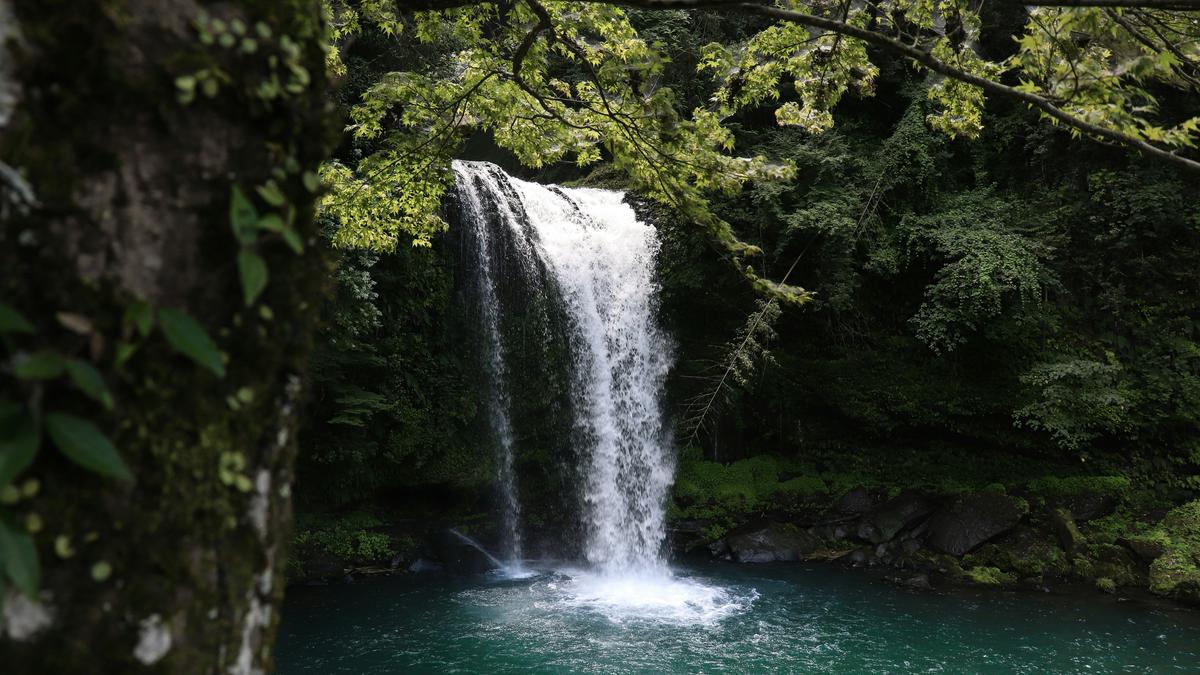
Water appears white in a waterfall due to multiple reflections and refractions of light within the water droplets.
Q: Why does water appear white in a waterfall even though it is colourless?
A: When all colours are reflected from the surface of an object, it appears white. In a waterfall, water drops can be thought of as being suspended in air and as an inhomogeneous mixture of water and air.
We know that when light enters from a lighter medium (air) into a denser medium (water), some of it is reflected by the surface and the rest is refracted. In a waterfall, light suffers numerous such reflections and refractions.
The light refracted by a layer on top would also contribute to reflection at the next layer of drops. As a result, most of the light is reflected by the waterfall. This leads to whiteness.
Mist, paper, water vapour, colloidal solutions, clouds, talcum powder, snow, white paint, and sugar also appear white because of the same reason.
(There are no white pigments in white paint. White paint has transparent oxides of zinc, lead, and titanium suspended in a transparent solution.)
To see a waterfall white, light should not be directional, i.e. it should be coming from all directions. If it is directional, one would see colours as in a rainbow.


A lorry carrying firecrackers caught fire after hitting a high-tension wire in Hyderabad, but drivers escaped unharmed.

A Q and A career counselling column for students

Senior Yakshagana artist Surikumeri K. Govinda Bhat, aged 88, has passed away, leaving behind a legacy of performance and teaching.

Meet Nivrritii Mahesh, a Bharatanatyam dancer who dances with Cochlear implants

A Lamborghini driver has been booked for performing dangerous stunts at Anil Kumble Circle, raising road safety concerns in Bengaluru.

Kunhalikutty files nomination in Malappuram, showcasing communal harmony with support from representatives of diverse communities.

NHRC mandates teams of qualified doctors for custodial death autopsies to ensure procedural integrity and objectivity in investigations.

PM Modi discusses regional stability with Iran's President, emphasizing secure shipping lanes and condemning attacks on critical infrastructure.

Tribal council chiefs and their families enter Assam's electoral scene, aiming for representation in the 2026 Assembly elections

A Russian drone strike in Zaporizhzhia kills two, complicating upcoming U.S.-Ukraine peace talks amid ongoing conflict.

Chief Minister Naidu advocates transforming TTD temples into advanced spiritual hubs for enhanced pilgrim experiences and proactive governance.

Himachal CM Sukhu presents a ₹54,928-crore budget for 2026-27, citing BJP's lack of support and raising milk procurement prices.

Three arrested in Chennai chain-snatching case; police recover ₹1.91 lakh and seize vehicle and mobile phone.