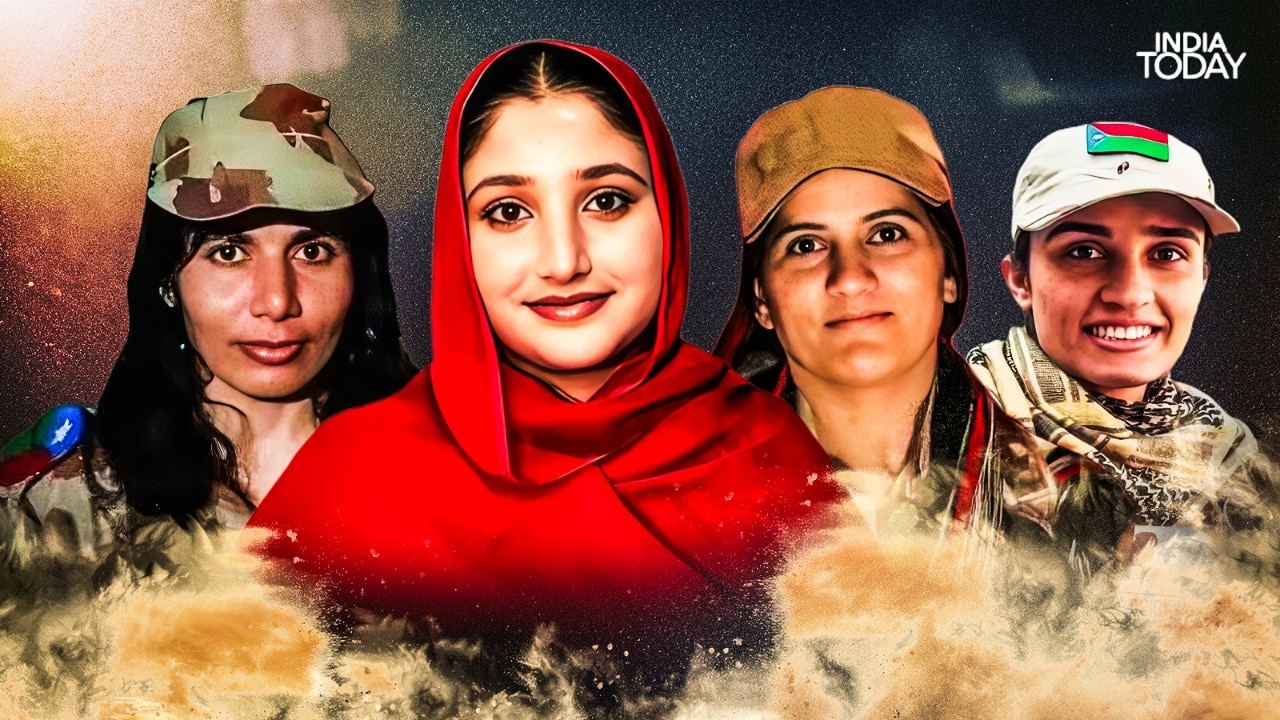
Why Baloch women are taking up arms, raining death on Pak forces
India Today
Baloch women fighters played a key role in the BLA's recent coordinated attacks across Balochistan. The involvement of women in the Baloch armed movement is part of the broader trend. After peaceful protests over enforced disappearances and exploitations failed, with men jailed or killed, the once-silent Baloch women are picking up arms, and even turning suicide bombers.
All through the night last Friday and into the weekend, Baloch rebels upped the ante against the Pakistani establishment. At least 10 security personnel were killed in coordinated attacks targeting security forces, police, and civilian infrastructure across 12 locations in Balochistan. The province's chief minister, Sarfaraz Bugti, was visibly shaken and in tears. What stood out most for many in the Balochistan Liberation Army (BLA)'s attacks was the release of images of two of the attackers. Both of them were women, screamed news headlines. That raises a larger question. Militancy and armed resistance have long been seen as a male preserve, where men dangled AK-47s and blew themselves up in suicide attacks. How then did Baloch women come to take up arms?
Why is the Baloch resistance no longer the age-old male-dominated tribal rebellion it once was? In a nutshell, the answer is the brutal repression of the Pakistani military establishment on the Baloch community. Analysts point to a mix of factors like, changing times, Pakistani mistreatment of its largest province, rage, despair, and strategic adaptation.
"It's important to look at what it means when women become part of an insurgency", according to Pakistani political scientist Ayesha Siddiqa.
It is also the story of women pushed to the brink after the forced disappearances of their men by the Pakistani military apparatus and joint economic exploitation of Balochistan by the Pakistanis and the Chinese.
After the days-long attacks that left 50 civilians and 17 security personnel dead, the BLA released images of two of its attackers. Both were women, one of them identified as 24-year-old Asifa Mengal. Pakistan's Defence Minister Khawaja Asif also acknowledged that two of the attacks involved female rebels.
Asifa Mengal joined the BLA's Majeed Brigade on her 21st birthday. According to the BLA's statement, she decided to become a fidayee in January 2024 and was the attacker who targeted the ISI headquarters in Nushki on Saturday.


Speaking at the White House, Trump said the United States was in contact with "the right people" in Iran and suggested that Tehran was eager to reach an agreement to halt hostilities. "We're in negotiations right now," he told reporters, without offering further details on the scope or format of the talks.

Casting doubt on the prospects of any immediate resolution, Jeffrey Sachs dismissed the idea of a near-term endgame.

Iran has issued a blunt warning to the US, threatening to sink US ships and paralyse the country if attacked. A senior official said any strike would trigger a "head for an eye" response, if US strikes on Iranian infrastructure.

The young aviator, Rishi, is seen confidently guiding the aircraft during a practice session at California's Oxnard Airport.

Lebanon's Ministry of Foreign Affairs said the decision was formally conveyed after Secretary-General Abdul Sattar Issa summoned Iran's chargé d'affaires in Beirut, Tawfiq Samadi Khoshkho. The ministry confirmed that Sheibani must leave Lebanese territory no later than March 29.

A US county judge, who made history as the first Indian-origin judge in Fort Bend, Texas, has been convicted of financial crimes. KP George, who traces his roots to Kerala, was found guilty of money laundering with prosecutors arguing he had misused funds intended for his election campaign.

A rare moment of peace between humans and wildlife was captured on IIT Madras campus by a research scholar and the wholesome video has over 10 million views.

The Strait of Hormuz, a narrow passage between the Persian Gulf and the Gulf of Oman, carries a significant share of the world's oil shipments, making it vital for global energy stability.


A spontaneous musical duel in Paris brought a dream to life for street pianist Emilio Piano, and it features classical pianist Lang Lang. The video has gone viral.

Despite upgraded features like seat belts, WiFi, charging ports and cushioned seating, passengers were seen misusing the facilities of an MTC bus in Chennai by putting their feet on the seats.

Operating under Pakistan's diplomatic umbrella, Iran's Interests Section in Washington remains Tehran's only official foothold in the US. It is sustaining consular services and a fragile backchannel, even as the war between the US and Iran is escalating.