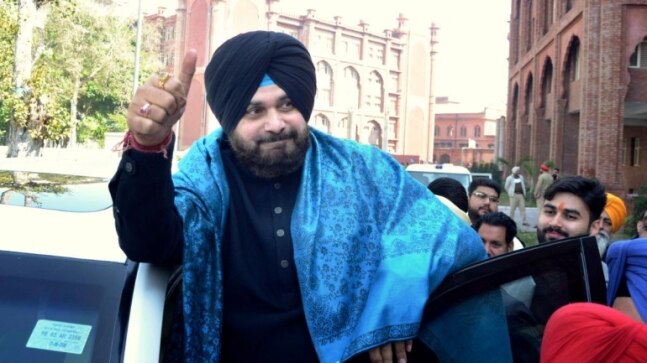
What lies ahead for Navjot Sidhu after SC awards him 1-year jail term
India Today
After the Supreme Court sentenced Sidhu to a one-year jail term in a 34-year-old road rage case, India Today explains the legal options available to the Congress politician now.
Tough days are ahead for former cricketer and Congress politician Navjot Singh Sidhu as the Supreme Court on Thursday sentenced him to one year rigorous imprisonment and a fine of Rs 1000 in a 34-year-old road rage case.
Sidhu was earlier let off with a fine of Rs 1,000. Now, the maximum possible punishment under Section 323 of the IPC has been awarded to the former Punjab Congress President as the victim’s family filed a review petition before the top court while pressing for enhancement of punishment.
Sidhu will be taken into custody by Punjab police to serve out the sentence. However, a bench of Justices A M Khanwilkar and S K Kaul rejected the plea for fastening culpable homicide not amounting murder charge under Section 304A of the IPC on Sidhu.
According to Supreme court advocate Ashwani Dubey, Sidhu can file a curative petition before the top court but he has little grounds to use this option, as there is no question of law which has been left by the court.
A curative petition is filed after a review plea against the final conviction is dismissed or exhausted. The petition has two objectives to avoid miscarriage of justice and to prevent abuse of process. This petition is usually decided by judges in the chamber, unless a specific request for an open-court hearing is allowed.
Explaining the procedure which needs to be followed by Sidhu from now on will be to surrender in the concerned court himself.
Supreme Court advocate Rajesh Chugh explained, "The order of the top court will be sent to the concerned Director-General of Police (DGP) or through the registrar general of the high court to the concerned police station for compliance and after that he will be taken to jail to complete his 364 days jail term."


Delhi Police busted an illegal LPG racket in Sangam Vihar, seizing 183 cylinders and arresting four delivery agents accused of diverting and storing supplies meant for customers.

Amazon's price history analysed by India Today over the past 90 days, shows a steady rise in household items. A similar pattern is visible in aviation: airfares have climbed following the February 28 US-Israel strikes on Iran.


US President Donald Trump dialled Prime Minister Narendra Modi on Tuesday, four weeks after the Iran war started. The timing is crucial, coming on the back of Pakistan's emergence as Trump's choice as a mediator. Was Trump's call a damage-control exercise?

The armoured regiments of the Army have inducted around six Shaurya Squadrons that add the power of drone-warfare to the tanks.

The Iranian embassy in New Delhi thanked India and Kashmir for sending humanitarian aid, then quietly deleted the posts. Could pressure and online vitriol from Pakistan-based users be to blame?

The incident is believed to have taken place between 2 am and 3 am on Sunday. The viral footage of the incident showed the luxury car executing high-speed turns and repeated drifts at the Anil Kumble Circle in Bengaluru.

Lalu Prasad Yadav's elder son, Tej Pratap, is speaking of wisdom and devotion again. He's no longer the Krishna bhakt that he was. He is now sporting saffron attire in Reels, and is propagating Shiva bhakti. His new Instagram handle is SantTejPratapYadav. After political and personal isolation, Teju bhaiya seems to have found solace in Rudraksha, Shiva bhajans and the Shiva Puran.

"At that time, we did not know that one of them was an Indian billionaire," a Maldives official said after rushing to aid victims of a speedboat crash involving industrialist Gautam Singhania.


Authorities said the metro tunnel lies approximately 80 to 100 feet below ground level. The breach was discovered near Mandai Metro Station, raising safety concerns.
