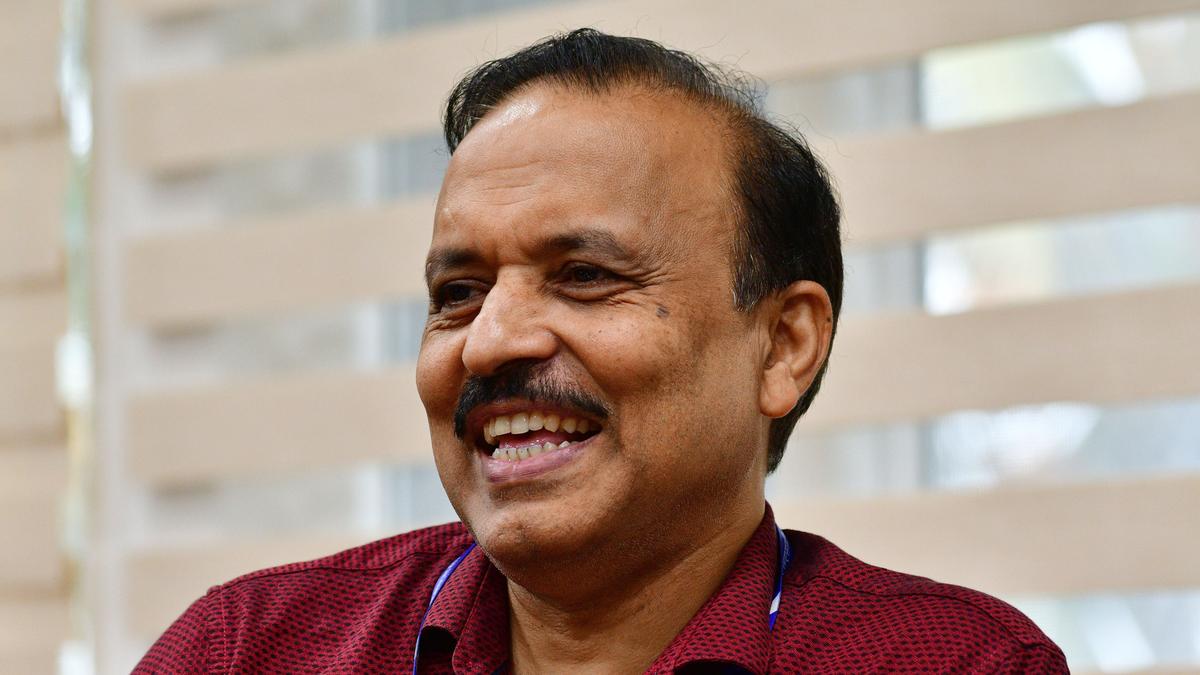
VSSC Director says ISRO is committed to sustainable space exploration practices
The Hindu
ISRO's eco-friendly launch systems showcase commitment to sustainable space exploration, highlighted at EVINCE 2025 conference.
The progress made by the Indian Space Research Organisation (ISRO) in developing eco-friendly launch vehicle systems reflects a strong commitment to sustainable space exploration practices, S. Unnikrishnan Nair, Director, Vikram Sarabhai Space Centre (VSSC), has said.
Dr. Nair was speaking after inaugurating a two-day national conference on Emerging Vistas in Chemical Engineering (EVINCE 2025), organised by the Indian Institute of Chemical Engineers (IIChE), Thiruvananthapuram chapter, here on Friday.
Emphasising the growing role of sustainable technologies in the space arena, he noted the advancements ISRO had made in developing eco-friendly systems using semi-cryogenic, cryogenic and Liquid Oxygen-Methane propellants. In this context, he also underscored the critical role of chemical engineering in India’s technological advancement, particularly in the space sector.
Presiding over the inaugural session, M.C. Dathan, Mentor (Science) to the Chief Minister of Kerala, and former VSSC director, said there was a need to place emphasis on sustainability and the principles of circular economy to develop innovative solutions for mitigating carbon footprint.
Anirudha Bhalchandra Pandit, Vice-Chancellor of the Institute of Chemical Technology, Mumbai; C. Anandharamakrishnan, Director, CSIR-National Institute for Interdisciplinary Science and Technology (NIIST), Thiruvananthapuram; R Vijay, Director, International Advanced Research Centre for Powder Metallurgy and New Materials (ARCI); and S.K. Manu, Deputy Director, VSSC, also spoke.
EVINCE 2025 is themed on ‘The art and science of artificial intelligence and additive manufacturing for revolutionising the design and production of materials.’


CERN's Large Hadron Collider discovers the Xi-cc-plus particle, enhancing understanding of quantum mechanics and baryon behavior.

Vibha Batra’s latest book, Spotless (Hachette India) is a novel in verse for young adults

In its first edition, the Madras Art Salon spotlights the works of journalist and artist Narayan Lakshman at The Botanical Club, a social space in the British Deputy High Commission, Chennai

Cholesterol enhances melanoma cell invasion by making nuclei squishier, revealing a potential treatment target in cancer progression.

The designers reinterpret the Swedish artist’s symbolic forms and colour energy through contemporary resortwear silhouettes

Discover the inspiring legacy of Bibha Chowdhuri, a pioneering woman in physics and a trailblazer in STEM history.

Discover the inspiring legacy of Bibha Chowdhuri, a pioneering woman in physics and a trailblazer in STEM history.

Ashdeen’s Spring 2026 collection features saris inspired by the designer’s Parsi gara archive

Red ochre burials, ritual markings and myths across cultures show that red repeatedly marks liminal thresholds such as puberty, sacrifice and death; anthropologists argue that the colour functions as a technology of collective ritual and value, binding communities through shared symbolic acts

India approves 23 institutions for quantum labs under the National Quantum Mission, aiming to advance quantum technology and research.

India approves 23 institutions for quantum labs under the National Quantum Mission, aiming to advance quantum technology and research.

The Gaza conflict exacerbates environmental damage, emitting millions of tonnes of CO2 and threatening climate stability in West Asia.

Chefs and cookery experts share smart kitchen hacks, hybrid cooking methods and appliance tips to help households reduce LPG use without compromising on food