How did kangaroos evolve to hop? Premium
The Hindu
Discover how ancient kangaroos evolved unique adaptations for hopping, enabling them to manage their immense size and weight.
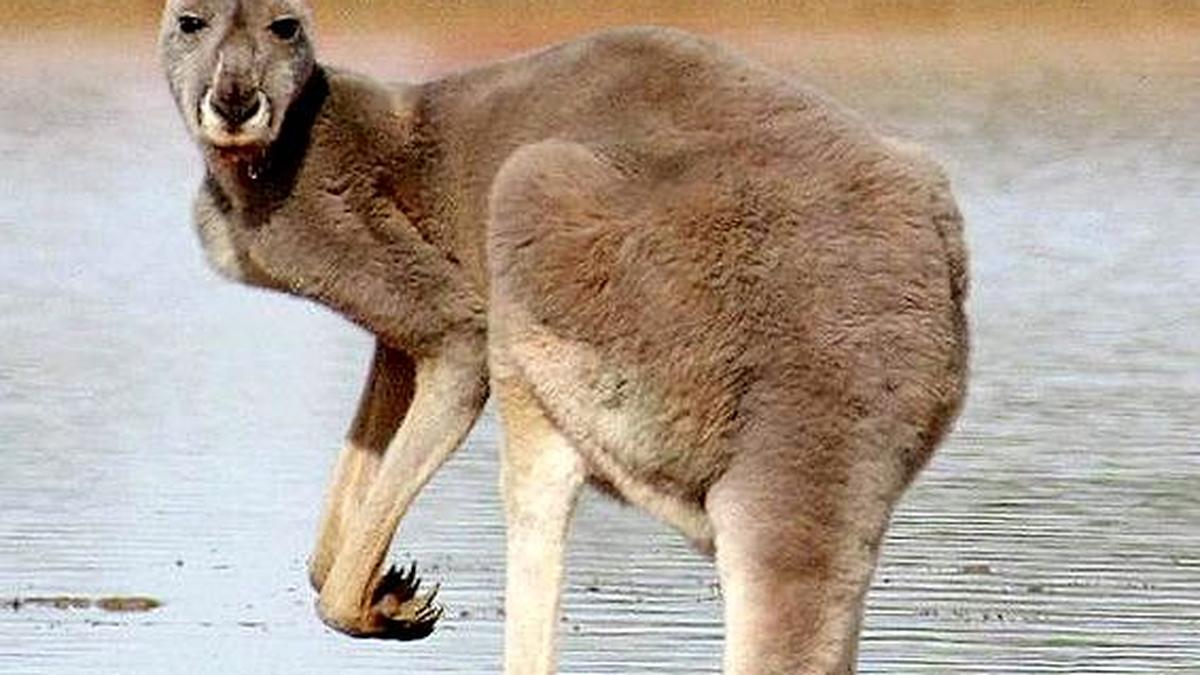
For a long time, biomechanics experts believed that giant, extinct kangaroos were simply too heavy to hop. While the largest modern kangaroos weigh around 90 kg, their prehistoric relatives were much larger and weighed more than 250 kg. And scientists previously calculated that if you took the anatomy of a modern kangaroo and scaled it up to that weight, the forces generated by hopping would snap their ankle tendons and fracture their bones.
However, a January 22 study has challenged this limit: by looking at the fossils rather than relying only on mathematical scaling from modern kangaroos, researchers have found that kangaroo ancestors didn’t just grow larger: they also evolved a different skeletal structure to handle the immense weight.
The study identified two major adaptations that made hopping mechanically possible for these giants. First, their weight-bearing foot bones, the fourth metatarsals, were significantly shorter and thicker than those of modern kangaroos. This compact shape made the bones more resistant to bending forces, preventing fractures upon landing. Second, their heel bones, called calcanea, were much wider, providing a large area for the gastrocnemius tendon to attach. This suggested the animals possessed thick tendons capable of withstanding the tensions required to lift their bodies.
There was one trade-off, however. While the adaptations allowed them to hop without injury, the giants likely sacrificed speed and energy efficiency. Unlike modern kangaroos that bounce efficiently over long distances, the extinct giants probably hopped only for short, high-power bursts, perhaps to escape predators.


Explore 2026's wallpaper trends in India, highlighting botanicals and handmade designs that enhance modern homes with nature-inspired aesthetics.

Mercedes-Benz CLA 250+ with EQ Technology review: design, performance, range and features explained. Discover how the new electric CLA combines advanced AI, long range, fast charging and futuristic styling for the next generation of luxury EVs.

AI tool for sparrow conservation

BTS’s comeback with ‘Arirang’ marks a major global music event. When does the album release, and where can you watch their concert live stream? We have all the details

The 2026 U.S. cholesterol guidelines urge starting screening and treatment at 30 to prevent cardiovascular disease effectively.

Olam Festival 2026 in Thiruvananthapuram returns March 27-29 with 120+ vendors, music, art, and cultural zones.

A few storytellers in Thiruvananthapuram share their journeys, challenges, and evolving methods on World Storytelling Day, inspiring young minds.

76-year-old Kurian Jacob from Kerala triumphs with seven medals, including five golds, at the Open Masters Games in Abu Dhabi.

Explore the nature of the human mind as an emergent property of brain activity and complex neural interactions.

CERN's Large Hadron Collider discovers the Xi-cc-plus particle, enhancing understanding of quantum mechanics and baryon behavior.

Vibha Batra’s latest book, Spotless (Hachette India) is a novel in verse for young adults

In its first edition, the Madras Art Salon spotlights the works of journalist and artist Narayan Lakshman at The Botanical Club, a social space in the British Deputy High Commission, Chennai

Cholesterol enhances melanoma cell invasion by making nuclei squishier, revealing a potential treatment target in cancer progression.