To make sense of cosmic rays, CERN team tracks a fragile nucleus Premium
The Hindu
CERN's ALICE collaboration reveals how fragile deuterons survive high-energy collisions, impacting models of cosmic rays and dark matter.
The hydrogen atom is the lightest in the universe and it consists of the simplest nucleus: a single proton. But while helium is the second-lightest element, its nucleus isn’t the second simplest. That distinction belongs to the deuteron, the nucleus of the deuterium atom, which contains one proton and one neutron. (Deuterium is an isotope of hydrogen.)
However, the two particles are bound with a very low binding energy, making deuterons seem fragile relative to the energetic, messy environment created when particles collide at nearly the speed of light at the Large Hadron Collider (LHC). Yet experiments have repeatedly observed deuterons (and anti-deuterons) emerging from these collisions. How do they survive this environment?
Physicists have come up with two broad explanations. One, called direct emission, assumes the deuterons are produced directly from a hot source, meaning their formation doesn’t involve a different particle (or particles) condensing from a soup of energy, then decaying to form deuterons. The other idea, called coalescence, holds that the proton and neutron are produced first, then they stick together later if they get close enough.
The problem is a proton and a neutron can’t fuse if they have too much energy, so there has to be a third particle to carry away the excess energy. That third participant can be a type of particle called pion that acts like a catalyst, i.e. it will enable the reaction without becoming part of the final deuteron.
Finding out whether this is possible matters beyond collider physics. If scientists have to predict how light nuclei and antinuclei form in high-energy collisions in space — such as when cosmic rays strike interstellar gas — they need to know which formation mechanisms are possible and which ones nature doesn’t ‘allow’.
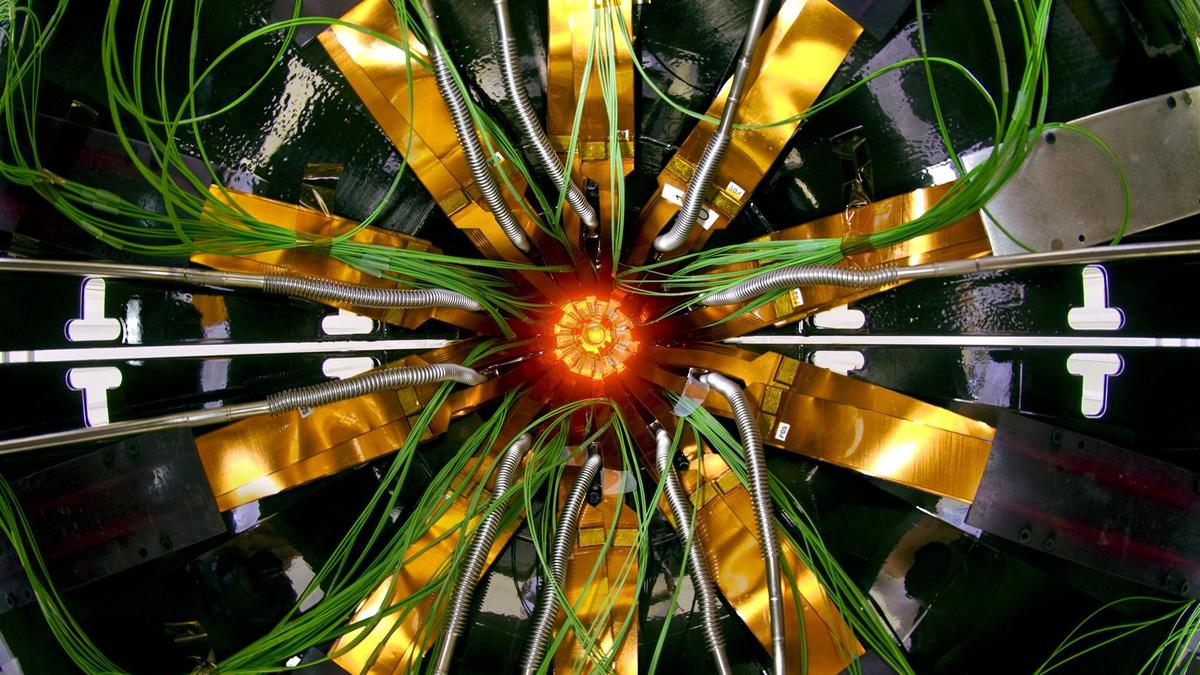
A new study out of the ALICE collaboration at the LHC has provided the answer. The collaboration works with the ALICE detector, one of nine detectors on the LHC. At four points on its ring, the LHC smashes together opposing beams of protons at high energy. The collisions produce a morass of particles and reactions between them. The detectors have computers and sensors that are triggered when they identify reactions of interest and which they record and analyse.


Discover the inspiring legacy of Bibha Chowdhuri, a pioneering woman in physics and a trailblazer in STEM history.

Ashdeen’s Spring 2026 collection features saris inspired by the designer’s Parsi gara archive

Red ochre burials, ritual markings and myths across cultures show that red repeatedly marks liminal thresholds such as puberty, sacrifice and death; anthropologists argue that the colour functions as a technology of collective ritual and value, binding communities through shared symbolic acts

India approves 23 institutions for quantum labs under the National Quantum Mission, aiming to advance quantum technology and research.

India approves 23 institutions for quantum labs under the National Quantum Mission, aiming to advance quantum technology and research.

The Gaza conflict exacerbates environmental damage, emitting millions of tonnes of CO2 and threatening climate stability in West Asia.

Chefs and cookery experts share smart kitchen hacks, hybrid cooking methods and appliance tips to help households reduce LPG use without compromising on food

Discover groundbreaking research on Titan's lakes, bat vaccinations, and the unique aroma of ripening bananas in just one minute.

IRSO's NavIC system faces challenges as the last atomic clock fails, reducing operational satellites for navigation services.

Discover efficient pressure cooking techniques to save up to 50% on fuel. OPOS B Ramakrishnan tells you how

Mercedes-Benz CLA 250+ with EQ Technology review: design, performance, range and features explained. Discover how the new electric CLA combines advanced AI, long range, fast charging and futuristic styling for the next generation of luxury EVs.

Pi Day is celebrated every year on March 14, honouring the significance of the mathematical constant π and its applications in mathematics.

Discover how sculptural interior design transforms modern spaces, blending creativity and functionality to evoke emotion and identity.