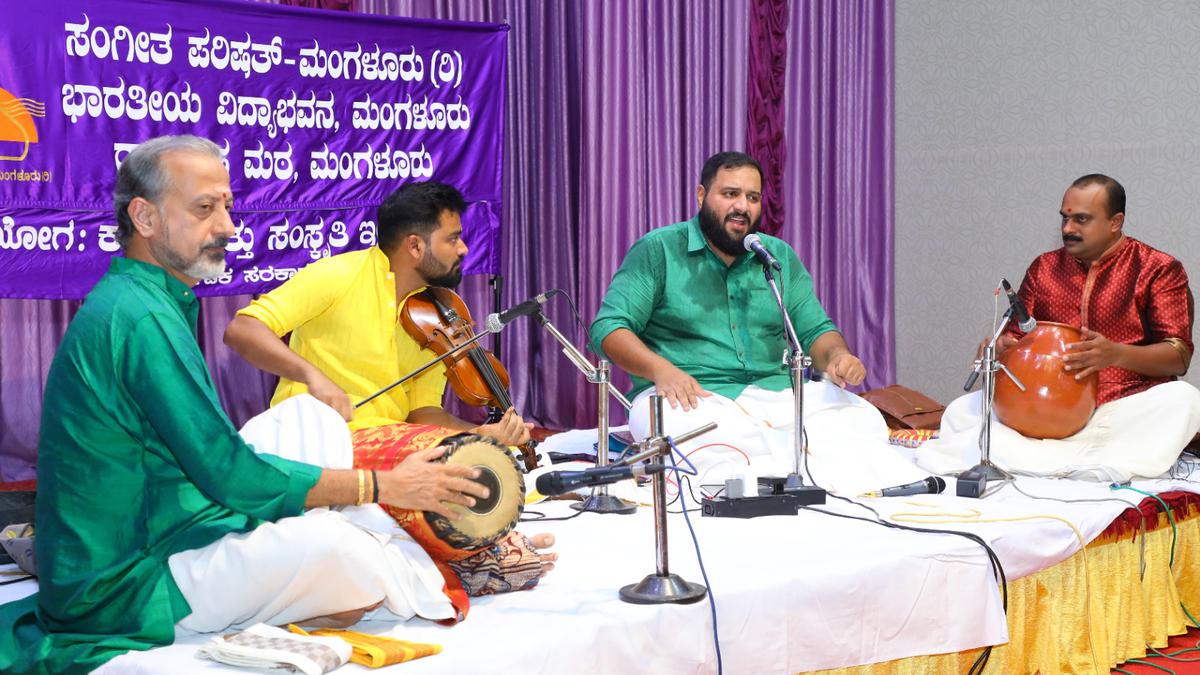
Vignesh Ishwar’s singing was backed by a good voice and style
The Hindu
Vignesh Ishwar performs N. Gopalakrishna Iyer memorial concert
N. Gopalakrishna Iyer, the well-known flautist and music guru from Thirupunithura, started his music school ‘Kalaniketana’ in Mangalore in 1956. Along with his brother Rajan Iyer and Srinivasa Udupa and Sundarachar, he trained innumerable students in Carnatic music. Many of his disciples have done him proud — the most famous of them being the late saxophone maestro Kadri Gopalnath. Gopalakrishna Iyer served Carnatic music until the age of 92 and was duly honoured by the Karnataka Government and other music sabhas.
Mangaluru’s Sangeetha Parishad, Bharathiya Vidya Bhavan and Sri Ramakrishna Mutt, with the support of Karnataka’s Department of Kannada and Culture, has been organising since last year a concert in memory of N. Gopalakrishna Iyer.
This year, Chennai-based Carnatic vocalist Vignesh Ishwar performed. Bestowed with a voice that combines majesty and melody, Vignesh rendered the kritis with appropriate emotion and decorated them with effortlessly flowing swaras.
Vignesh, a student of T.M. Krishna, began his concert with Tyagaraja’s ‘Bhavanutha’ in Mohanam, in which the saint requests Lord Rama to take rest in his heart. Another Tygaraja kriti, ‘Sri Narada Nadasaraseeruha Bringa’ (Narada is described as the honey bee that buzzes around the lotus flower called Naada) in Kanada, followed. The niraval for ‘Vaeda janita vara veena’ was elaborate and full of raga bhava.
A lively thanam in Khamas appeared, and as the audience was savouring that, Vignesh glided into ‘Brochaevarevaruraa’ by Mysore Vasudevachar. Dikshitar’s ‘Soundararaajam aashrayae’ in Brindavana Saranga shone like a bright solitaire, as the pure effulgence of the kriti reigned.
A brisk ‘Sarasa saama daana’, with expected swaraprasthara for ‘Hitavu maatalentho’ was a welcome energiser.
The main piece was in Bhairavi. After the alapana, Vignesh presented Syama Sastri’s ‘Kamakshi, Amba’. The kriti’s beauty was embellished further during the swara session, when he took the first phrase of each charanam for his swaraprasthara, such as ‘Kundaradana’, ‘Kambugala’ and ‘Kumbakucha’.


Oscars 2026 security heightened amid FBI warnings of a potential Iranian drone threat ahead of the Hollywood ceremony.

Directed by Rahul Pandey, the series also stars Naila Grewal, Nidhi Bisht, Anant Joshi, Anjum Batra and Kusha Kapila

A tribute to the versatile actor and comedian V.K. Ramasamy in his birth centenary year.

‘One Piece’ Season 2 review: As the Straw Hats enter the Grand Line, Netflix’s live-action adaptation finds its sea legs with bigger islands, stranger villains and the same stretch-happy sense of boundless adventure

Geeta Gandbhir, the Indian-origin American filmmaker is waves at this year’s Oscars with not one, but two nominations. Her documentaries, ‘The Perfect Neighbor’ and ‘The Devil is Busy’ are in the race for the Academy Award

Directed by filmmaker and environmentalist Pradip Krishen, the film follows a group of "dope-smoking, bellbottom-wearing and vaguely idealistic" final-year students racing to complete their theses.

Alan Ritchson powers through 'War Machine', a lean sci-fi action thriller on Netflix. A competent, Reacher-style chase adventure with nonstop tension and solid set pieces

Explore the Unshelving Memories exhibition in Thiruvananthapuram, showcasing diverse book art by 61 talented artists until March 15.

Oscars 2026 date and timings: Watch the 98th Academy Awards live on March 15, 2026, at 4:30 a.m. IST in India on various platforms.

The 12-day Tribal Art Festival, taking place in Delhi until March 13, brings together more than 75 tribal artists and over 1,000 artworks representing more than 30 tribal art traditions.

Tom Cruise wins Best Actor at the 2026 Saturn Awards, while 'Avatar: Fire and Ash' takes home multiple major honors.

The new God of War is a coming-of-age story that builds Kratos into the formidable warrior seen in later games

Rachel Weisz dazzles in Vladimir, a sharp, sexy Netflix mini‑series that probes power, desire, and academia in eight smart, bingeable episodes