U.S. tariffs ruling could have far-reaching impact, offers hope for pleas against H1B visa fees Premium
The Hindu
U.S. Supreme Court ruling on tariffs strengthens checks and balances, potentially impacting H1B visa fee challenges and presidential powers.
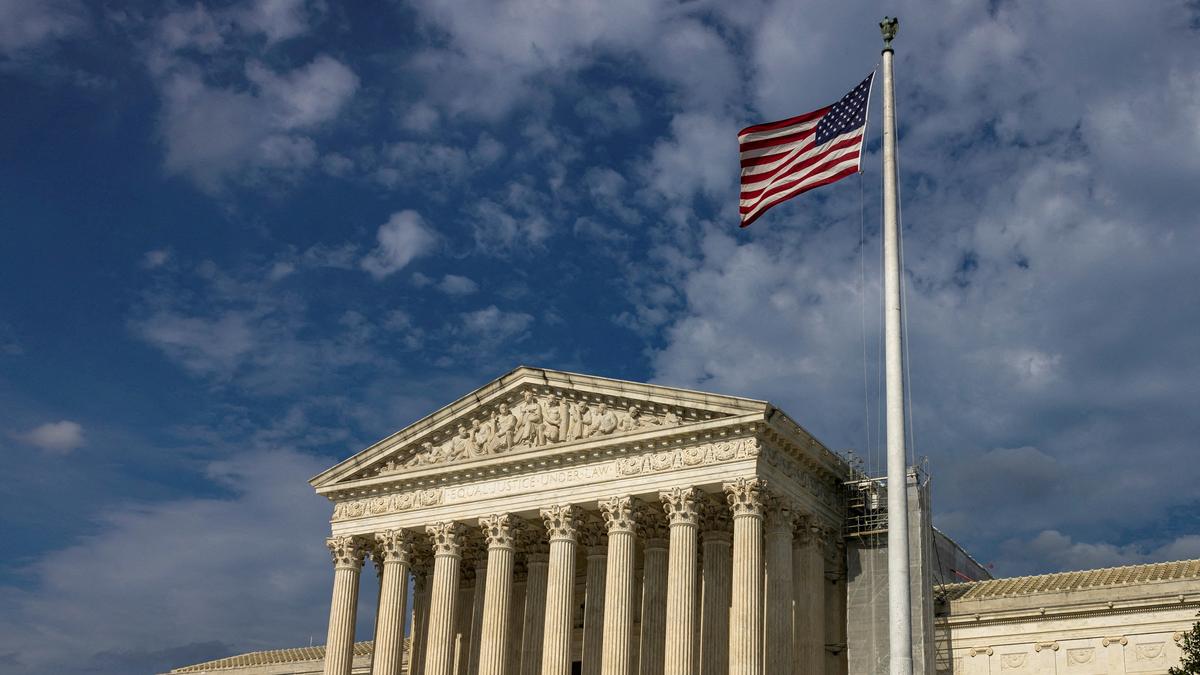
The U.S. Government has sought to reimpose tariffs struck down by the nation’s Supreme Court by invoking a different law. But the Supreme Court judgment that dealt with the tariffs imposed by exercising President Donald Trump’s emergency powers strikes at the very root of his unilateral decision to impose tariffs. It requires him to seek Congressional approval, reinforcing a central tenet of U.S. governance model and public life — checks and balances and the seeking of consensus.
U.S. Supreme Court rejects tariffs LIVE | India faces lower 10% tariff after Trump’s proclamation on new levies, effective Feb. 24
Shortly after taking office, Mr. Trump sought to address two “foreign threats”: the influx of illegal drugs from Canada, Mexico, and China, and “large and persistent” trade deficits. Mr. Trump declared a national emergency citing these two and imposed tariffs to deal with each threat.
The court called this case a “major question” case and invoked the major questions doctrine as per which only the U.S. Congress has powers to impose tariffs. Section 8 of the U.S. Constitution says: “Congress shall have power to lay and collect taxes, duties, imposts and excises.” “The framers of the Constitution gave that power to “Congress alone”,” the court said.
While the principle of checks and balances may apply across democracies, in the U.S. safeguards are far more effective and accorded primacy. Checks and balances are intended to ensure no one gets “tyrannical” power. Tyranny — by England’s king — was the main reason for the founding of the U.S.A and its Constitution and U.S. public life is built against tyranny. Strong, independent institutions are a feature of U.S. life. Laws ensure consensus and constant dialogue, often requiring bipartisan cooperation, even solidarity.
For instance, the U.S. Congress — equivalent to India’s Parliament — makes all laws, not the President. But Congress is a permanent body and is independent of the President. It can be dominated by a party different from that of the President. The President does have certain powers such as emergency powers and, more importantly, the power of veto over any law passed by the Congress. The President is, by definition, a popular leader and Congress is often loathe to go against him or her as a result. Everyone needs to work together.


Experts link Punjab's distress migration to economic stagnation and job mismatches, highlighting systemic failures in political leadership.

India's merchandise exports remain flat in February, with Commerce Secretary warning of a potential dip in March due to trade constraints.

Hard Rock International closes 10 outlets in India, including three cafes in Bengaluru, while Goa hotel remains open.

The booming market for artificial intelligence servers brought Taiwan's Foxconn a 24 percent jump in annual net profit, the company said

In a statement on its website, Adobe said it has in recent years streamlined its sign-up and cancellation processes and made them more transparent.

Stock markets recover as Sensex and Nifty bounce back following a three-day slump, driven by value-buying in blue-chip stocks.

U.S. President Donald Trump’s administration is set to receive a roughly $10 billion fee from investors in the recently completed deal to take control of TikTok’s U.S. business, the Wall Street Journal reported

Meta is planning sweeping layoffs that could affect 20% or more of the company, three sources familiar with the matter told Reuters

Learn how to choose the best personal loan lender by evaluating eligibility, interest rates, and borrowing experience.

Discover why pension planning is essential in modern India to ensure financial security and peace during retirement.

The U.S. has launched two investigations under Section 301 of the Trade Act of 1974 against India and other economies to examine practices that may be ‘unreasonable or discriminatory and burden or restrict U.S. commerce’. One probe examines whether countries, including India, are using excess manufacturing capacity to export to the U.S. in a manner that hurts American businesses, while another looks at whether countries have taken ‘sufficient steps’ to prohibit imports of goods produced with forced labour.

NHAI raises annual pass fee to ₹3,075 from April 1, 2026, streamlining toll payments for FASTag users.

The U.S. probes forced labour in global supply chains, scrutinizing China and India's exports, warns the Global Trade Research Initiative.