The evolving nature of trade agreements Premium
The Hindu
Explore the implications of Trump's trade agreements, their legal status, and their impact on global trade dynamics.
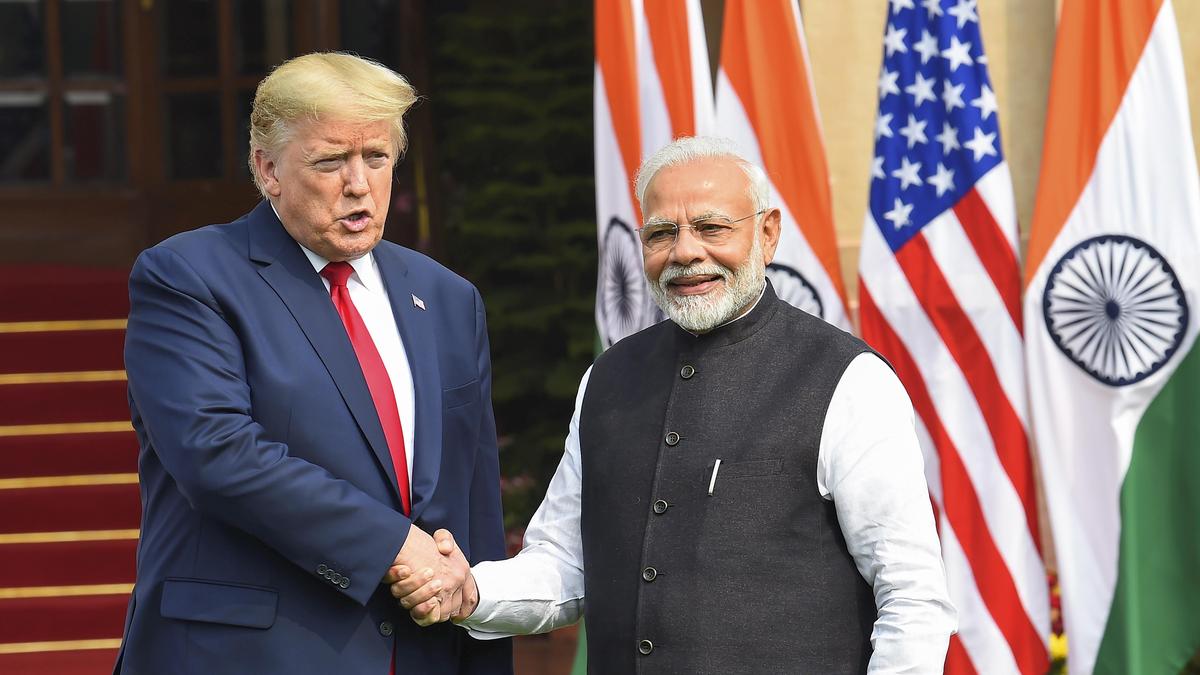
U.S. President Donald Trump has signed several trade agreements with countries such as Malaysia, Cambodia, Argentina, and Bangladesh. These agreements have been signed under the shadow of intimidating and illegal tariffs. The U.S. has also announced a trade agreement with India, for which the two sides have issued a joint statement. Trade agreements exemplify the legalisation of international trade relations. But are all trade agreements the same? Can the India-U.S. trade deal, once finalised, be compared to India’s recent agreements with the EU or the U.K.?
The U.S. refers to agreements signed by Mr. Trump as Agreements on Reciprocal Trade (ART), as opposed to Free Trade Agreements (FTAs). This creates a new category in international trade deals, which now consists of three typologies.
At the core of international trade treaties is the robust multilateral trade agreement established by the General Agreement on Tariffs and Trade (GATT) and the World Trade Organization (WTO). The GATT untethered the global American project of creating a non-discriminatory trading regime firmly grounded in the most-favoured-nation (MFN) rule (this WTO rule specifies that if a special favour is granted to one country, such as lower tariffs, then it has to be extended to all other WTO members as well).
The U.S. established a multilateral trading arrangement, based on an unconditional MFN rule, due to the pursuit of trade protectionism during the interwar years. Further, the formation of the WTO in 1995 provided an institutional architecture to this multilateral trade project. The WTO expanded trade beyond goods to include services and intellectual property, and established an intricate dispute settlement mechanism. While some view the WTO as part of a global imperialist state, its one-country-one-vote principle provides developing countries with some agency and an opportunity to forge alliances and bargain with the developed world.
Interestingly, while the WTO establishes a trading regime based on non-discrimination, it allows its members to sign preferential trading agreements on a non-MFN basis. Two such arrangements are recognised in Article XXIV of GATT — free trade areas and Customs Unions (CUs). However, since these arrangements are an exception to the MFN principle, they are subject to stringent conditions. For instance, an FTA creating a free trade area should cover ‘substantially all trade’ between its constituents. Likewise, a CU should not only cover ‘substantially all trade’ but also have a common external trade policy for non-members. These stringent conditions aim to make FTAs and CUs building blocks rather than impediments to trade multilateralism.
Until the 1980s, these arrangements were not popular among countries. However, in the last three decades, there has been a proliferation of FTAs. While most FTAs are bilateral, some are quite large, covering 10 to 15 countries, such as the Regional Comprehensive Economic Partnership (RCEP) agreement. Many of these FTAs are WTO-plus, that is, they go beyond the topics covered by the WTO, by including rules on labour, environment, and foreign investment protection. These FTAs are criticised for thrusting new obligations on developing countries. However, as these FTAs are notified to the WTO as a mandatory legal requirement, they provide countries adversely affected by them with an opportunity to raise questions and scrutinise them.


India's merchandise exports remain flat in February, with Commerce Secretary warning of a potential dip in March due to trade constraints.

Hard Rock International closes 10 outlets in India, including three cafes in Bengaluru, while Goa hotel remains open.

The booming market for artificial intelligence servers brought Taiwan's Foxconn a 24 percent jump in annual net profit, the company said

In a statement on its website, Adobe said it has in recent years streamlined its sign-up and cancellation processes and made them more transparent.

Stock markets recover as Sensex and Nifty bounce back following a three-day slump, driven by value-buying in blue-chip stocks.

U.S. President Donald Trump’s administration is set to receive a roughly $10 billion fee from investors in the recently completed deal to take control of TikTok’s U.S. business, the Wall Street Journal reported

Meta is planning sweeping layoffs that could affect 20% or more of the company, three sources familiar with the matter told Reuters

Learn how to choose the best personal loan lender by evaluating eligibility, interest rates, and borrowing experience.

Discover why pension planning is essential in modern India to ensure financial security and peace during retirement.

The U.S. has launched two investigations under Section 301 of the Trade Act of 1974 against India and other economies to examine practices that may be ‘unreasonable or discriminatory and burden or restrict U.S. commerce’. One probe examines whether countries, including India, are using excess manufacturing capacity to export to the U.S. in a manner that hurts American businesses, while another looks at whether countries have taken ‘sufficient steps’ to prohibit imports of goods produced with forced labour.

NHAI raises annual pass fee to ₹3,075 from April 1, 2026, streamlining toll payments for FASTag users.

The U.S. probes forced labour in global supply chains, scrutinizing China and India's exports, warns the Global Trade Research Initiative.

The Hindu collection of images of the LPG crisis: War lights a kitchen fire