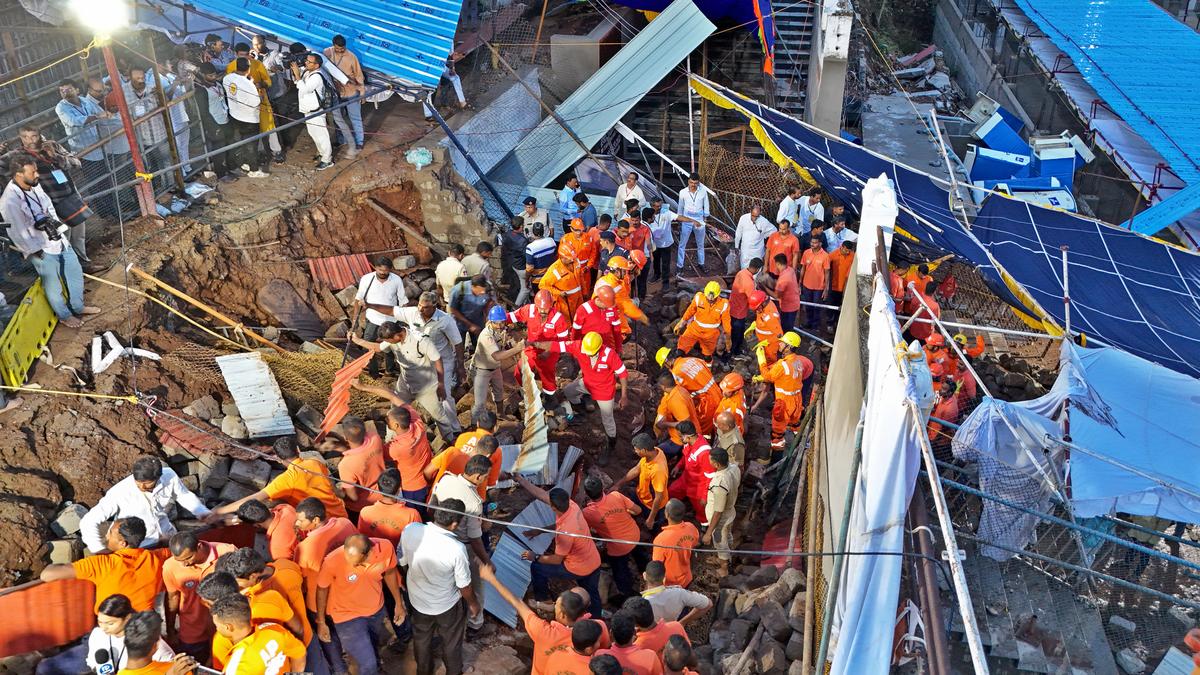
Simhachalam temple wall collapse: Missed writing on the wall Premium
The Hindu
Tragedy strikes at Simhachalam temple during Chandanotsavam, leaving seven dead and many injured due to wall collapse.
When Umamaheswara Rao and wife Sailaja set out to the Simhachalam hills in Visakhapatnam from their home at Chandrampalem at 2.30 a.m. on April 30, they were probably thinking of the moment they would finally fulfil a long-cherished dream: to witness the ‘nijaroopa darshan’ of Sri Varaha Lakshmi Narasimha Swamy, a rare sight available only once a year during the temple’s ‘Chandanotsavam’.
The couple were just three years into their marriage, and life seemed good. The two software professionals, both 30 years old, were ambitious as well as deeply spiritual.
They reached the temple after short trip of 25 km and joined a sea of devotees hailing from across Andhra Pradesh, Telangana, Odisha and beyond. Many of them had reached the hill the previous evening (April 29) itself to avoid the rush after midnight. All had one objective: to catch a glimpse of the original form of the idol, which remains covered in sandalwood paste throughout the year except this occasion.
From around midnight, devotees began taking their place in their respective queues [sarva (free) darshan; ₹300, ₹1,000 and ₹1,500 ticket darshans]. Umamaheswara Rao, Sailaja, her mother P. Venkata Ratnam (50) and his aunt G. Mahalakshmi (55) took up their spot in the ₹300 queue, located close to Rajagopuram and the bus terminus atop the hill. Above them, on a higher elevation, a massive new brick and concrete wall towered.
The festival began with ‘Suprabhatam’ at 1 a.m. on April 30, followed by a few other rituals. The hereditary trustee Pusapati Ashok Gajapathi Raju had the first darshan of the deity at 3 a.m., followed by some ministers and other VVIPs, who entered the main temple through the Rajagopuram. The darshan for common devotees was to begin from 4 a.m.
Shortly after, however, the weather took a drastic turn and heavy downpour, accompanied by gales, began pummelling the region. Naresh, a volunteer present at the site, recalls what happened next. “There was a loud thud, and people began screaming. At first, we thought nobody was hurt, but when we reached the spot, we saw the wall had collapsed onto the queue line, and many were trapped under the debris; it was a horrifying sight.”
The hilltop, the divine abode, began echoing with wails of ambulance sirens and the screams of the injured. Seven people lost their lives that day, including Umamaheswara Rao, Sailaja, Mahalakshmi and Venkata Ratnam. While the bodies were taken to King George Hospital (KGH), the injured were shifted to Visakha Institute of Medical Sciences (VIMS) near Hanumanthawaka. Outside the KGH mortuary, heartbroken relatives wept inconsolably; some were stunned into stillness by what had just happened.


Assembly protest ends in arrests as BJP targets Government over guarantees

Andhra Pradesh accelerates city gas distribution with streamlined approvals, enhancing access to cleaner energy and supporting sustainable urban development.

Sattankulam father-son custodial deaths case: Trial court convicts all nine accused police personnel
Nine police personnel convicted in Sattankulam custodial deaths; sentencing to be announced on March 30.

Minister Laxmi Hebbalkar supports local protests against a solid waste management plant in Turmuri, addressing residents' concerns.

Sattankulam father-son custodial deaths case: Trial court convicts all nine accused police personnel
Nine police personnel convicted in Sattankulam custodial deaths; sentencing to be announced on March 30.

Erode district conducts first EVM randomisation for April 23 Assembly elections, ensuring transparency and fairness in allocation.

TNCC conducts public consultation in Erode to gather community input for its upcoming election manifesto.

CID to investigate sexual assault allegations against suspended Moodbidri Police Inspector P.G. Sandesh, reveals Home Minister Parameshwara.

A 50-year-old woman was found dead in southwest Bengaluru’s Kengeri in the early hours of Monday, the police said.

Papanasam dam's water level reaches 66.15 feet, with inflow at 76 cusecs and discharge at 300 cusecs.

Development without impact: Coastal residents of Kanniyakumari and Nagercoil constituencies voice discontent

Rampant encroachments in Tiruchi threaten pedestrian safety and traffic flow, undermining smart pavement initiatives and exacerbating congestion.

Discover Kerala's electoral history in 'Vottarivu,' a 201-page booklet released ahead of the 2026 Assembly elections.