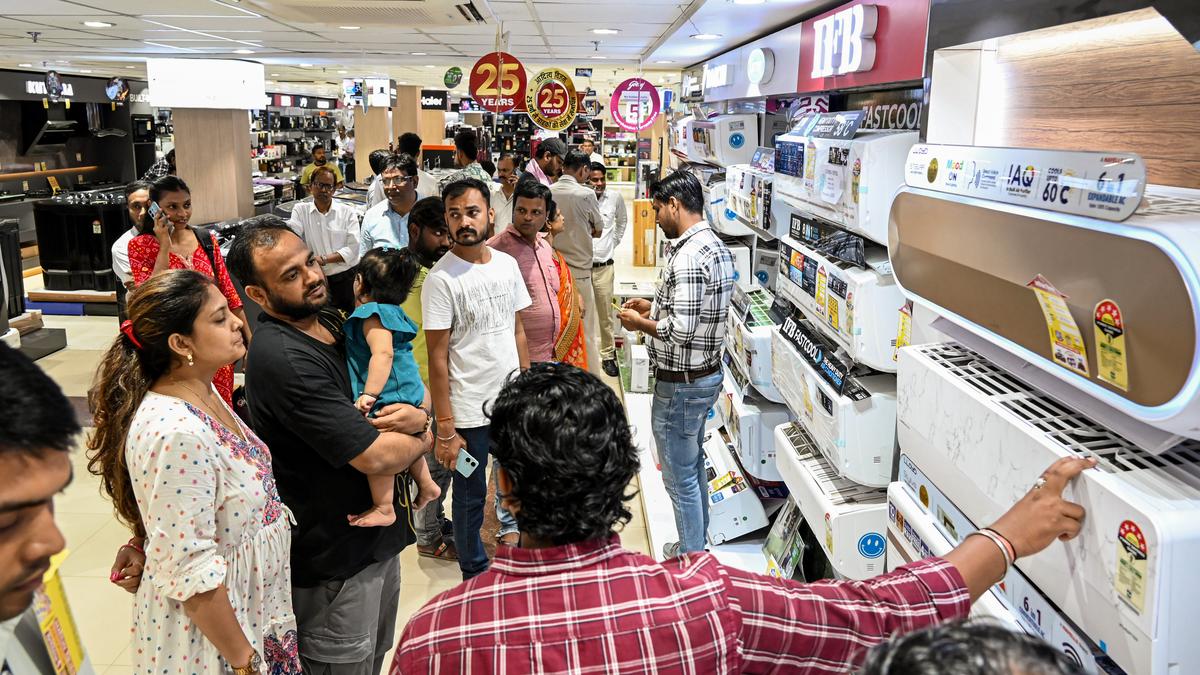
Science behind setting the right temperature on the air conditioner
The Hindu
Union Ministry of Power considers restricting new ACs to 20-28 degrees Celsius for energy efficiency and health benefits.
The Union Ministry of Power has said it is mulling restricting the temperature range of new air conditioners (ACs) in the country to between 20 degrees and 28 degrees Celsius.
In a press conference on Tuesday, Power Minister Manohar Lal Khattar told presspersons the restriction would apply to ACs in households, hotels, and cars. The option is reportedly being considered at present and no firm decision has been taken.
The idea is not new: in 2018 and then in 2021, R.K. Singh, then the Minister of State (Independent Charge) for Power had said the Ministry was speaking to AC manufacturers about labelling ACs with the optimum temperature setting from the energy efficiency and health points of view and fixing the default temperature setting at 24 degrees. At the time the Ministry had also said in a statement that it would consider instituting the default setting following an awareness campaign for four to six months and after public consultations.
“Every 1 degrees Celsius increase in the air conditioner temperature setting results in saving of 6% of electricity consumed,” Mr. Singh said. He added that the 24 degrees Celsius recommendation had come from a Bureau of Energy Efficiency study and that should all consumers adopt the setting, the country would save 20 billion units of electricity per year. The BEE had said at the time that the total connected load due to ACs would be 200 gigawatt by 2030.
Aside from calling the 18-21 degrees Celsius range “uncomfortable”, the Minister said it was “unhealthy”. Indeed, many studies have found that the blood-pressure load rises quickly below 18 degrees Celsius, with vasoconstriction and sympathetic activation being found to drive the systolic blood pressure up by about 6-8 mm (Hg) and long-term exposure translating to higher risk of hypertension. Separate trials involving children in Japan, New Zealand, and the United Kingdom have also found they breathed easier when they slept with ACs set to more than 18 degrees Celsius. On the flip side, whole-house warming with insulation and/or heaters was found to mitigate the prevalence of respiratory infections and lower antibiotic use within a few months.
In 2018, the International Energy Agency estimated there were 2 billion ACs in use around the world and that the number of residential units tripled from 2000 to 2022, to 1.5 billion. The agency also said that as of 2022, 43% of people in the Asia Pacific region were still in need of additional cooling.
An AC works by pumping heat from one space to another. Heat naturally flows from warmer to cooler areas, which means continuously moving it in the other direction — e.g. from a room at 30 degrees Celsius to an environment at 35 degrees Celsius — requires work. This work is represented in the AC’s power consumption.


Discover the Minor Planet Centre, the key hub for tracking and verifying observations of small solar system bodies.

In this week's Science for All newsletter, XX explains

Test your knowledge with the quiz on Science films at the Oscars through history

Set between the Siwalik hills and the plains, Butwal offers travellers a mix of regional cuisine, pilgrimage trails to Lumbini and the comfort of Hyatt’s new hospitality landmark

Explore 2026's wallpaper trends in India, highlighting botanicals and handmade designs that enhance modern homes with nature-inspired aesthetics.

Mercedes-Benz CLA 250+ with EQ Technology review: design, performance, range and features explained. Discover how the new electric CLA combines advanced AI, long range, fast charging and futuristic styling for the next generation of luxury EVs.

AI tool for sparrow conservation

BTS’s comeback with ‘Arirang’ marks a major global music event. When does the album release, and where can you watch their concert live stream? We have all the details

The 2026 U.S. cholesterol guidelines urge starting screening and treatment at 30 to prevent cardiovascular disease effectively.

Olam Festival 2026 in Thiruvananthapuram returns March 27-29 with 120+ vendors, music, art, and cultural zones.

A few storytellers in Thiruvananthapuram share their journeys, challenges, and evolving methods on World Storytelling Day, inspiring young minds.

76-year-old Kurian Jacob from Kerala triumphs with seven medals, including five golds, at the Open Masters Games in Abu Dhabi.

Explore the nature of the human mind as an emergent property of brain activity and complex neural interactions.