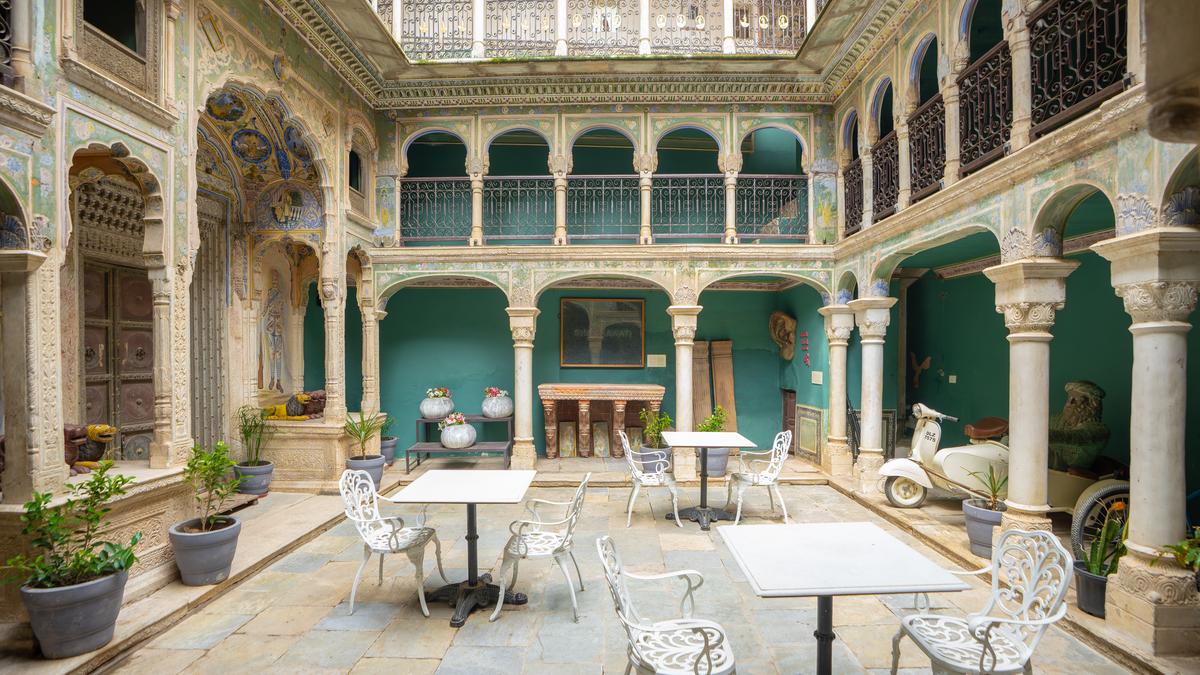
Rajasthan’s Nawalgarh is among the world’s living-art open air galleries. We take a tour
The Hindu
Nawalgarh, in Rajasthan, is a proud testament of a community’s success and a region’s craftsmanship. Its colourful bygone glory is enjoying a new lease of life now
Aabid Khan Kayamkhani is overcome with emotion at the loss of some of the finest works in the havelis of Nawalgarh. As a tour guide, he gives visitors a quick lesson in the place’s history and art. One such haveli has been painted over in cream and pink, leaving a mere door and the space around it as a reminder of the lost art.
“We grew up hearing about and seeing the artwork of these havelis. Our generation has seen this place become this wonderful centre of art. There is no other place in the world that can match Nawalgarh’s havelis,” says Aabid, who also works as a location liaison for movie and OTT shooting crews.
The lit-up inner courtyard of Podar Haveli Museum | Photo Credit: Garima Verma
His sentiment might seem amplified but it was his ancestors who stood witness to the history of the region for four centuries before Thakur Nawal Singh founded Nawalgarh in the Jhunjhunu district of the Shekhawati region of Rajasthan. It was a Chauhan prince, Rana Karamchand, who converted to Islam in 1356 under the rule of Firuz Shah Tughlaq, became Kayam Khan and thus, began a community called Kayamkhani, which followed both Rajput and Muslim traditions. Their weddings, thus, had both pheras and nikah.
When Nawalgarh came into being in 1737, the Marwari community flocked to it, making it one of the most affluent places over time. Many well-known Marwari business families, like Jaipurias, Goenkas, Jiwrajkas, Khaitans, Morarkas, Podars, Seksarias, and others have roots in Nawalgarh. And, during the 18th-19th centuries, these wealthy businessmen and merchants built multi-storeyed, multi-courtyard mansions that even put many palaces to shame with their craftsmanship.
Sone ki dukan haveli’s work, Mahansar | Photo Credit: Garima Verma


Nawalgarh, in Rajasthan, is a proud testament of a community’s success and a region’s craftsmanship. Its colourful bygone glory is enjoying a new lease of life now

Kanpur luxury car crash: Lawyer claims Shivam Mishra wasn't driving; police provide evidence contradicting this assertion.

Belagavi DCCB threatens legal action against Ramesh Katti and others for spreading false claims about the bank's financial stability.

TGSRTC bus tickets promote message on KYC updation for uninterrupted banking services during Financial Literacy Week,

Madras High Court allows 'Jana Nayagan' producer to withdraw writ petition, clearing the way for CBFC's revising committee review.

Former Minister and Congress leader V.S. Sivakumar has said that truth has finally prevailed after the Vigilance investigation into a disproportionate assets case gave him a clean chit.

Over 18,700 Karnataka government schools lack land records, prompting new legislation for property registration and protection.

PM Modi praises Bastar's transformation from violence to development and self-confidence, highlighting the successful 'Bastar Pandum' festival.

ICC Twenty20 World Cup 2026: Netherlands vs Namibia match in New Delhi on February 10, 2026

Cantonment police charge film director Kunju Muhammad with outraging modesty after allegations from a fellow filmmaker in Thiruvananthapuram.

A minor was fatally stabbed in West Delhi's Khyala; two juveniles have been apprehended in connection with the incident.

West Bengal faces ongoing challenges with bonded labour, affecting migrant workers and youth from Bihar, Jharkhand, and Odisha.

Delhi's air quality is poor with an AQI of 268, while Mundka reports the worst at 357.