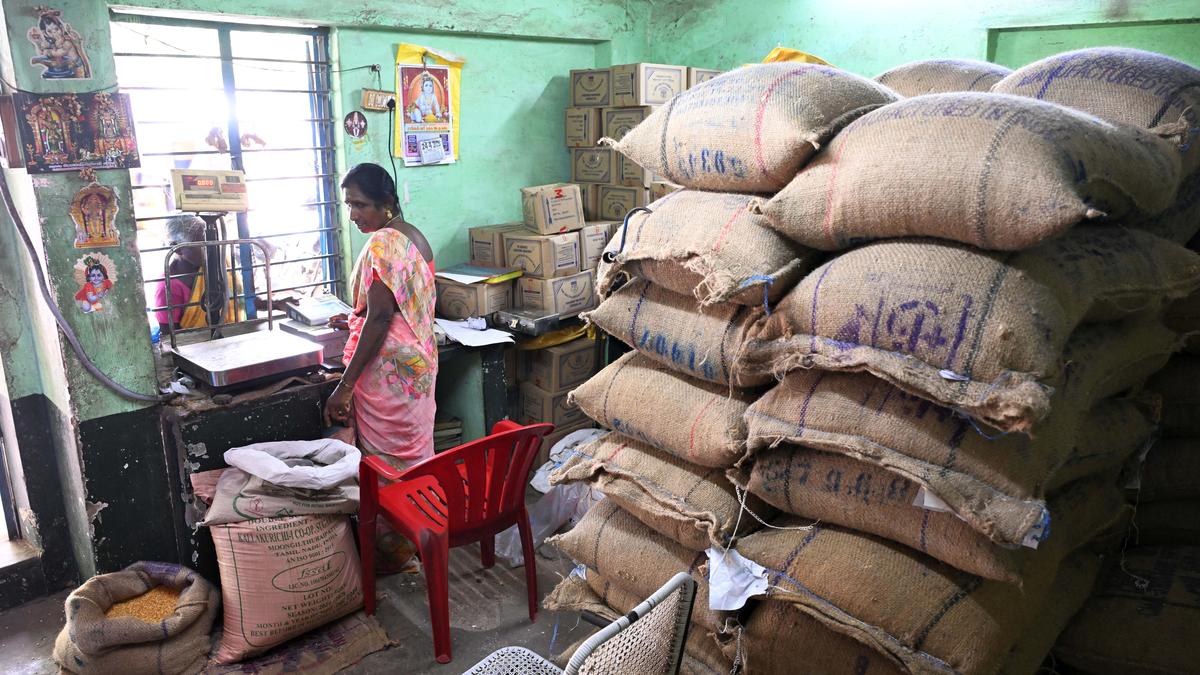
Public Distribution System compromised by irregularities
The Hindu
Public Distribution System (PDS) scrutinized for irregularities compromising its purpose, authenticity, and genuineness, raising questions about its relevance.
A serious scrutiny of the Public Distribution System (PDS), which was introduced with the objective of providing essential commodities at a fair price and of good quality to the public, reveals irregularities allegedly occurring at ration shops, compromising its purpose and relevance to a large extent.
As per official records, the Public Distribution System was implemented in the country during the inter-war period with focus on distribution of food grains in urban scarcity areas and emanated during the food shortage crisis in 1960s. In the subsequent years, reports and studies showed that the system had substantially contributed to containment of rise in prices of food grains and ensured access to food to urban consumers.
“As the national agricultural production grew in the aftermath of Green Revolution, the outreach of PDS was extended to tribal blocks and areas of high incidence of poverty in the 1970s and 1980s,” reads the official website of the Department of Food and Distribution System.
Though lauded for its reach and service to people living in remote areas, the system appears to be compromised due to loopholes, raising questions about its authenticity and genuineness.
For instance, an issue that does not directly affect the public but causes a huge loss to the government exchequer is bogus entry of products on a card holder’s registry. When a customer with a sugar card, who is eligible for sugar, urad dal and commodities, wishes to buy only sugar and not the other two products, the bill received by the card holder in mobile phone mostly includes the other two unpurchased products.
As per government records, all ration card holders have one of the cards – rice card, sugar card, no commodity card, Old Age Pension (OAP) cards, Annapoorna card and Antyodaya Anna Yojana (AAY) - based on income criteria.
Take the case of A. Muniyandi, a resident of Vairavanpatti near Karungalakudi. He is an agricultural labourer and a rice card holder. Most of the time, he gets rice from the farm where he works and does not buy from the ration shop. “While I buy only sugar and oil, for which I am eligible, rice too gets automatically registered in my account,” he says.


T.N. Chief Secretary and DGP visit Governor at Lok Bhavan, presenting flowers in courtesy call.

Eight TSPC Maoists arrested in Hazaribag, Jharkhand, with weapons and ammunition seized during a police operation.

Four ambulances of a Jewish community service in London were set ablaze in a suspected antisemitic hate crime.

Gautham Manohar hopes his photographs serve as reminders of the Earth’s delicate beauty

Thousand Lights faces parking chaos and traffic congestion despite its political significance and ongoing development efforts.

Generic semaglutide increases accessibility, but doctors caution against misuse and quality concerns

Haryana Police removes 857 links to Badshah's 'Tateeree' for objectionable content, ensuring a safer digital environment.

Congress criticises Modi for not leveraging the upcoming BRICS+ Summit to address the West Asia crisis amid U.S. tensions.

Nagapattinam faces underdevelopment and resource challenges, impacting its rich heritage and the livelihoods of its fishing community.

One of the best games of 2025 makes it over to the PC, with a harder mode and bristling with new graphic tech

Air Force employee arrested for espionage, allegedly sharing sensitive information with Pakistani handlers since 2023 for money.

Four killed and several injured in a Bengaluru–Mysuru Expressway crash; driver arrested for alleged negligence.

Four injured in SUV collision with a stranded goods carrier on Narsingi ORR, causing significant traffic congestion.