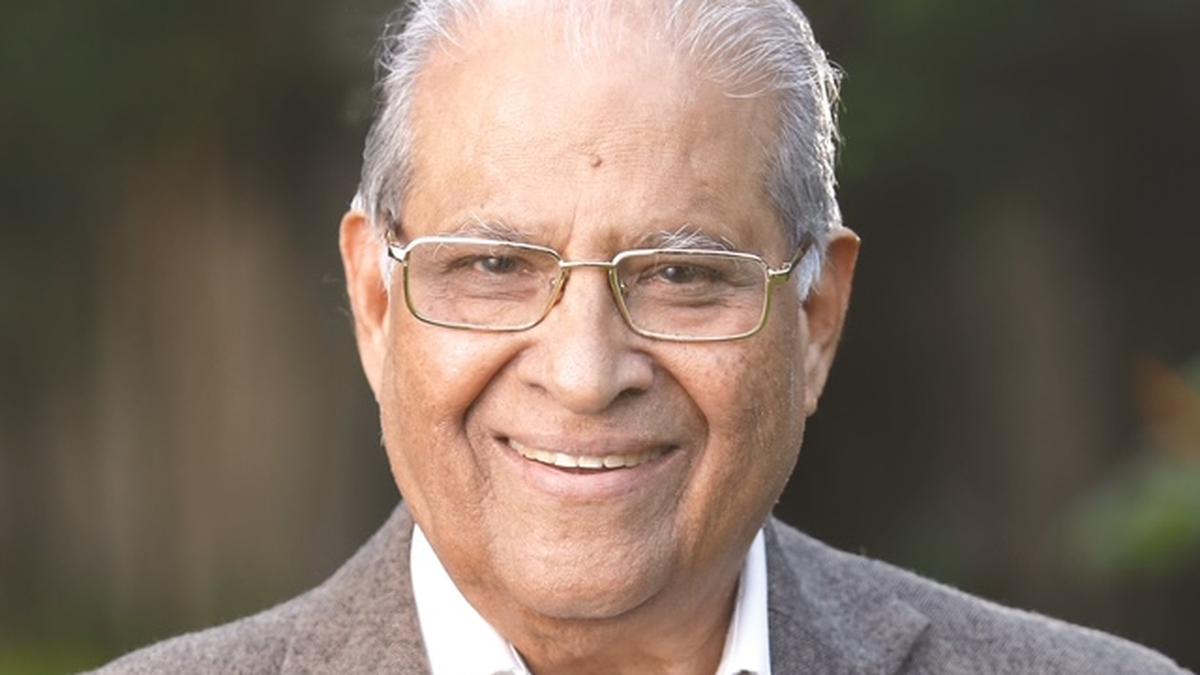
Prof. J. Philip, renowned management educationist, passes away
The Hindu
Renowned management educationist Prof. J. Philip passes away, leaving a lasting legacy in Indian business education.
Professor J. Philip, the Founder and Chairman of Xavier Institute of Management & Entrepreneurship (XIME) passed away on Saturday (February 21, 2026). The Institution deeply mourns the eminent management educationist’s passing.
Prof. J. Philip was very much the country’s foremost savant in the field of management education. Commencing with the distinction to have been the youngest Dean of XLRI, Jamshedpur in the late nineteen sixties and becoming an eminent institution builder as the founder Chairman of Xavier Institute of Management & Entrepreneurship (XIME) Bangalore for three decades till his last days, his career in service to management education spanned for over sixty five years, a singular record in the history of Indian management education.
At XLRI, one of the pioneers of business education in the country, the young J. Philip won his spurs in the late 1960s as designer of its ground-breaking post graduate course in management. Equally lauded was the exceptional competence he had displayed as its Dean in sustaining the institution’s high standards on a par with those of the best, not only in India but overseas.
It was his stellar record at XLRI combined with a creditable stint at Harvard that led to his selection by the Government of India to head the staff college of the Steel Authority of India in Ranchi. J. Philip’s flair as a leader and innovator was in full flow in the way he performed at the helm of that premier public sector training establishment, leaving a durable imprint on it.
It is given to few management educationists to have their timbre tested in a demanding executive position in corporate business, much as it constitutes the focal point of their vocation. J. Philip’s well-acclaimed success in teaching management as an academic discipline and in employing its tools in training of executives for the public sector filled the bill for him to be chosen by the Oberoi’s, one of the country’s premier hotel groups as Vice President for Human Resource management. His tenure there was remarkable for the transformational stimulus that it brought into the vital HR functions of the enterprise.
J. Philip’s subsequent choice as the Director of Indian Institute of Management (IIM) in Bangalore in 1985 was assuredly owing to the government’s recognition of his extraordinary calibre as a management educationist with a proven track record in several functional areas of management both as an academic discipline and as an art and profession. And his tenure in that leadership position was marked by the turnaround he accomplished for that institution from a worrisome parenthesis of disarray and organisational drift to restoration of its original stature of globally recognised excellence.


Experts link Punjab's distress migration to economic stagnation and job mismatches, highlighting systemic failures in political leadership.

India's merchandise exports remain flat in February, with Commerce Secretary warning of a potential dip in March due to trade constraints.

Hard Rock International closes 10 outlets in India, including three cafes in Bengaluru, while Goa hotel remains open.

The booming market for artificial intelligence servers brought Taiwan's Foxconn a 24 percent jump in annual net profit, the company said

In a statement on its website, Adobe said it has in recent years streamlined its sign-up and cancellation processes and made them more transparent.

Stock markets recover as Sensex and Nifty bounce back following a three-day slump, driven by value-buying in blue-chip stocks.

U.S. President Donald Trump’s administration is set to receive a roughly $10 billion fee from investors in the recently completed deal to take control of TikTok’s U.S. business, the Wall Street Journal reported

Meta is planning sweeping layoffs that could affect 20% or more of the company, three sources familiar with the matter told Reuters

Learn how to choose the best personal loan lender by evaluating eligibility, interest rates, and borrowing experience.

Discover why pension planning is essential in modern India to ensure financial security and peace during retirement.

The U.S. has launched two investigations under Section 301 of the Trade Act of 1974 against India and other economies to examine practices that may be ‘unreasonable or discriminatory and burden or restrict U.S. commerce’. One probe examines whether countries, including India, are using excess manufacturing capacity to export to the U.S. in a manner that hurts American businesses, while another looks at whether countries have taken ‘sufficient steps’ to prohibit imports of goods produced with forced labour.

NHAI raises annual pass fee to ₹3,075 from April 1, 2026, streamlining toll payments for FASTag users.

The U.S. probes forced labour in global supply chains, scrutinizing China and India's exports, warns the Global Trade Research Initiative.