Onwards and upwards: women of Tamil Nadu claim their space in local administration Premium
The Hindu
Women in Tamil Nadu are rising in local governance, asserting their power and challenging systemic discrimination in administration.
The thought that paved the way for the 73rd and 74th Amendments to the Indian Constitution, mandating 33% reservation for women in local self-governance institutions, was based on the fulcrum that political participation is the ‘master key’ that would allow marginalised groups to unlock the doors of justice and legal protection.
Emphasising equality across all levels of governance – from panchayat to Parliament – the Indian federal system recognised that meaningful participation must begin at the grassroots.
Despite providing a system for women’s participation, a society deeply rooted in caste and patriarchy often overlooks their true potential, viewing them instead as mere “proxies” or “placeholders” for their male relatives.
Nevertheless, the system of reserving seats for women, intended for women across all rungs of society, has indeed fulfilled its purpose, bringing generations of women to the forefront, ready to claim their rightful space at various levels.
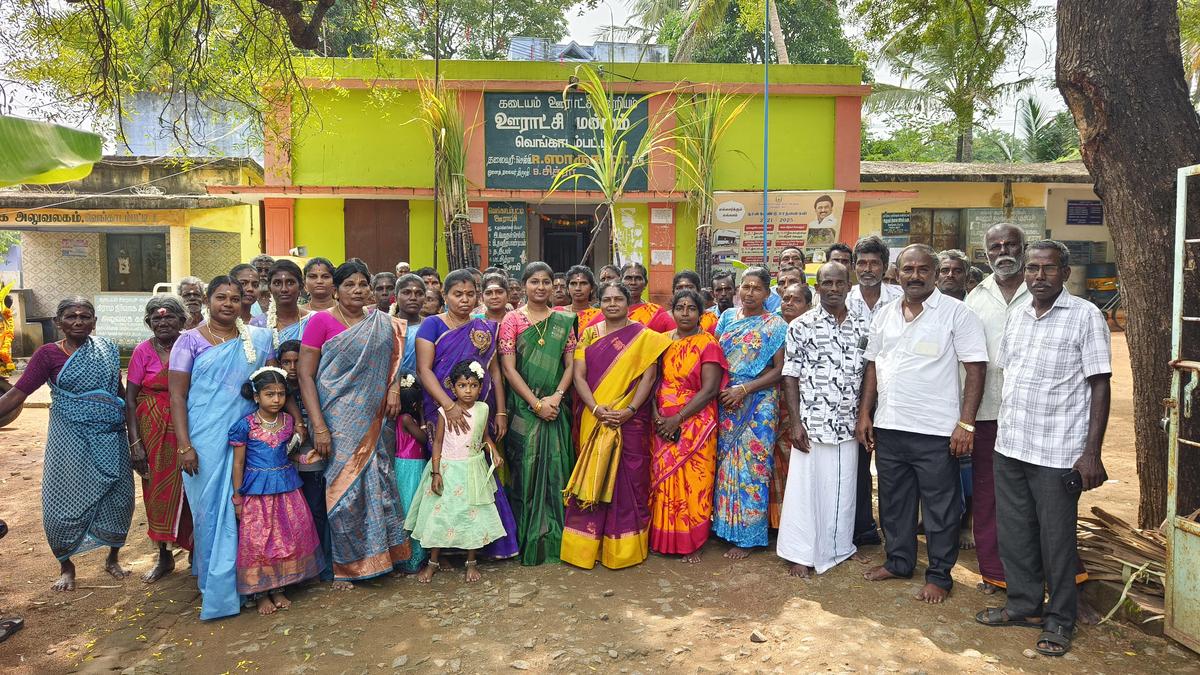
The State’s youngest panchayat president, R. Sharukala, is a living testament of this emerging, confident generation of powerful women in local governance. Elected to Venkatampatti Panchayat at just 22, the engineering graduate did not merely hold office; she embraced her role with a determination to succeed where many of her male predecessors had failed.
Ms. Sharukala and residents at the Pongal event | Photo Credit: Special Arrangement


Economist Arvind Subramanian advises CM Revanth Reddy on strengthening Telangana's finances during a meeting in Hyderabad.

Supreme Court emphasizes stakeholder consultation for legal education reforms, hesitant to change five-year law course duration.

Authorities in Andhra Pradesh are set to tranquillise a roaming tiger near Annavaram temple for safety and conservation.

MEA criticizes USCIRF for bias, urging focus on vandalism of Hindu temples in the U.S. over selective criticism of India.

Bengaluru's Urban Development aims to beautify underutilized flyover spaces, enhancing city aesthetics and improving green cover initiatives.

Indian Navy warships escort merchant vessels in the Gulf of Oman, ensuring safe passage amid regional tensions under Operation Sankalp.

A rare crab species exhibiting both male and female traits was discovered in Silent Valley, revealing unique biological characteristics.

Gujarat court convicts five in 2016 Una flogging case; punishment announcement scheduled for March 17, 2026.

The Greater Bengaluru Authority (GBA) has extended the deadline for citizens to submit claims and objections to the revised draft voters’ list for the upcoming elections to five city corporations under its jurisdiction until March 20.

SSC Public Examinations-2026 commenced peacefully, with a 98.90% attendance across 3,415 centres and rigorous monitoring in place.

Flying Squad Team seizes whistles, ‘manjappai’ bearing TVK name in Thoothukudi

Thousands gathered for a Ramzan prayer meet, promoting spiritual renewal and civic responsibility amidst calls for peace and justice.

Players get double bill horror as Resident Evil returns with Grace, a new series character, and other fan favourites in their latest edition