One of the oldest unsolved problems
The Hindu
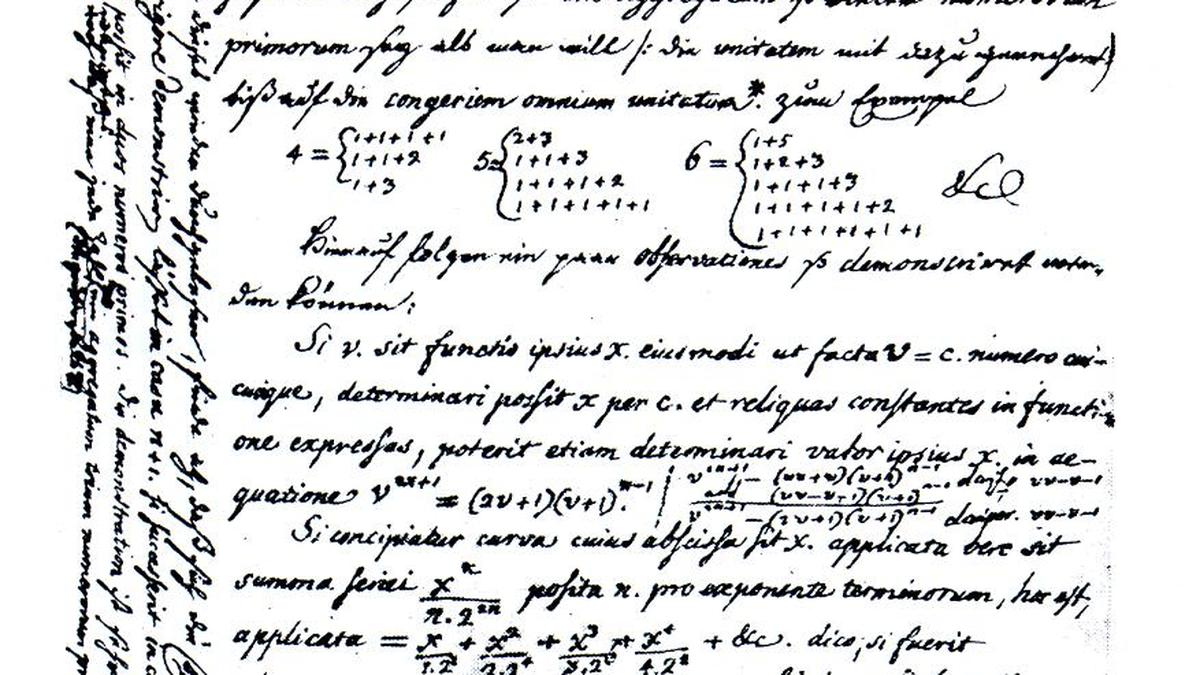
On June 7, 1742, Prussian mathematician Christian Goldbach wrote a letter to Swiss polymath Leonhard Euler. Why does it warrant attention, you seem to be asking. Goldbach outlined a conjecture that bears his name in this letter, a conjecture that is now one of the oldest and most famous unsolved problems in all of number theory. Intrigued? A.S.Ganesh hands you more details about Goldbach and Goldbach’s conjecture…
The son of a pastor, Christian Goldbach was born on March 18, 1690 in Konigsberg – the historic German and Prussian name of the city we now know as Kaliningrad, Russia. Growing up in that city and attending university there, Goldbach studied some mathematics (don’t raise your eyebrows), but mainly took to law and medicine.
When he was out of his teens, he set out travelling. His journey around much of Europe began in 1710 and his lengthy travels enabled him to meet many of the leading scientists of the day. We’ll get to that in a bit.
After spending nearly 15 years thus, travelling, Goldbach settled down, so as to say. He had become an established mathematician by this point. Despite initial rejections, Goldbach became a professor of mathematics and historian at the newly set up Saint Petersburg Academy of Sciences.
In 1728, when Peter II became the tsar of Russia, Goldbach was named as the new tutor of the young emperor. When Peter II moved the court from St. Petersburg to Moscow, Goldbach moved with him. From this time onwards, Goldbach grew in stature as an administrator too.
Even though there were plenty of changes in the political scene, Goldbach remained unaffected. While there was a purge of officials along with the various political moves that accompanied the replacement of one Russian ruler by another, Goldbach was never one of them.
He continued to rise in status, drew bigger salaries, and also received lands. He laid down the guidelines for the education of royal children, guidelines that remained in practice for nearly 100 years.
By 1740, the administrative work occupied so much of his time that Goldbach asked his duties at the Academy to be reduced. When he further rose to a senior position in the Ministry of Foreign Affairs, he stopped working for the Academy. Goldbach died in Moscow on November 20, 1764, aged 74.


76-year-old Kurian Jacob from Kerala triumphs with seven medals, including five golds, at the Open Masters Games in Abu Dhabi.

Explore the nature of the human mind as an emergent property of brain activity and complex neural interactions.

CERN's Large Hadron Collider discovers the Xi-cc-plus particle, enhancing understanding of quantum mechanics and baryon behavior.

Vibha Batra’s latest book, Spotless (Hachette India) is a novel in verse for young adults

In its first edition, the Madras Art Salon spotlights the works of journalist and artist Narayan Lakshman at The Botanical Club, a social space in the British Deputy High Commission, Chennai

Cholesterol enhances melanoma cell invasion by making nuclei squishier, revealing a potential treatment target in cancer progression.

The designers reinterpret the Swedish artist’s symbolic forms and colour energy through contemporary resortwear silhouettes

Discover the inspiring legacy of Bibha Chowdhuri, a pioneering woman in physics and a trailblazer in STEM history.

Discover the inspiring legacy of Bibha Chowdhuri, a pioneering woman in physics and a trailblazer in STEM history.

Ashdeen’s Spring 2026 collection features saris inspired by the designer’s Parsi gara archive

Red ochre burials, ritual markings and myths across cultures show that red repeatedly marks liminal thresholds such as puberty, sacrifice and death; anthropologists argue that the colour functions as a technology of collective ritual and value, binding communities through shared symbolic acts

India approves 23 institutions for quantum labs under the National Quantum Mission, aiming to advance quantum technology and research.

India approves 23 institutions for quantum labs under the National Quantum Mission, aiming to advance quantum technology and research.