NASA blows up another inflatable space station structure after exceeding the recommended safety levels
The Hindu
NASA and Sierra Space test inflatable space habitat LIFE, exceeding safety levels by 22%, for future space station projects.
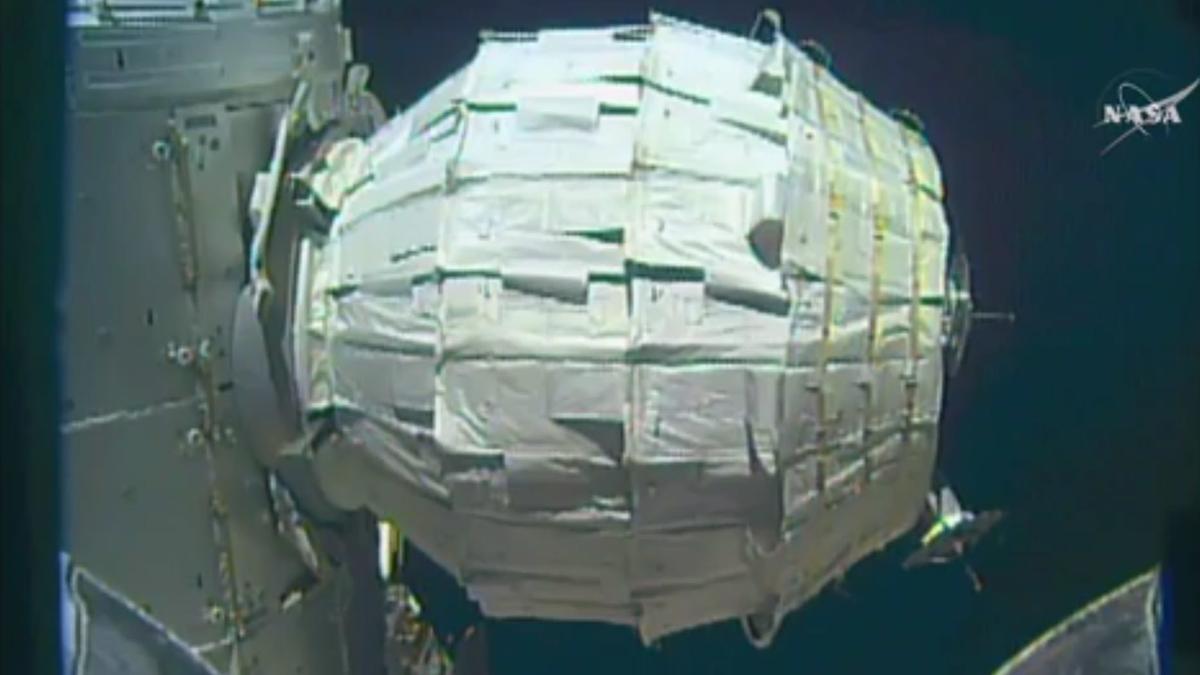
NASA and Sierra Space blew up another space habitat, after the full-size inflatable structure exceeded NASA’s recommended safety levels by 22%.
Known as the Large Integrated Flexible Environment, or LIFE, the inflatable structure last underwent stress earlier this year. It is intended to be used as a component in the Orbital Reed Space station project which involves NASA, Blue Origin, and Sierra Space.
The structure is built from “basket-weaved Vectran fabrics” that strengthen once inflated. The structure reportedly stood over 20 feet tall and is about the size of an average family home. This was the second such test structure, called LIFE 285, and is reported to be lighter and larger than the earlier structures, allowing the model to expand and have larger windows.
During the latest stress test, the structure reached 74 PSi before bursting, which was enough to verify its scalability for 10 cubic-meter and up to 1,400 cubic meter structures, a report from The Verge said.
(For top technology news of the day, subscribe to our tech newsletter Today’s Cache)
In the latest test, the structure failed only after exceeding NASA’s recommended X4 safety levels.
In the coming years, Sierra Space plans to test its first 500-cubic meter space station technology.


BTS’s comeback with ‘Arirang’ marks a major global music event. When does the album release, and where can you watch their concert live stream? We have all the details

The 2026 U.S. cholesterol guidelines urge starting screening and treatment at 30 to prevent cardiovascular disease effectively.

Olam Festival 2026 in Thiruvananthapuram returns March 27-29 with 120+ vendors, music, art, and cultural zones.

A few storytellers in Thiruvananthapuram share their journeys, challenges, and evolving methods on World Storytelling Day, inspiring young minds.

76-year-old Kurian Jacob from Kerala triumphs with seven medals, including five golds, at the Open Masters Games in Abu Dhabi.

Explore the nature of the human mind as an emergent property of brain activity and complex neural interactions.

CERN's Large Hadron Collider discovers the Xi-cc-plus particle, enhancing understanding of quantum mechanics and baryon behavior.

Vibha Batra’s latest book, Spotless (Hachette India) is a novel in verse for young adults

In its first edition, the Madras Art Salon spotlights the works of journalist and artist Narayan Lakshman at The Botanical Club, a social space in the British Deputy High Commission, Chennai

Cholesterol enhances melanoma cell invasion by making nuclei squishier, revealing a potential treatment target in cancer progression.

The designers reinterpret the Swedish artist’s symbolic forms and colour energy through contemporary resortwear silhouettes

Discover the inspiring legacy of Bibha Chowdhuri, a pioneering woman in physics and a trailblazer in STEM history.

Discover the inspiring legacy of Bibha Chowdhuri, a pioneering woman in physics and a trailblazer in STEM history.